
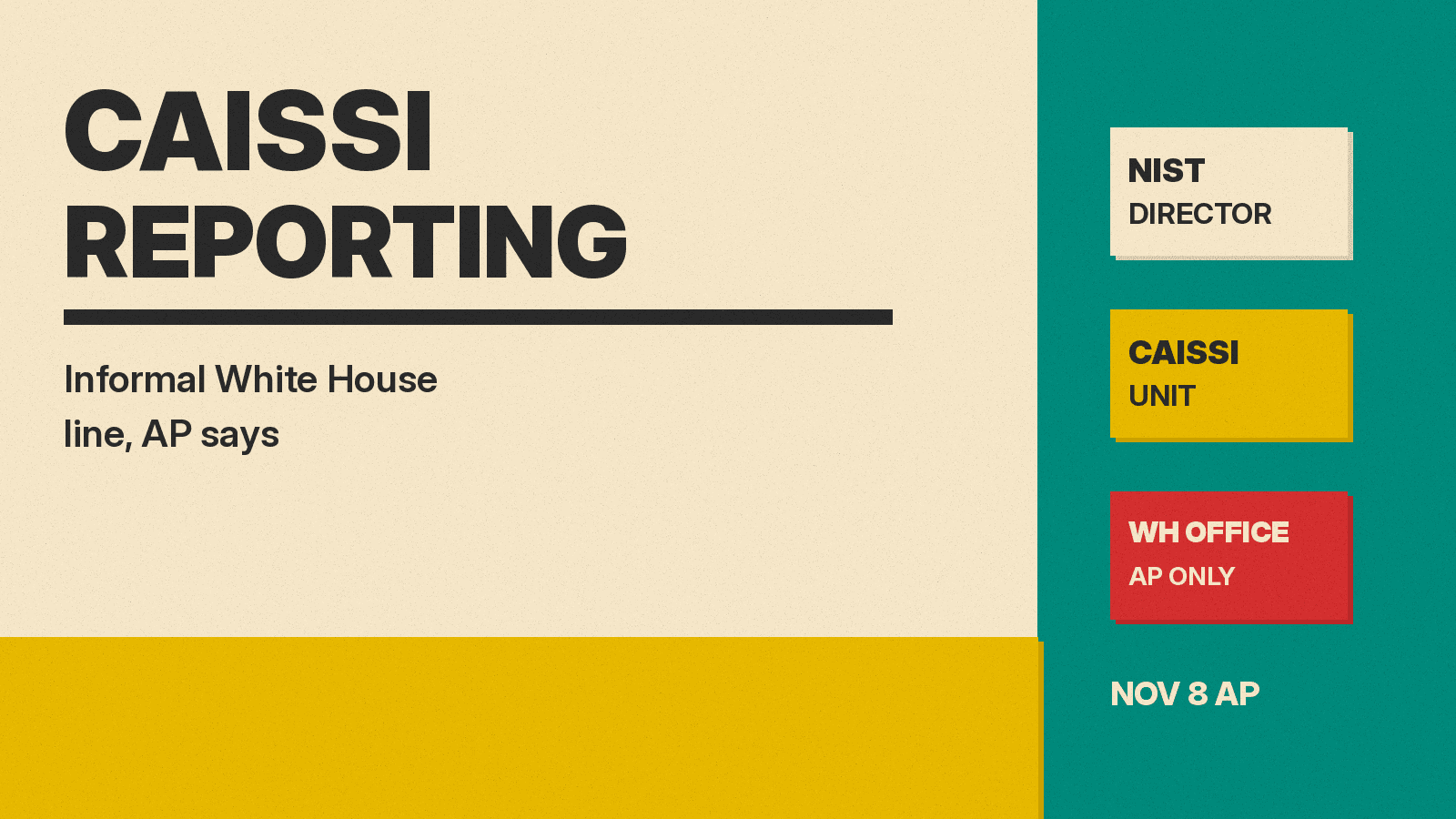
The Associated Press reported on Sunday, November 8, 2026, that officials at the Center for Advancing Innovation and Standards for Super Intelligence, or CAISSI, recently were asked to informally report to an office of the White House. AP attributed that account to two former government officials who spoke on condition of anonymity. The White House did not answer AP's specific questions about CAISSI.
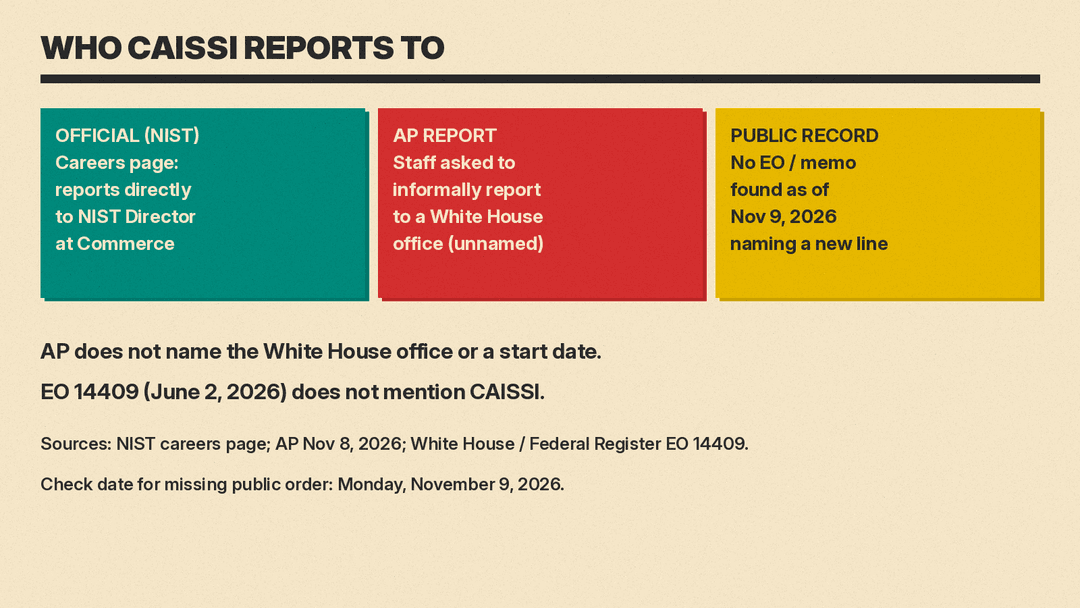
That is attributed reporting, not a published reorganization. As of Monday, November 9, 2026, we found no White House memorandum, Commerce directive or Federal Register document that assigns CAISSI a new formal reporting line. NIST's own careers page still describes the center as reporting to the NIST director.
What CAISSI is, in official words
NIST's CAISSI overview uses the full name Center for Advancing Innovation and Standards for Super Intelligence. The page says CAISSI "will serve as industry's primary point of contact within the U.S. government to facilitate testing and collaborative research related to harnessing and securing the potential of commercial SI systems."
NIST lists work that includes voluntary agreements with SI developers, "unclassified evaluations of SI capabilities that may pose risks to national security," a focus on "demonstrable risks, such as cybersecurity, biosecurity, and chemical weapons," and coordination with Defense, Energy, Homeland Security, the Office of Science and Technology Policy, and the Intelligence Community.
NIST's Careers at CAISSI page states: "CAISSI is a research unit reporting directly to the NIST Director at the Department of Commerce."
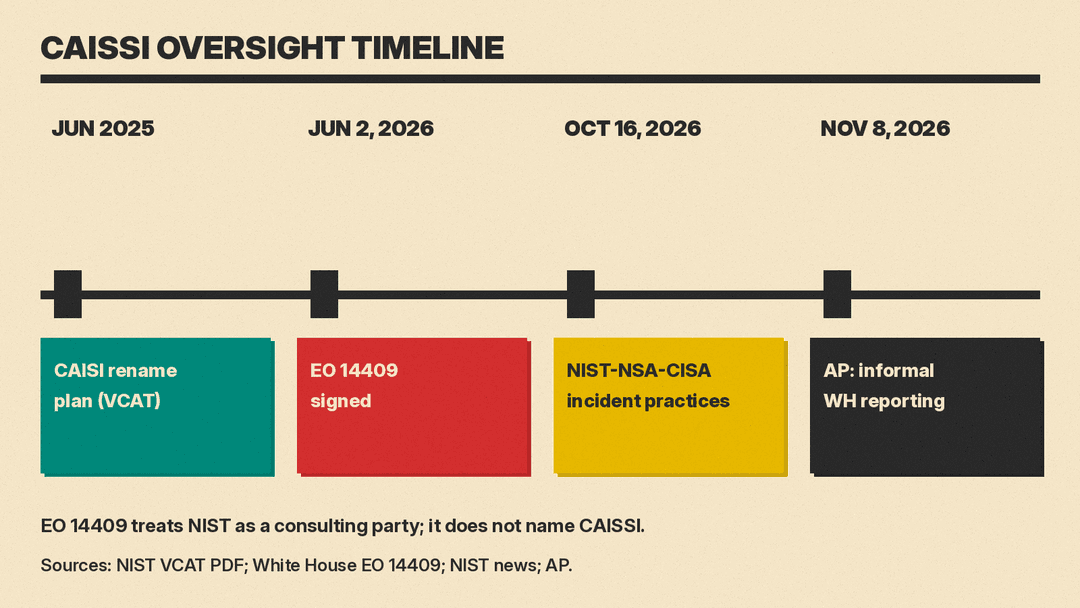
The center sits inside NIST under Commerce. A June 2025 NIST Visiting Committee announcement said Commerce Secretary Howard Lutnick planned to reform the U.S. AI Safety Institute into the Center for AI Standards and Innovation (CAISI), and that CAISI would "continue to operate within NIST." NIST's current page title uses the longer CAISSI name.
What AP says changed
AP, carried in full by PBS News, wrote that CAISSI officials "recently were asked to informally report to an office of the White House." AP does not name the White House office, does not give a start date, and does not describe a formal transfer out of Commerce.
AP also reported that the center lacks a permanent leader, is allocated "$10 million per year," and "has stopped publishing its research." Congress, AP said, began asking in August why the center stopped making public its reports on how safely certain AI systems were performing.
NIST's public record is not blank. The CAISSI page still lists a September 17, 2026 assessment of Z.ai's GLM-5.3 and an October 16, 2026 joint document on incident readiness with NSA and CISA. Congress's August inquiry is reported in AP's own voice, separate from the anonymous officials. Which reports were at issue, and what AP means by stopped research publication, are not explained in a NIST statement.
What Executive Order 14409 requires
The main published order on federal pre-release frontier-model testing is Executive Order 14409, "Promoting Advanced Artificial Intelligence Innovation and Security," signed June 2, 2026, and published in the Federal Register on Friday, June 5, 2026 (91 FR 34565; FR Doc. 2026-11415).
Section 3 says that within 60 days, the Treasury Secretary, the Secretary of War through the NSA director, and the Homeland Security Secretary through CISA, in consultation with the White House Chief of Staff through the National Cyber Director, the Assistant to the President for Science and Technology, and "the Secretary of Commerce, through the Director of the National Institute of Standards and Technology," shall develop a "classified benchmarking process" for "covered frontier model" designations (made by the NSA director) and design a "voluntary framework" under which developers may give the government access for "up to 30 days" before releasing a covered model to other trusted partners.
Section 3(a) says assessments may be shared with AI developers and researchers "as appropriate." Section 3(c) says nothing in the section authorizes "a mandatory governmental licensing, preclearance, or permitting requirement."
The order text does not mention CAISSI or CAISI by name. It does not create a White House reporting line for the center, and it does not require public publication of model assessments.
What the White House said, and what it did not
AP reported that the White House, in a statement, said Trump had formally established his Super Intelligence Force, had commissioned a risk report from his Council of Advisors on Science and Technology, and would ensure "continued U.S. leadership on SI for the benefit of the American people." AP said the White House did not answer its specific questions about CAISSI.
We searched whitehouse.gov presidential actions and the Federal Register for a public order that places CAISSI under a White House office. As of November 9, 2026, we did not find one. The published organizational description on NIST's careers page still points to the NIST director.
Separately, on October 12, Reuters reported, citing The Information and a White House official, that the administration planned to move three unnamed senior CAISSI officials to the White House, where they would report to OSTP Director Michael Kratsios and National Cyber Director Sean Cairncross. That was described as a plan, not a completed transfer, and Reuters said the White House and Commerce could not immediately be reached for comment.
Why the reporting line matters for oversight
CAISSI's listed work sits at the center of voluntary federal AI testing. If the arrangement AP describes holds, and staff answer informally to a White House office while the public chart still names the NIST director, outside readers cannot tell from official documents who sets priorities, who clears publications, or how national-security discretion interacts with technical review.
AP quoted critics who worry about politicization and about an unclear role for government testing when labs also hire external evaluators. It also noted arguments that closer White House ties could give the division more prominence and perhaps more funding. Those are opinions reported by AP, not findings in a government directive.
Sayash Kapoor, an incoming assistant professor at UC Berkeley's School of Information, told AP that previous methods "would just look at the final answer," so a major agent mistake can go unseen "unless you're looking at the entire set of steps that an agent took." Kapoor also told AP there is still no standard process for testing how safely AI agents act in the real world, even on a task such as booking a flight.
Related coverage: NIST, NSA and CISA practices for SI training incidents, Trump on banning the term AI for Super Intelligence, and White House plans to expand AI safety testing to open models.
What is not yet stated
As of the November 9, 2026 check:
- No public text names the White House office in the informal reporting arrangement AP described.
- No public text sets an effective date for that arrangement.
- Executive Order 14409 does not mention CAISSI and does not require publication of assessments.
- NIST has not replaced its careers-page line that CAISSI reports to the NIST director.
Until Commerce, NIST or the White House publishes a directive, the confirmed public facts are NIST's current organizational text, EO 14409's voluntary testing framework, and AP's anonymous-sourced account of an informal White House reporting request.
Sources
- Associated Press: Staff at the US center for AI safety are reporting to the White House, raising independence concerns
- PBS News: AP sources reprint of the same report
- NIST: Center for Advancing Innovation and Standards for Super Intelligence (CAISSI)
- NIST: Careers at CAISSI
- The White House: Executive Order 14409, June 2, 2026
- Federal Register: EO 14409, 91 FR 34565 (June 5, 2026)
- NIST: Key Practices for Incident Readiness and Response in Super Intelligence Training and Evaluation (October 16, 2026)
- NIST VCAT announcements PDF, June 2025: CAISI rename plan
- Associated Press: Staff at the US center for AI safety are reporting to the White House, raising independence concerns
