Before 2021, computer vision models were largely constrained by closed-set supervised classification. Deep convolutional networks like ResNet were trained to predict one of exactly 1,000 discrete categories on ImageNet via a final linear layer and a softmax cross-entropy objective. This setup created rigid models: classifying an unencountered category or adapting to downstream domain shifts required throwing away the classification head, collecting thousands of labeled samples, and retraining or fine-tuning the weights.
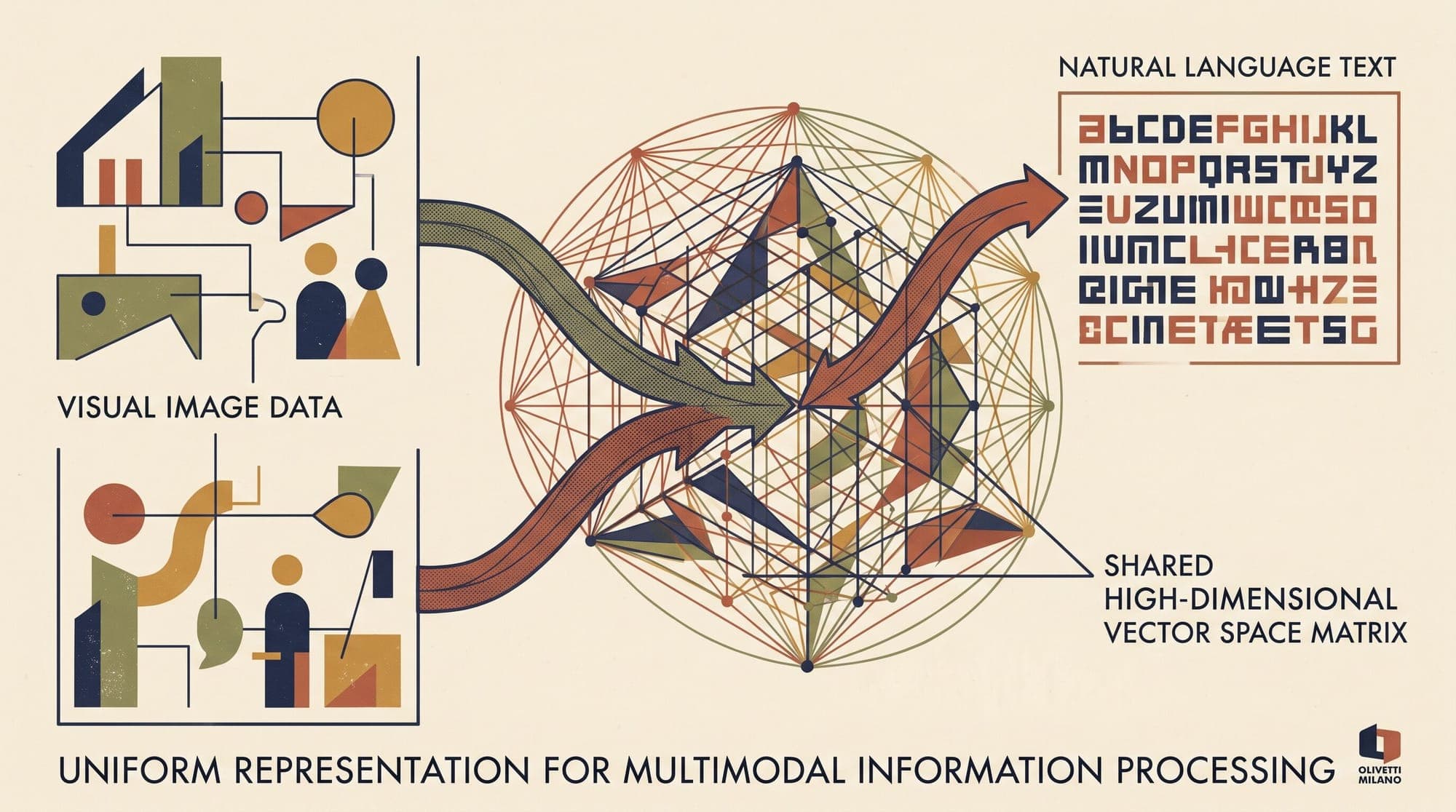
In March 2021, OpenAI introduced Contrastive Language-Image Pre-Training (CLIP) by Alec Radford and colleagues. Instead of predicting predefined class IDs from curated datasets, CLIP trained dual encoders on 400 million noisy (image, text) pairs collected from the public web using an open-vocabulary contrastive objective. By projecting visual features and natural language text into a shared latent metric space, CLIP demonstrated that models could perform zero-shot classification across dozens of computer vision benchmarks without updating a single weight, matching the performance of a fully supervised ResNet-50 baseline on ImageNet.
Understanding CLIP's dual-encoder mechanics, its symmetric loss formulation, and its evolutionary successor SigLIP provides foundational context for modern vision-language models, text-to-image diffusion pipelines, and dense multimodal retrieval systems.

The Dual-Encoder Architecture
CLIP decouples visual perception and linguistic interpretation into two separate neural network backbones that communicate solely through a final projection into a joint embedding space.
1. The Image Encoder
CLIP evaluated two architectural families for visual extraction:
- Modified ResNet: Deep residual networks spanning ResNet-50, ResNet-101, and scaled variants up to RN50x64 (scaled via the EfficientNet heuristic). Rather than standard global average pooling, CLIP replaced the final stage with a multi-head attention pooling mechanism, where a single query token attends across the spatial grid of convolutional feature maps.
- Vision Transformer (ViT): Architectures spanning ViT-B/32, ViT-B/16, ViT-L/14, and ViT-L/14 at 336-pixel input resolution (ViT-L/14@336px). The ViT splits an image into non-overlapping spatial patches (for example, 14x14 pixels), flattens them into 1D linear projections, adds learnable 1D position embeddings, prepends a class token
[CLS], and processes them through standard Transformer encoder layers with pre-layer normalization.
Given an input image x_i, the image encoder outputs a base visual representation f_I(x_i).
2. The Text Encoder
The text encoder is a standard autoregressive Transformer decoder with causal masking, matching the architectural design of GPT-2. The model operates on a lowercased byte-pair encoding (BPE) vocabulary of 49,152 tokens with sequence lengths capped at 76 tokens. The text sequence is bracketed with [SOS] (start of sequence) and [EOS] (end of sequence) control tokens.
Unlike masked language models (such as BERT) that pool across the sequence or average token states, CLIP extracts the hidden state activations from the highest Transformer layer at the exact position of the [EOS] token as the feature representation f_T(y_j).
3. Joint Multi-Modal Projection and L2 Normalization
The raw visual representation f_I(x_i) \in \mathbb{R}^{d_I} and raw textual representation f_T(y_j) \in \mathbb{R}^{d_T} typically reside in differing vector dimensionalities. CLIP maps both representations into a shared latent metric space of dimension d_e (such as 512, 768, or 1024) via learned linear projection matrices W_I \in \mathbb{R}^{d_I \times d_e} and W_T \in \mathbb{R}^{d_T \times d_e}:
I_e^{(i)} = f_I(x_i) W_I / || f_I(x_i) W_I ||_2
T_e^{(j)} = f_T(y_j) W_T / || f_T(y_j) W_T ||_2
Crucially, both projected vectors are strictly L2-normalized onto the unit hypersphere \mathbb{S}^{d_e - 1}. Normalization ensures that vector dot products correspond directly to cosine similarities, preventing high-magnitude vector norms from dominating the objective function.
Mathematical Formulation: Symmetric InfoNCE Loss
Given a training batch of N paired examples {(x_1, y_1), (x_2, y_2), ..., (x_N, y_N)}, the model constructs an N \times N pairwise cosine similarity matrix.
The scalar similarity between image embedding i and text embedding j is defined as:
S_{i, j} = \exp(t) \cdot (I_e^{(i)} \cdot T_e^{(j)})Where t is a learned temperature parameter initialized to t = \ln(1 / 0.07) \approx 2.659 (corresponding to initial temperature \tau = 0.07). During training, t is optimized alongside model weights and clamped to t \le \ln(100) \approx 4.605 (\tau \ge 0.01) to prevent logit explosion and numerical instability in FP16 precision.
The training objective is a symmetric multi-class cross-entropy loss that simultaneously optimizes two retrieval directions:
1. Image-to-Text Loss (Row-wise Softmax)
For each image i, the model treats paired caption i as the positive target and all other N - 1 text captions in the batch as negative distractors:
L_I^{(i)} = - \log \frac{\exp(S_{i, i})}{\sum_{j=1}^N \exp(S_{i, j})}Averaged across the batch:
\mathcal{L}_I = \frac{1}{N} \sum_{i=1}^N L_I^{(i)}2. Text-to-Image Loss (Column-wise Softmax)
For each text prompt j, the model treats paired image j as the positive target and all other N - 1 images in the batch as negative distractors:
L_T^{(j)} = - \log \frac{\exp(S_{j, j})}{\sum_{i=1}^N \exp(S_{i, j})}Averaged across the batch:
\mathcal{L}_T = \frac{1}{N} \sum_{j=1}^N L_T^{(j)}3. Total Loss
The final optimization objective is the arithmetic mean of both cross-entropy terms:
\mathcal{L} = \frac{1}{2} (\mathcal{L}_I + \mathcal{L}_T)By maximizing cosine similarity along the diagonal (i, i) while minimizing off-diagonal pairings (i, j) where i \ne j, CLIP pulls semantically aligned visual and textual representations together while pushing non-matching pairs apart in the shared latent space.
Training Dynamics and Scaling Economics
To make contrastive pre-training effective without explicit human labels, OpenAI curated the WebImageText (WIT) dataset: 400 million (image, text) pairs retrieved by searching for 500,000 queries with up to 20,000 pairs per query to maintain topic diversity.
Key training dynamics detailed in the research include:
- Massive Batch Sizing: Contrastive learning relies on a high number of negative samples per batch to learn rich representations. CLIP was trained with a global batch size of
N = 32,768distributed across 592 Nvidia V100 GPUs using mixed-precision training. - Sample Efficiency vs Generative Baselines: In comparative ablation studies, predicting exact target words via an autoregressive captioning language model required more than 3x the compute of a contrastive objective to reach comparable zero-shot ImageNet accuracy. Contrastive matching avoids modeling fine-grained textual grammar and syntax, focusing exclusively on global semantic alignment.
- Compute Scaling: The largest original model, ViT-L/14@336px, achieved 76.2% zero-shot top-1 accuracy on ImageNet, matching the accuracy of a supervised ResNet-50 trained directly on ImageNet labels.
Zero-Shot Transfer and Prompt Engineering
CLIP performs zero-shot image classification by framing the classification task as a text-retrieval ranking problem over natural language descriptions.
Input Image x ──► [Image Encoder] ──► I_e (L2-normed vector)
                                             │
Candidate Labels:                            ▼
"a photo of a plane"   ──► [Text Encoder] ──► T_e^(1) ──► Cosine Sim S_1 ──► Softmax Probability
"a photo of a car"     ──► [Text Encoder] ──► T_e^(2) ──► Cosine Sim S_2 ──► Softmax Probability
"a photo of a dog"     ──► [Text Encoder] ──► T_e^(3) ──► Cosine Sim S_3 ──► Softmax Probability
The Inference Pipeline
- Prompt Template Construction: Rather than evaluating raw single-word class labels (such as
"dog"or"crane"), labels are formatted into full sentences using prompt templates:"a photo of a {label}."Full sentences disambiguate polysemous words (such as"crane"the bird versus"crane"the construction machine) by providing structural linguistic context. - Text Embedding Cache: For a target dataset with
Kcandidate classes, allKtext prompts are passed through the text encoder once to compute normalized text embeddings{T_e^{(1)}, T_e^{(2)}, ..., T_e^{(K)}}. These embeddings are cached in memory as a static weight matrix. - Similarity and Probability Computation: For each incoming query image
x, its normalized image vectorI_eis multiplied against the cached text embedding matrix:
p(y = k \mid x) = \frac{\exp(\tau^{-1} \langle I_e, T_e^{(k)} \rangle)}{\sum_{m=1}^K \exp(\tau^{-1} \langle I_e, T_e^{(m)} \rangle)}Prompt Ensembling
The authors found that zero-shot classification performance improved substantially by ensembling embeddings across multiple prompt templates. By generating 80 distinct templates (e.g., "a photo of a small {label}.", "a centered photo of the {label}.", "a rendition of a {label}."), encoding each template, and computing their average normalized vector representation:
\bar{T}_e^{(k)} = \frac{\sum_{t=1}^M T_{e, t}^{(k)}}{\| \sum_{t=1}^M T_{e, t}^{(k)} \|_2}Prompt ensembling yielded a consistent +3.5% top-1 accuracy gain on ImageNet without increasing per-image inference compute, as text embeddings are pre-computed offline.
Evolution: OpenCLIP and SigLIP
Following OpenAI's closed dataset release, open-source research introduced structural refinements to the contrastive pre-training paradigm.
1. OpenCLIP Scaling Laws
The OpenCLIP project (Cherti et al., 2023) replicated and scaled CLIP on publicly transparent datasets including LAION-400M, LAION-2B, and DataComp-1B. By scaling compute up to ViT-G/14 (2.5 billion parameters) and ConvNeXt-XXLarge, OpenCLIP models pushed zero-shot ImageNet accuracy to 80.1%, establishing empirical scaling laws across data quality and compute budgets.
2. SigLIP: Pairwise Sigmoid Loss
In 2023, Google researchers introduced SigLIP (Sigmoid Loss for Language Image Pre-Training) by Xiaohua Zhai and team. Standard CLIP uses a global softmax denominator \sum_{j=1}^N \exp(S_{i, j}) that normalizes across all samples in a batch. In distributed multi-GPU training, this requires an expensive all-gather collective communication operation to assemble negative embeddings across all worker nodes.
SigLIP replaced the global softmax normalization with independent binary logistic regressions evaluated on every (image, text) pair in the matrix:
\mathcal{L}_{\text{SigLIP}} = - \frac{1}{N} \sum_{i=1}^N \sum_{j=1}^N \log \sigma \left( z_{ij} \cdot (\exp(t) \langle I_e^{(i)}, T_e^{(j)} \rangle + b) \right)Where:
z_{ij} = +1ifi = j(positive pair) andz_{ij} = -1ifi \ne j(negative pair).\sigma(u) = 1 / (1 + \exp(-u))is the sigmoid function.bis a learnable bias term initialized to negative values to account for class imbalance (since negative pairs outnumber positive pairs byN - 1).
SigLIP decoupled per-pair loss computations from the global batch denominator. This eliminated cross-node synchronization bottlenecks, stabilized training across small and massive batch sizes, and yielded higher zero-shot classification accuracy with lower compute overhead.
Downstream Ecosystem Impact
CLIP's dual-encoder representations have become standard infrastructure across multiple domains of machine learning:
- Vision-Language Models (VLMs): Systems like LLaVA and early Gemini variants use pre-trained CLIP or SigLIP ViT encoders as frozen or fine-tuned vision backbones. Visual patch tokens are projected directly into LLM token embedding spaces.
- Text-to-Image Diffusion Models: Early latent diffusion architectures, including Stable Diffusion 1.5, Stable Diffusion 2.1, and SDXL, rely on CLIP text encoders (such as OpenAI CLIP ViT-L/14 and OpenCLIP ViT-bigG/14) to condition cross-attention layers on semantic text prompts.
- Dense Document and Visual Retrieval: Models such as ColPali build on modern vision-language backbones to project document page screenshots into multi-vector token embeddings, bypassing error-prone OCR and text-chunking pipelines.
Structural Limitations and Failure Modes
Despite its zero-shot versatility, CLIP exhibits distinct architectural failure modes:
- Bag-of-Words Behavior: Because contrastive objectives train models to match global semantic presence rather than syntactic structure, CLIP models frequently act as "bags of visual words." They struggle with fine-grained relational syntax (e.g., distinguishing "the dog bites the man" from "the man bites the dog").
- Compositional Binding Failures: On adversarial benchmarks such as Winoground (Thrush et al., 2022), where paired images and text swap subject-object roles or attribute bindings, CLIP models perform near random chance (often below 30% group score).
- Fine-Grained Counting and Localization: Global L2-normalized vector pooling discards spatial coordinate geometry, making CLIP unreliable for object counting, spatial bounding, or fine-grained visual reasoning tasks.
Key Takeaways
- Dual-Encoder Paradigm: CLIP decouples image and text encoding into independent Transformer or residual backbones that map into a shared L2-normalized metric space.
- Symmetric Cross-Entropy: InfoNCE loss simultaneously optimizes image-to-text and text-to-image similarity matrices across large batches, pulling true pairs together and pushing distractors apart.
- Zero-Shot as Retrieval: Zero-shot image classification is framed as cosine similarity matching against natural language prompt templates, with prompt ensembling boosting accuracy without runtime inference costs.
- SigLIP Optimization: Replacing softmax normalization with pairwise binary sigmoid loss eliminated multi-GPU synchronization bottlenecks and improved training stability.
- Trade-Offs: While highly transferable for general semantic recognition, standard contrastive models suffer from spatial blindness, weak attribute binding, and bag-of-words insensitivity.
Sources
- Radford et al. (2021): Learning Transferable Visual Models From Natural Language Supervision (OpenAI CLIP)
- Zhai et al. (2023): Sigmoid Loss for Language Image Pre-Training (SigLIP)
- Cherti et al. (2023): Reproducible scaling laws for contrastive language-image learning (OpenCLIP)
- Thrush et al. (2022): Winoground: Scrutinizing Language-Image Models for Compositional Reasoning
- Faysse et al. (2024): ColPali: Efficient Document Retrieval with Vision Language Models