
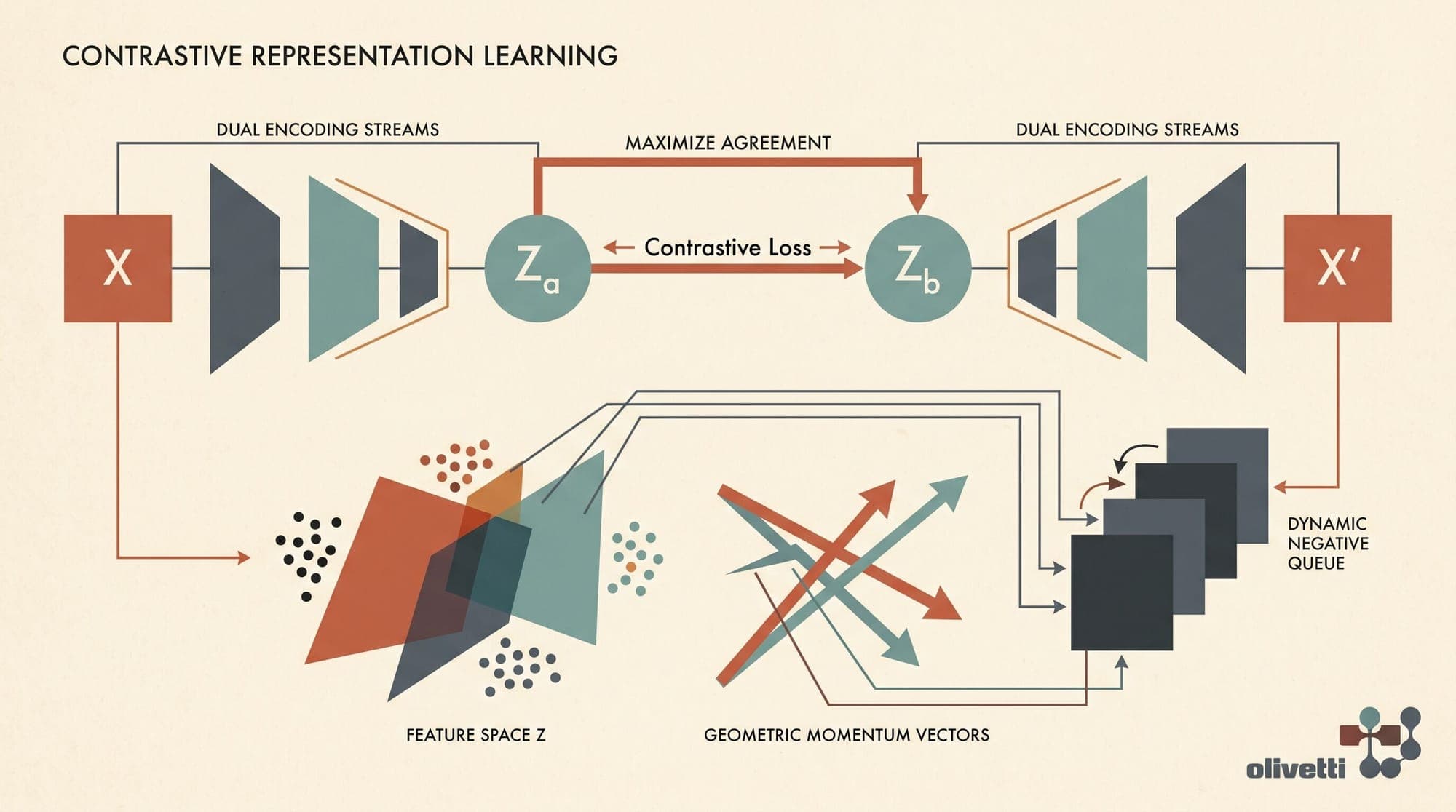
Self-supervised visual representation learning underwent a foundational transformation in 2020 with the introduction of contrastive learning frameworks. Prior to this period, pre-training computer vision models without human annotations relied on heuristic pretext tasks such as jigsaw puzzle solving, rotation prediction, or autoencoding color channels. These methods forced networks to learn low-level geometric or statistical artifacts rather than generalizable semantic abstractions.
Contrastive learning reframed visual representation learning as a dynamic dictionary lookup problem. Given an encoded query image patch, the learning objective pulls the representation of a matching positive key close in latent space while pushing a collection of negative keys away. Two distinct architectural paradigms emerged to solve the core scaling challenge of contrastive learning: Google Brain's SimCLR (Simple Framework for Contrastive Learning of Visual Representations) and Meta FAIR's MoCo (Momentum Contrast).
Understanding how SimCLR scaled end-to-end batch optimization and how MoCo decoupled dictionary size from batch compute using momentum encoders provides the theoretical foundation for modern contrastive vision architectures, multimodal models such as CLIP, and dense vector embeddings.
The Mathematical Foundation: Contrastive Dictionary Lookup and InfoNCE
The objective of self-supervised contrastive learning is to map high-dimensional visual inputs into normalized low-dimensional embedding vectors such that representations of semantically identical samples are clustered together while distinct samples are uniformly dispersed across the hypersphere.
Anchor View (x_i) -----> Encoder f_q(·) -----> Query vector (q)
                                                    │
                                                    ▼
Positive View (x_i') ---> Encoder f_k(·) -----> Positive key (k+)   [PULLED CLOSE]
                                                    ▲
                                                    │
Negative Views (x_j) ---> Encoder f_k(·) -----> Negative keys {k-}  [PUSHED APART]
This dynamic is formalized through the InfoNCE loss function, derived from Noise-Contrastive Estimation by van den Oord et al. (2018):
Where:
- is the normalized representation of an anchor query image ().
- is the normalized representation of a positive key generated from a different augmented view of the same source image ().
- is a set of normalized negative key representations derived from distinct images ().
- is a scalar temperature hyperparameter governing the concentration of the distribution.
The Role of Temperature Scaling
The temperature parameter dictates the penalty profile applied to hard negative samples during optimization. As demonstrated by Wang and Isola (2020), the gradient of the InfoNCE loss with respect to query vector decomposes into:
Where and represent the softmax probabilities assigned to the positive and negative keys.
When is set to a low value (such as or ), the softmax denominator exponentiates dot products sharply. Negative keys that exhibit high cosine similarity to query (hard negatives) dominate the summation, receiving exponentially larger repulsive gradient updates. If is set too high, all negative keys exert equal repulsive force regardless of their semantic proximity, degrading representation quality. Conversely, an excessively low temperature leads to optimization instability and gradient saturation.
The InfoNCE loss acts as a variational lower bound on the mutual information between different views of the same instance:
Maximizing the mutual information bound requires maximizing the number of negative keys . The engineering challenge that separated SimCLR and MoCo was how to scale efficiently.
SimCLR: End-to-End Minibatch Contrastive Learning
Introduced by Ting Chen et al. (ICML 2020), SimCLR established a simple end-to-end framework that abandoned memory banks and specialized pretext architectures in favor of large minibatches, aggressive data augmentations, and non-linear projection heads.

The SimCLR Pipeline
- Stochastic Data Augmentation: For each source image in a minibatch of size , two random augmentation operators and are applied, producing a correlated pair of views . The optimal augmentation policy combines:
- Random resized cropping with horizontal flips.
- Color jittering (random adjustments to brightness, contrast, saturation, and hue).
- Gaussian blurring.
The paper demonstrated that combining random cropping with color jittering is essential: without color distortion, models exploit color histograms across crops of the same image as a trivial shortcut, causing contrastive representations to collapse.
- Base Encoder : A standard convolutional network (such as ResNet-50) extracts feature representations from augmented images:
- Non-Linear Projection Head : A multi-layer perceptron (MLP) with one hidden layer and a ReLU activation projects representations into the contrastive embedding space:
- Normalized Temperature-Scaled Cross-Entropy Loss (NT-Xent): For a minibatch of images, augmented views are processed. For each positive pair , the remaining augmented views in the batch serve as negative samples:
The Critical Role of the Non-Linear Projection Head
A key discovery in SimCLR was that computing the contrastive loss on the projection output rather than the representation significantly improved downstream linear probe performance.
Because the contrastive loss enforces invariance to the applied transformations (such as color jitter and spatial cropping), the representation space discards transformation-dependent information. By inserting the non-linear projection head , the intermediate representation preserves rich spatial and semantic features (such as object color, scale, and orientation) that downstream classifiers require, while absorbs the transformation invariance.
The Compute Bottleneck in SimCLR
SimCLR relies entirely on current minibatch samples to supply negative keys. To achieve high representation quality, the dictionary size must be large:
- At (), linear probe accuracy on ImageNet reached 64.6%.
- At (), linear probe accuracy reached 69.3%.
Training with a batch size of 4,096 images requires simultaneous forward and backward passes across 128 TPU cores. Furthermore, standard Batch Normalization introduces an information leakage vulnerability: intra-batch communication via batch statistics allows the model to identify positive pairs through shared normalization metrics rather than visual semantics. SimCLR resolved this by implementing Synchronized Batch Normalization (SyncBN) across all compute devices.
MoCo: Momentum Contrast and Dynamic Memory Queues
To eliminate the requirement for massive compute clusters and extreme batch sizes, Kaiming He et al. (CVPR 2020) introduced Momentum Contrast (MoCo). MoCo frames contrastive learning as building a dynamic dictionary with two core structural requirements:
- The dictionary must be large to provide a sufficient number of negative samples.
- The dictionary must remain consistent during training as representations evolve.
Decoupling Dictionary Size via a FIFO Queue
Instead of restricting negative samples to the active minibatch, MoCo maintains a dynamic First-In, First-Out (FIFO) queue of negative keys.
At each training step:
- The current minibatch of keys is encoded and enqueued.
- The oldest minibatch of keys in the queue is dequeued and discarded.
This design decouples the dictionary size from the mini-batch size . MoCo can maintain a dictionary of negative keys while training with a standard mini-batch size of on an 8-GPU server.
The Representation Consistency Failure Mode
Using a queue introduces a fundamental theoretical problem: keys in the queue were generated by encoder parameters at different historical training iterations ().
If the key encoder is updated via standard backpropagation alongside the query encoder , the weights change rapidly. Consequently, representations in the queue drift, and dot products between the current query and older queue keys become noisy and invalid, causing representation learning to fail.
The Momentum Encoder Solution
MoCo solves the consistency challenge by prohibiting gradient backpropagation into the key encoder . Instead, the key encoder parameters are updated using an Exponential Moving Average (EMA) of the query encoder parameters :
Where is the momentum coefficient.
Query View (x_q) ───> Query Encoder f_q(θ_q) ───> Query (q) ───┐
                          ▲ (Backpropagation)                   │
                          │                                     ▼
                     EMA Update (m = 0.999)               InfoNCE Loss
                          │                                     ▲
                          ▼                                     │
Key View (x_k)   ───> Key Encoder f_k(θ_k)   ───> Key (k+) ─────┤
                          (No Gradients)                        │
                                                                ▼
                                                      FIFO Memory Queue
                                                     [ k-_1, k-_2, ..., k-_K ]
By setting close to 1 (typically ), evolves smoothly across iterations. The key representations stored in the queue remain mutually consistent and aligned with the current parameter space of .
Empirical ablations in the MoCo paper confirmed this dynamic:
- With (key encoder updated directly by ), the loss exploded and training failed completely.
- With , linear probe accuracy reached 59.9%.
- With , linear probe accuracy reached 60.6%.
Shuffling Batch Normalization
Like SimCLR, MoCo had to address intra-batch information leakage through Batch Normalization. Because and compute statistics on their respective inputs, sub-batch communication on a single GPU could allow the model to cheat the contrastive task.
MoCo addressed this by implementing Shuffling Batch Normalization: the sample order across the multi-GPU cluster is randomly permuted before encoding key views and un-shuffled after encoding. This ensures that the batch statistics for query and positive key are computed over entirely different sub-batches, removing statistical shortcuts.
MoCo v2: Incorporating Projection Heads
Following the publication of SimCLR, Chen et al. (2020) released MoCo v2. By integrating SimCLR's two most effective design elements—a 2-layer MLP non-linear projection head and Gaussian blur data augmentation—MoCo v2 achieved state-of-the-art results without large batch sizes:
- ResNet-50 ImageNet top-1 linear classification accuracy jumped from 60.6% (original MoCo) to 71.1% (MoCo v2) at 200 epochs.
- MoCo v2 outperformed SimCLR's 69.3% accuracy while using an 8-GPU cluster instead of a 128-core TPU pod.
Architectural Comparison: SimCLR vs. MoCo
| Architectural Feature | SimCLR (Chen et al., 2020) | MoCo / MoCo v2 (He et al., 2020) | | :--- | :--- | :--- | | Dictionary Mechanism | In-batch negative sampling | FIFO Dynamic Memory Queue | | Key Encoder Update | End-to-end backpropagation | Momentum EMA () | | Negative Dictionary Size () | Tied to batch size (, e.g., 8,190) | Decoupled from batch size () | | Mini-Batch Size () | 4,096 to 8,192 samples | 256 to 512 samples | | Compute Requirements | 128 TPU cores or massive GPU clusters | 8 standard GPUs | | Batch Normalization Defense | Synchronized Batch Normalization (SyncBN) | Shuffling Batch Normalization | | Projection Head | 2-layer non-linear MLP () | Linear (v1) / 2-layer MLP (v2) | | Key Advantage | Conceptually simple, symmetrical gradients | Hardware-efficient, massive negative pool | | Key Limitation | Prohibitive GPU memory requirements | Asymmetric encoder architecture |
Impact on Multimodal AI and Modern Foundation Models
The technical principles pioneered by SimCLR and MoCo form the architectural substrate of modern multimodal foundation models, vision encoders, and dense retrieval systems.
1. Vision-Language Contrastive Models (CLIP and SigLIP)
OpenAI's CLIP (Radford et al., 2021) adapted SimCLR's end-to-end contrastive framework to multimodal pairs (image-text) across large mini-batches (32,768 pairs), utilizing normalized embeddings, temperature-scaled symmetric cross-entropy loss, and linear projection heads. Google's SigLIP (Zhai et al., 2023) replaced the global softmax normalization of InfoNCE with pairwise sigmoid loss, further stabilizing contrastive scaling.
2. Vision Encoders for Multimodal Large Language Models
Vision backbones used in modern MLLMs (such as CLIP ViT, SigLIP, and DINOv2) rely directly on self-supervised and contrastive pre-training objectives. The separation between feature representation and projection space established in SimCLR explains why modern multimodal projectors (such as those in LLaVA and Qwen-VL) extract features from the layer immediately preceding the projection head.
3. Dense Retrieval and Text Embeddings
Modern dense retrieval models (including Contriever, BGE, and E5) use InfoNCE loss with in-batch negatives or momentum queues to align semantic query and document representations.
4. Non-Contrastive and Self-Distillation Successors
The momentum encoder mechanism introduced in MoCo directly inspired subsequent self-supervised frameworks, including BYOL (Grill et al., 2020) and DINO (Caron et al., 2021), which eliminated negative pairs entirely by predicting representations across asymmetric online and target networks.
Sources
- A Simple Framework for Contrastive Learning of Visual Representations (Ting Chen, Simon Kornblith, Mohammad Norouzi, Geoffrey Hinton, ICML 2020)
- Momentum Contrast for Unsupervised Visual Representation Learning (Kaiming He, Haoqi Fan, Yuxin Wu, Saining Xie, Ross Girshick, CVPR 2020)
- Improved Baselines with Momentum Contrastive Learning (Xinlei Chen, Haoqi Fan, Ross Girshick, Kaiming He, 2020)
- Representation Learning with Contrastive Predictive Coding (Aaron van den Oord, Yazhe Li, Oriol Vinyals, 2018)
- Understanding Contrastive Representation Learning through Alignment and Uniformity on the Hypersphere (Tongzhou Wang, Phillip Isola, ICML 2020)
- Learning Transferable Visual Models From Natural Language Supervision (Alec Radford et al., OpenAI, 2021)
- Bootstrap Your Own Latent: A New Approach to Self-Supervised Learning (Jean-Bastien Grill et al., NeurIPS 2020)
- Emerging Properties in Self-Supervised Vision Transformers (Mathilde Caron et al., ICCV 2021)



