
Cognition has released SWE-2 Flash, a coding model that it says runs at three times the speed of its larger SWE-2 model at one-fifth the price. Cognition announced it on November 4, 2026, and it is available in Devin Desktop and the Devin CLI. Cognition is not sharing the weights publicly yet.
What Cognition released
Cognition describes SWE-2 Flash as a fully American coding model built for low cost and high speed. It is a post-trained version of Inkling-Small, a model from Thinking Machines Lab with 276B total and 12B active parameters. Thinking Machines released Inkling-Small with open weights under an Apache 2.0 license, according to its model card.
Cognition says this is the first time its recipe includes a mid-training stage before reinforcement learning. It describes that stage as a few trillion tokens of scientific articles, blogs, code and other sources, trained in three stages so the model sees the scarcest, highest-quality data later in training. Large-scale reinforcement learning followed. Cognition says most of the improvement over the SWE-2 recipe came from higher quality and more diverse reinforcement learning tasks, which it audited for instructions, environment setup and verifiers.
Cognition frames the target use as everyday engineering work. In its words, smaller models are increasingly able to handle a significant portion of the work that software agents do, such as automations, code review, feature development and updating documentation. Code review is a related area: OpenAI said the same day it will acquire Pierre, whose Diffs library is already used to review changes in the Codex app.
The benchmark numbers
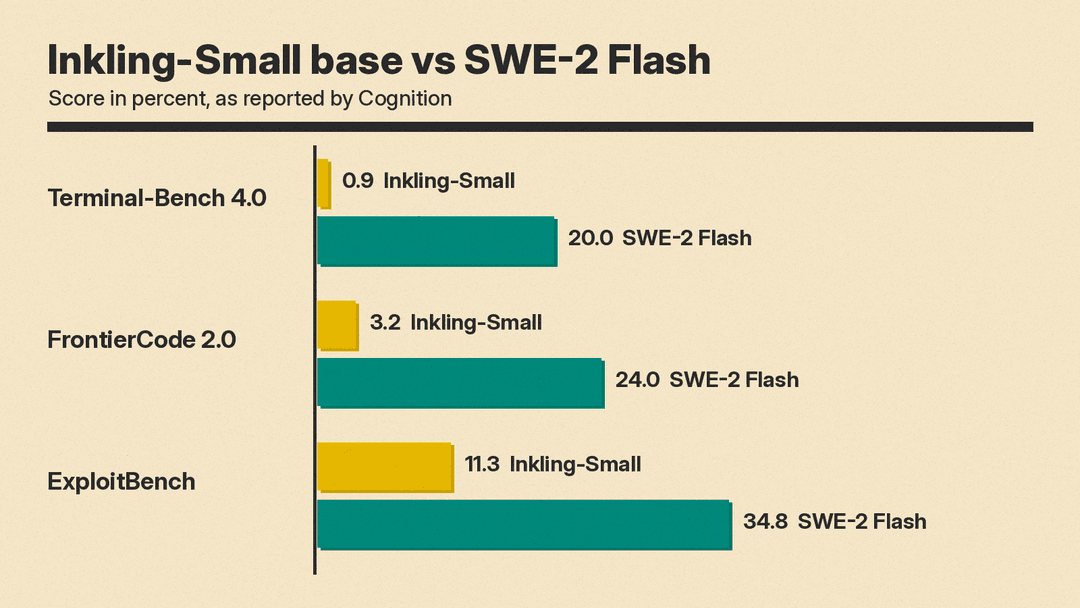
All figures below come from tables in Cognition's post, so they are Cognition's own reported results. Cognition says SWE-2 Flash moved from the Inkling-Small base as follows:
- Terminal-Bench 4.0: 0.9% to 20.0%
- FrontierCode 2.0: 3.2% to 24.0%
- ExploitBench: 11.3% to 34.8%
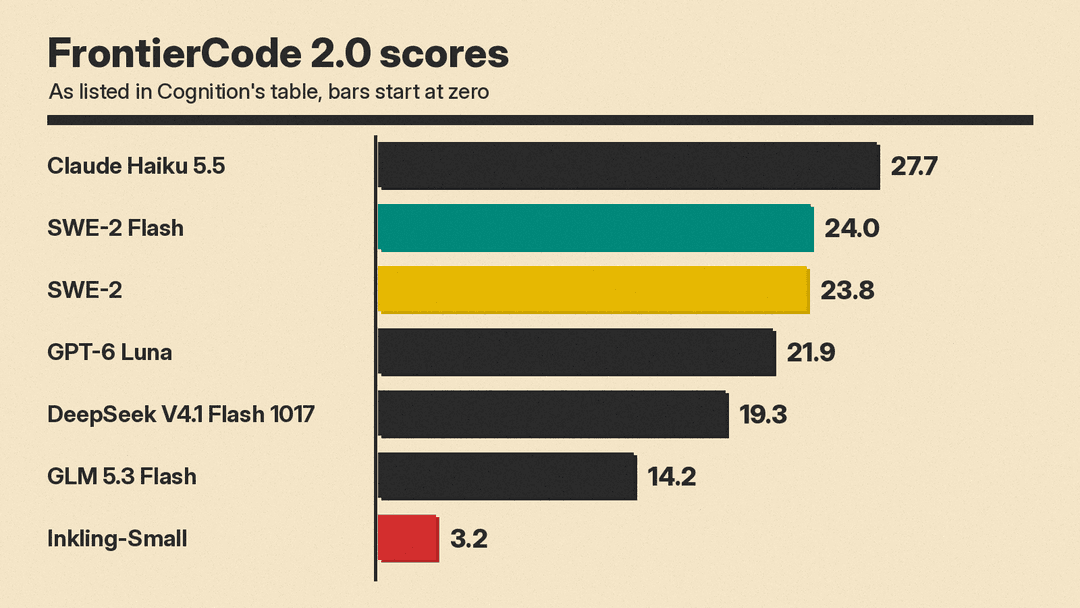
Cognition also says SWE-2 Flash outperforms all American open-weight models on leading evals, including models that are 3x larger. The table in the post lists other models too. On FrontierCode 2.0, it shows SWE-2 Flash at 24.0, SWE-2 at 23.8, GPT-6 Luna at 21.9, DeepSeek V4.1 Flash 1017 at 19.3, GLM 5.3 Flash at 14.2 and Claude Haiku 5.5 at 27.7.
The results are mixed across the table. On Terminal-Bench 4.0, the post lists GLM 5.3 Flash at 41.8, DeepSeek V4.1 Flash 1017 at 42.3 and Claude Haiku 5.5 at 39.2, against 20.0 for SWE-2 Flash. On DeepSWE 1.1, it lists SWE-2 Flash at 60.1 and DeepSeek V4.1 Flash 1017 at 77.0. Anyone choosing a model for a specific job should read the whole table, and our guide to how to read AI model scores explains what each benchmark type measures.
Speed
Cognition shows a replay of each model's run on a Terminal-Bench 4.0 task, with SWE-2 Flash at a simulated 200 tokens per second and SWE-2 at 60. The post says the transcripts are shortened to equal length for comparison. The post describes it as a replay at simulated speeds, so it illustrates the stated 3x difference rather than reporting a separate measurement.
Price and access
Cognition says SWE-2 Flash costs one-fifth as much as SWE-2, and its post says the model is free through November 30. In a post on LinkedIn, Cognition says the model is free for the next month for Pro, Teams and Max users in Devin Desktop and Devin CLI.
For reference, Devin's pricing page lists Pro at $20 per month, Max at $200 per month, and Teams at $80 per month for the team plan plus $40 per month for each full developer seat. Extra usage beyond a plan's allowance is bought at API pricing, which Devin's model documentation says is billed by the token cost of the selected model. That page lists SWE-2 at $3.00 per 1M input tokens, $15.00 per 1M output tokens and $0.30 per 1M cache input tokens. As of the page read on November 4, 2026, it has no separate line for SWE-2 Flash, so a per-token price for the new model is not published there.
Weights and cyber risk
Cognition says it wants to give industry partners and researchers transparent access to the weights, along with the ability to fine-tune and run the model in sensitive environments, including on-premises. It also says it targeted cybersecurity work in training, which raised the model's ExploitBench score from 11.3% to 34.8%.
Because the same capabilities can be used by attackers, Cognition says it is not sharing the weights publicly yet. It is building a program to share them securely with trusted industry partners and research labs, and says more details will come in a few weeks.
What to watch
Cognition says details of the partner weights program are coming in a few weeks. The company is also acquiring Corridor for Devin security work. Every benchmark figure in this post is self-reported by Cognition.
