
Anthropic has rewritten the rules for how people may use Claude. The company published a new Usage Policy on October 8 and says it takes effect on November 12, 2026. Most of the changes restate existing rules with new examples. A few are new: a ban on sustained cruelty toward Claude itself, the end of a blanket ban on personalized campaign targeting, and safety requirements for Claude models that drive physical equipment.
The abuse clause has drawn press coverage, but the hardware and high-risk sections are the parts most likely to change what developers have to build. Here is what the policy says, section by section, and who it affects.
Who the policy covers
The policy applies to "anyone who submits inputs to Anthropic's products or services," according to the policy text. That includes people using the Claude.ai apps and Claude Code, and developers and businesses using the API and developer platform. If you build on Claude, your product is bound by it, not only your own chats.
What is new and what is only clarified
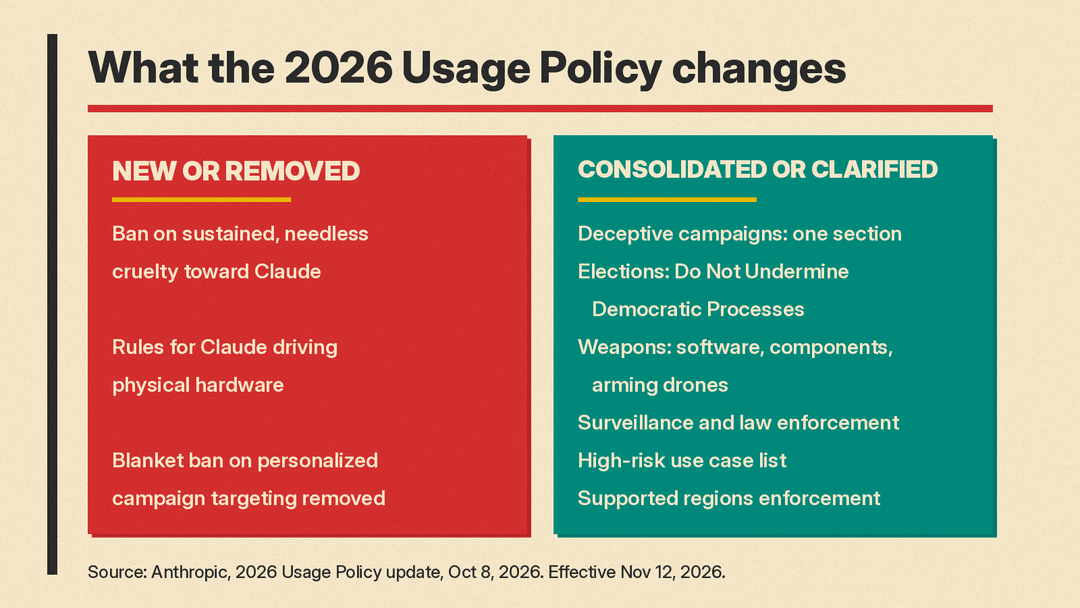
Anthropic's announcement says that most updates "are intended to clarify existing rules," because Claude now does "longer, more independent work." Sorted by that distinction:
- New rule: a prohibition on "sustained and needless abusive or cruel behavior toward our models."
- New rule: requirements for Claude connected to hardware that takes autonomous physical actions.
- Removed rule: the blanket ban on personalized vote and campaign targeting.
- Consolidated: influence-operation rules gathered into one new section on deceptive campaigns.
- Clarified, same enforcement: weapons, surveillance and law enforcement, high-risk use cases, and the Supported Regions Policy.
Deceptive campaigns get their own section
Anthropic says it has seen state media outlets, government propaganda offices and commercial firms use Claude to run networks of fake accounts and fabricated news sites. The rules against this were spread across the elections, fraud, privacy and disinformation sections. They now sit in one section, "Do Not Engage in Deceptive Campaigns or Artificial Activity," which covers political and commercial deception alike.
The policy text bans fake personas, accounts, media outlets or organizations used to mislead people about who is behind a message, how widely a view is held, or whether they are talking to a human. It also bans building the tools and infrastructure for such campaigns, and selling them as a service.
Elections: narrower, and one ban removed
The elections section is renamed "Do Not Undermine Democratic Processes." It now targets deceiving voters or disrupting elections: false information about candidates or how to vote, impersonating candidates or election officials, and trying to suppress turnout.
Anthropic also dropped its blanket ban on personalized vote and campaign targeting. The company says that rule blocked legitimate civic work, such as nonprofits writing voter information in other languages or election officials sending ballot cure notices. Targeting that relies on deception or misuses voters' personal data is still banned under the deceptive campaigns, surveillance and privacy sections.
Weapons and surveillance: more explicit, not stricter
Both sections are rewrites that Anthropic says match how it already enforced the old policy. Autonomous weapons and mass domestic surveillance were also the two uses at the center of Anthropic's dispute with the Pentagon this year.
- Weapons. The ban now spells out that it covers "the software and components that make weapons work," plus actions such as arming drones and other autonomous vehicles. Anthropic says it has seen people try to use its models to build guidance and control software for weapons.
- Surveillance and law enforcement. Tracking people without consent is banned, whether in real time or by analyzing data already collected. Claude cannot be used to decide or recommend who to investigate, arrest or charge, or to build or improve surveillance tools. The section also lists uses that stay allowed: tracking people have agreed to (such as fraud monitoring), content moderation, journalism and legal research.
High-risk uses and physical hardware
The core high-risk rule has not changed. When Claude's output can affect someone's health, legal rights, finances, livelihood or access to essential services, a qualified human must be able to review and change Claude's recommendations, and the affected person must be told AI was used. What changed is the layout: the section now lists which kinds of recommendations are covered and which are not, because users kept asking.
The new part follows Anthropic's Model Hardware Standard. For what the policy calls High-risk Physical Actions, the policy text requires:
- a qualified person who can observe the equipment and stop it at any time;
- equipment that stops or holds a safe state when that person intervenes or when the connection to Anthropic's services is lost;
- operating limits such as speed, force, temperature, voltage or dose enforced "by the equipment or a controller independent of model output."
In plain terms, the model cannot be the only thing keeping a machine within safe bounds. Our report on the standard's August research preview explains how it connects agents to equipment. Teams wiring Claude into lab, factory or robotics equipment have until November 12 to make sure a hardware-level limit and a human stop exist.
The rule about being cruel to Claude
The new clause sits in the section "Do Not Engage in Cruel, Abusive, or Psychologically Harmful Conduct," next to rules on self-harm and eating disorders, and bans engaging "in sustained and needless abusive or cruel behavior toward our models."
Anthropic says it applies "only in extreme cases, where users repeatedly act cruelly toward our models, with no discernible purpose." It explicitly excludes "common versions of user frustration, pushback, dark creative themes, or model testing and research." Swearing at a broken build or writing a cruel villain is not a violation.
Enforcement mostly reuses an existing feature. In August 2025 Anthropic let Claude Opus 4 and 4.1 end a rare subset of conversations with persistently abusive users. That post said the feature was developed "primarily as part of our exploratory work on potential AI welfare," and that the company remains "highly uncertain about the potential moral status of Claude." The new announcement says Claude models can already end these conversations on Claude.ai and Claude Code, and that this ability "will remain the primary enforcement mechanism."
The general enforcement terms still apply, though. The policy says Anthropic's Safeguards Team may "warn you or throttle, limit, suspend, or terminate your access" if it suspects a violation. It adds that hitting a real-time safeguard block "does not by itself indicate a violation."
Why this is contested: in September, Microsoft AI CEO Mustafa Suleyman criticized Anthropic's approach to model welfare. The Register reported that his essay argued "Anthropic is training Claude that it may be conscious," which he said could make future systems harder to control. A usage rule that protects the model, even narrowly, puts that debate into a contract customers agree to. Forbes summed the change up as Anthropic barring users from being "excessively mean" to its chatbots.
Supported regions
Anthropic also clarified how it enforces its regional restrictions. The announcement says Claude may not be used by people physically located in an unsupported region, by entities incorporated or headquartered in one, or by entities majority-owned or controlled by persons or entities in those regions. The list itself is on the supported regions page.
What to check before November 12
- Developers in health, finance, legal or hiring: read the rewritten high-risk section to see if your recommendations are on the covered list. If so, you need a qualified human reviewer and an AI disclosure to the affected person.
- Teams connecting Claude to hardware: add a human stop, a safe state on disconnect, and limits enforced outside the model.
- Civic groups and campaigns: personalized outreach is no longer banned outright, but it must not deceive voters or misuse their personal data.
- Security researchers: the policy still allows testing on systems you own or are authorized to test, and points to the Cyber Verification Program for adjusted safeguards.
- Everyday users: little changes. Frustration and dark fiction are fine. Repeated, pointless cruelty can get a chat ended.
Sources
- Anthropic: 2026 Usage Policy update
- Anthropic Usage Policy, effective November 12, 2026
- Anthropic: Claude Opus 4 and 4.1 can now end a rare subset of conversations
- Anthropic: Model Hardware Standard research preview
- Anthropic: Expanding the Cyber Verification Program
- The Register: Microsoft AI chief warns Anthropic not to put ideas in Claude's head
- Forbes: Anthropic Bans Being Excessively Mean To Claude
