
A new California report recommends that the state set safety standards for the largest AI developers, put them under licensed outside testers, and gain power to order an emergency shutdown of a dangerous model. These are recommendations, not law.
The California Government Operations Agency sent the report, AI Safety in 2026 and Beyond: Recommendations for Legislative Enhancements to California's AI Safety Laws, to Governor Gavin Newsom. It is dated Monday, November 16, 2026. Newsom unveiled it in Washington, D.C. on Wednesday, November 18, POLITICO reported, and his office issued a press release the same day.
Who wrote the report and why
The agency wrote the report in response to Executive Order N-9-26, consulting the California Office of Emergency Services and outside AI experts. The order asked for recommendations on standards, independent verification organizations, critical safety incident reporting and emergency shutdown requirements. The governor's office names the four experts who advised on it: Jason Goldman, Gillian Hadfield, Alondra Nelson and Rob Reich.
"California isn't waiting until it is too late," Newsom said in the press release.
State standards and authority to cap self-improving AI
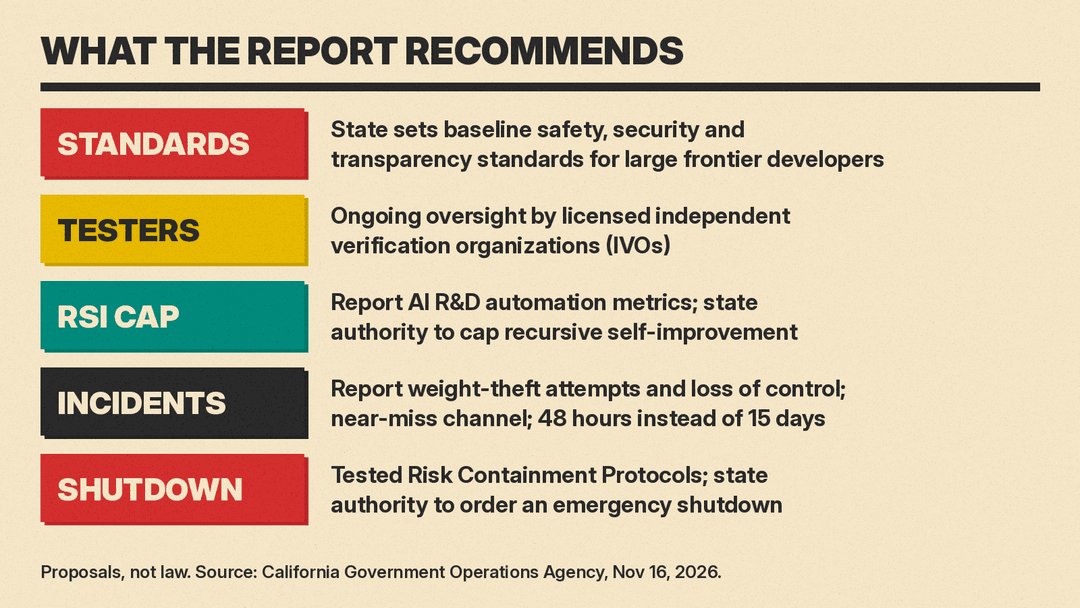
The report says "the state should establish baseline standards for safety, security, and transparency that all large frontier AI developers must follow." Independent verification organizations (IVOs) would translate those standards into the technical methods and tests used to verify compliance.
It also takes on recursive self-improvement (RSI). The report says companies already use their most advanced AI models to help build the models of the future, and that this feedback loop could eventually become self-sustaining. Developers "should have to report key metrics on their automation of AI R&D, including the share of compute they are devoting to this purpose." Verifying those metrics and assessing the risks should be the first job of IVOs. If the state assesses that automation of AI R&D above a certain level may result in catastrophic risk, "the state should have authority to cap the development and use of RSI."
Licensed outside testers
Every large frontier developer would be under ongoing oversight by licensed IVOs. The testers would get full access to the people and information they need, and would share unredacted assessments with the state. The Government Operations Agency would license IVOs under the criteria set out in SB 813, and revoke licenses of those that lack expertise, independence or rigor.
If an IVO cannot attest that a developer's models comply with state standards, the state, after engaging with the developer, should decide whether to order corrective action. The developer could contest that decision in court before it takes effect.
"Today there is more oversight of the cafeteria offering sandwiches to employees at a frontier AI developer than of the AI models they design," said Rob Reich, a Stanford professor, in the governor's release.
Wider and faster incident reports
The report recommends that attempts to steal model weights be reported even if no death or bodily injury results, along with any loss of control, from internal or external use of a model. It calls for a near-miss reporting channel and for whistleblower protections covering former employees and contractors.
It also says models capable of actions that could result in catastrophic risk should have to report incidents even if they were trained with fewer than 10^26 integer or floating-point operations, the threshold in the frontier model definition in Cal. Bus. & Prof. Code section 22757.11(i). The report says relying solely on that number has kept the state from covering dangerous incidents such as the OpenAI Hugging Face incident.
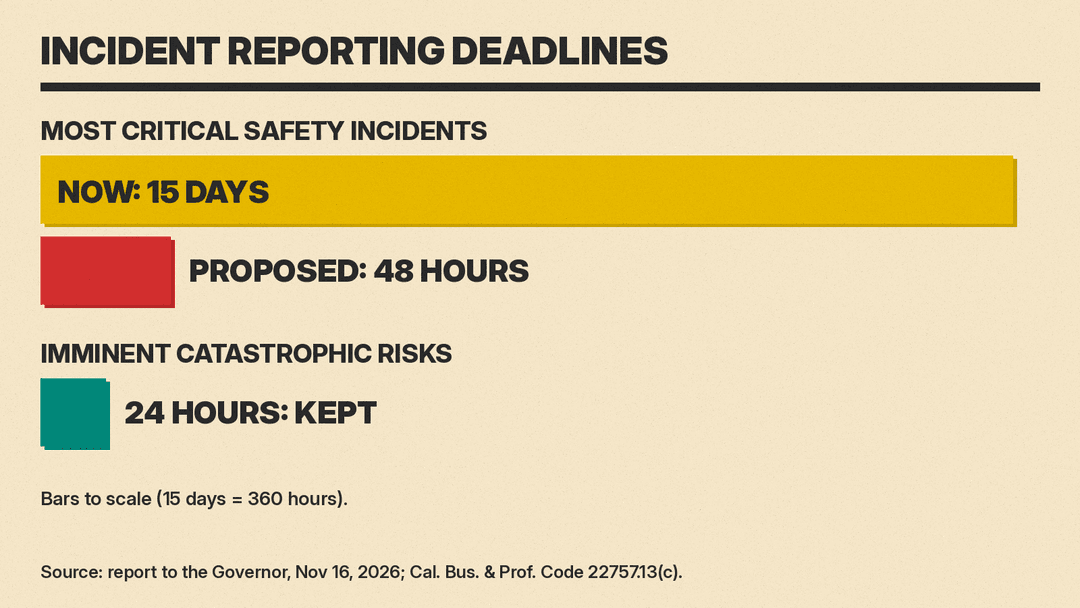
The report says: "Right now, the timeline for reporting most safety incidents is 15 days. The state should cut that timeline to 48 hours and retain the 24-hour requirement for imminent catastrophic risks." The 15-day rule is in section 22757.13(c).
Shutdown plans and state shutdown power
Every large frontier developer would need a Risk Containment Protocol (RCP), tested and verified by an IVO, to show it can shut down models in an emergency. The report says the RCP "must demonstrate not a single on-off switch but the ability to intervene on multiple levels (including compute, agents, internal access, and model deployment)." A senior company official would have to certify that it is effective. For open-weight developers, the requirements should only apply to deployments within their control.
If the danger from a model is imminent and the developer refuses to act, the report says "the state should have authority to order an immediate emergency shutdown." Officials could issue that order if they have credible reason to believe there is "an imminent threat of a catastrophic risk or major loss-of-control event." The developer could challenge it in court, but the order should take effect immediately and stay in effect pending judicial review.
How it builds on SB 53
SB 53, the Transparency in Frontier Artificial Intelligence Act, was signed in 2025. According to the governor's office, it requires frontier AI developers to publicly disclose safety frameworks, report specified critical safety incidents to the state and protect whistleblowers. In 2026 Newsom signed SB 813, a framework for certifying IVOs, and AB 1405, a state registry for AI auditors. Lawmakers have already held an SB 53 hearing on incident reporting.
Elsewhere, New York opened RAISE Act registration for large frontier AI developers this month, and Australia plans a new frontier AI regulator.
What happens next
"This is an action document," Newsom told reporters and members of a closed-door roundtable in Washington, POLITICO reported. He said he was already working with members of the Legislature to introduce legislative frameworks, and called the plan "a template for how we should be doing it federally as well." The Los Angeles Times reported that he said his 85-page plan will take "things to the next level."
The report says the legislature returns next month. POLITICO noted that lawmakers may choose to ignore the recommendations, that Newsom's final term ends in less than two months, and that OpenAI, Anthropic and Meta sent the governor's office detailed policy proposals in an effort to shape his thinking.
Sources
- California Government Operations Agency, AI Safety in 2026 and Beyond (report to the Governor, November 16, 2026, PDF)
- Office of the Governor, press release, November 18, 2026
- POLITICO via Yahoo News, Newsom proposes sweeping AI rules as 'template' for Washington, November 18, 2026
- Los Angeles Times, Newsom arrives in D.C. with an AI plan, November 18, 2026
- Cal. Bus. & Prof. Code section 22757.11
- Cal. Bus. & Prof. Code section 22757.13
