
ByteDance's Seed team released Seedream 5.5 on November 9, 2026. It is the company's new image model, and it targets three problems that slow down people who use AI images for real work: edits that slowly ruin the parts of an image you did not touch, cutouts that need manual cleanup, and garbled small text.
In its launch post, the Seed team says the model "supports continued work on the same image across 100 rounds of editing", generates images with a transparent background directly, and renders skin textures more naturally and text more accurately. All performance figures below come from ByteDance's own tests, not an independent lab.
What is new in Seedream 5.5
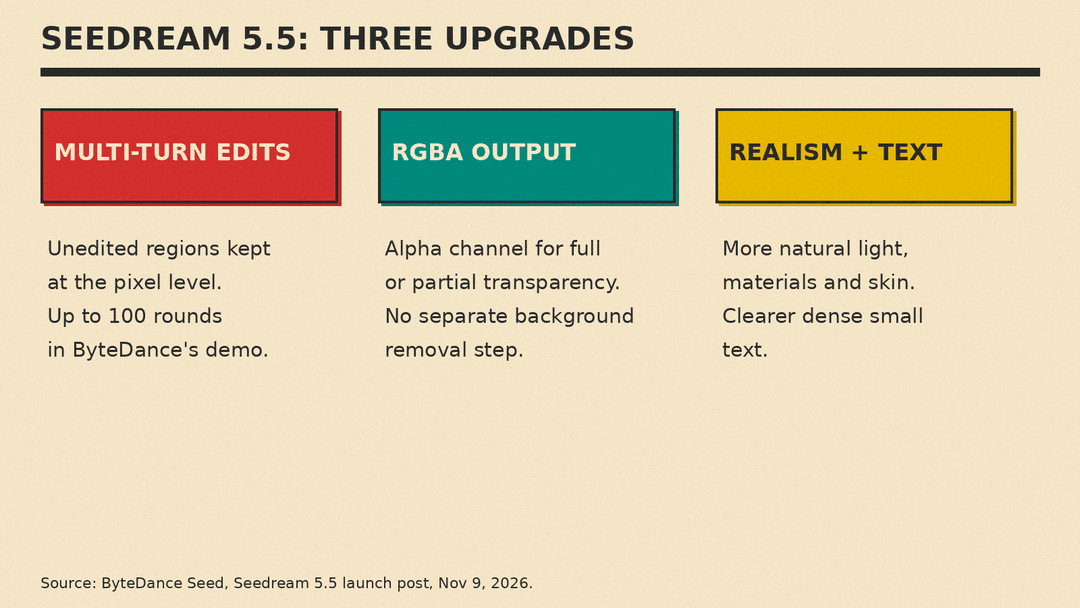
ByteDance lists three upgrades on the Seedream 5.5 product page and in its blog post.
Multi-turn editing that leaves the rest alone. The Seed team says Seedream 5.5 can "preserve unedited regions at the pixel level and eliminate color shifts in those areas". That matters because in multi-turn editing each output becomes the next input, so small errors can pile up, as the Seed team notes. In its demo, ByteDance made 100 successive edits to one image of a person, changing clothing, accessories and objects on a table. The company says the model could still edit small items such as rings and eyeglass frames after those rounds. A demo is a chosen example, not a guarantee for every image.
Transparent images without background removal. The model now outputs RGBA images, which means the file carries an alpha channel for full or partial transparency. ByteDance says this lets generated elements go straight into layout and compositing "without separate background removal or edge cleanup." Examples on the blog and product page include cartoon stickers, a snowy owl with detailed wing feathers, and a set of plush cartoon characters, each output as a separate image with a transparent background.
More realistic photos and clearer small text. The Seed team says the model renders lighting, materials and skin more naturally and "reduces excessive gloss and overexposure." It also says text rendering is better, including dense small text and Chinese characters with many strokes.
What ByteDance's tests show
ByteDance tested Seedream 5.5 against its previous model, Seedream 5.0 Pro, in six use cases: e-commerce, marketing, film and television, gaming, office productivity and fashion design. According to the Seed blog, the tests ran on its MagicArena platform, with experienced image-generation evaluators scoring quality and usability.
These are the results ByteDance reported on November 9, 2026:
- Quality scores and usability rates went up in all six use cases compared with Seedream 5.0 Pro.
- In film and television and in office productivity, usability rates were "more than twice" those of Seedream 5.0 Pro.
- In side-by-side comparisons scored as GSB (Good/Same/Bad), Seedream 5.5 got positive scores against the previous version in all four comparisons. The highest was +55.62% for realism in image-to-image tasks.
- Against GPT Image 2.5 Sunburst and Nano Banana 2.1, ByteDance says Seedream 5.5 "leads in text structure across both tasks and shows a substantial advantage in text-to-image realism."
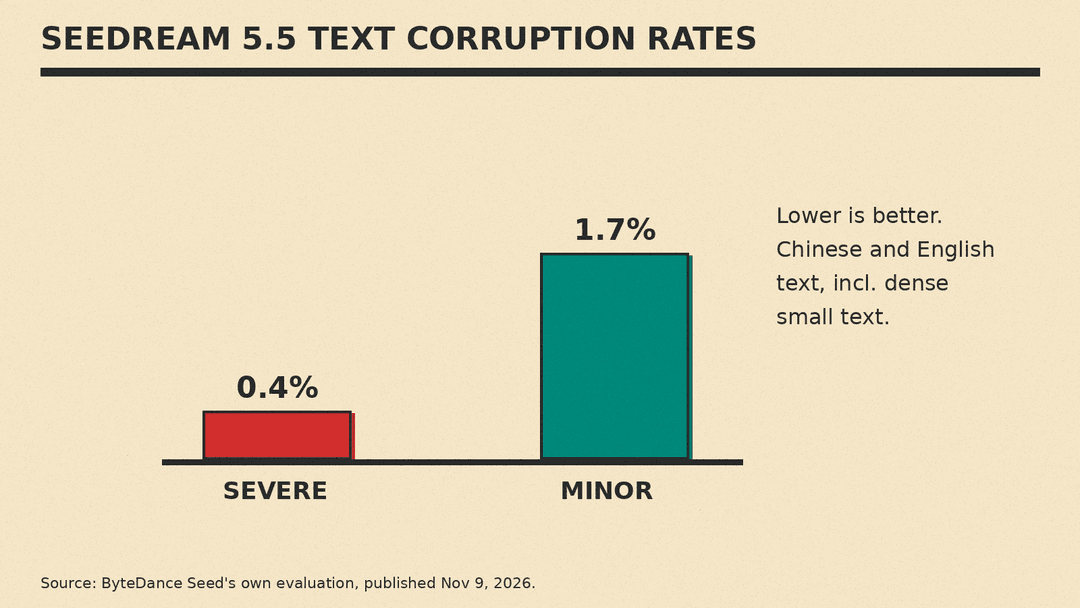
- In Chinese and English text tests, the severe text corruption rate fell to 0.4% and the minor text corruption rate to 1.7%.
The blog post does not give the size of the test sets or the number of evaluators. The rival models it names are the ones we compared in our GPT Image 2.5 vs Nano Banana 2.1 guide. Our November 5 post covers GPT Image 2.6 in OpenAI's API. ByteDance's post does not compare against that version.
Where you can use it
The Chinese version of the Seed blog post says Seedream 5.5 is "陆续" (gradually) going live on Jimeng, Doubao, Doubao Work and Volcano Ark (火山方舟). Reports differ on the API timing. IT Home lists Volcano Ark among the platforms now rolling out, while Caiwen via 10jqka reported that Doubao, Doubao Work and Jimeng had the model and that the API was "即将上线" (about to go live) on Volcano Ark.
On price, IT Home reported that the API keeps a two-part charge for input images and output images, with no charge for text tokens. IT Home's example: editing one 2K square image costs about 0.28 yuan, which it says is less than half the cost of Seedream 5.0 Pro. That figure is as reported on November 9, 2026. ByteDance's English blog post does not list prices.
If you are new to ByteDance's consumer app, our explainer on what Doubao is covers how it fits into ByteDance's AI lineup.
Why it matters
The Seed models page lists Seedream 5.5 under GenMedia, next to Seedance 2.5, the video model we covered in our Seedance 2.5 explainer. With 5.5, ByteDance pitches the image model at production teams. The blog post frames the goal as delivering "usable results that meet quality standards and deadlines while staying within budget."
The three upgrades line up with the steps ByteDance describes in its post. Stable multi-turn edits target the loop of making one change, then another, to the same image. Native transparency targets the step of cutting an element out so it can go into a layout. Better small-text rendering targets dense layouts; ByteDance's own examples are a newspaper-style page and an infographic with small Chinese captions.
The caveat is that all of the evidence so far is ByteDance's own. The company picked the use cases, ran the evaluations on its own platform and chose the comparison models. Independent tests, such as public leaderboards, would show whether the gains hold up.
What comes next
ByteDance says a Pro version of the Seedream 5.5 series "will follow", with no date given. The Seed team also says it plans to support more complex contextual inputs and creative instructions and, guided by production needs in film, e-commerce, advertising and design, to expand the model's use in agent workflows.
Sources
- ByteDance Seed: Introducing Seedream 5.5 (English blog, Nov 9, 2026)
- ByteDance Seed: Seedream 5.5 (Chinese blog, Nov 9, 2026)
- ByteDance Seed: Seedream 5.5 product page
- ByteDance Seed: Models
- IT Home: Seedream 5.5 release and pricing (Nov 9, 2026)
- Caiwen via 10jqka: Seedream 5.5 availability (Nov 9, 2026)
