PEFT6 articles

PEFT

Articles

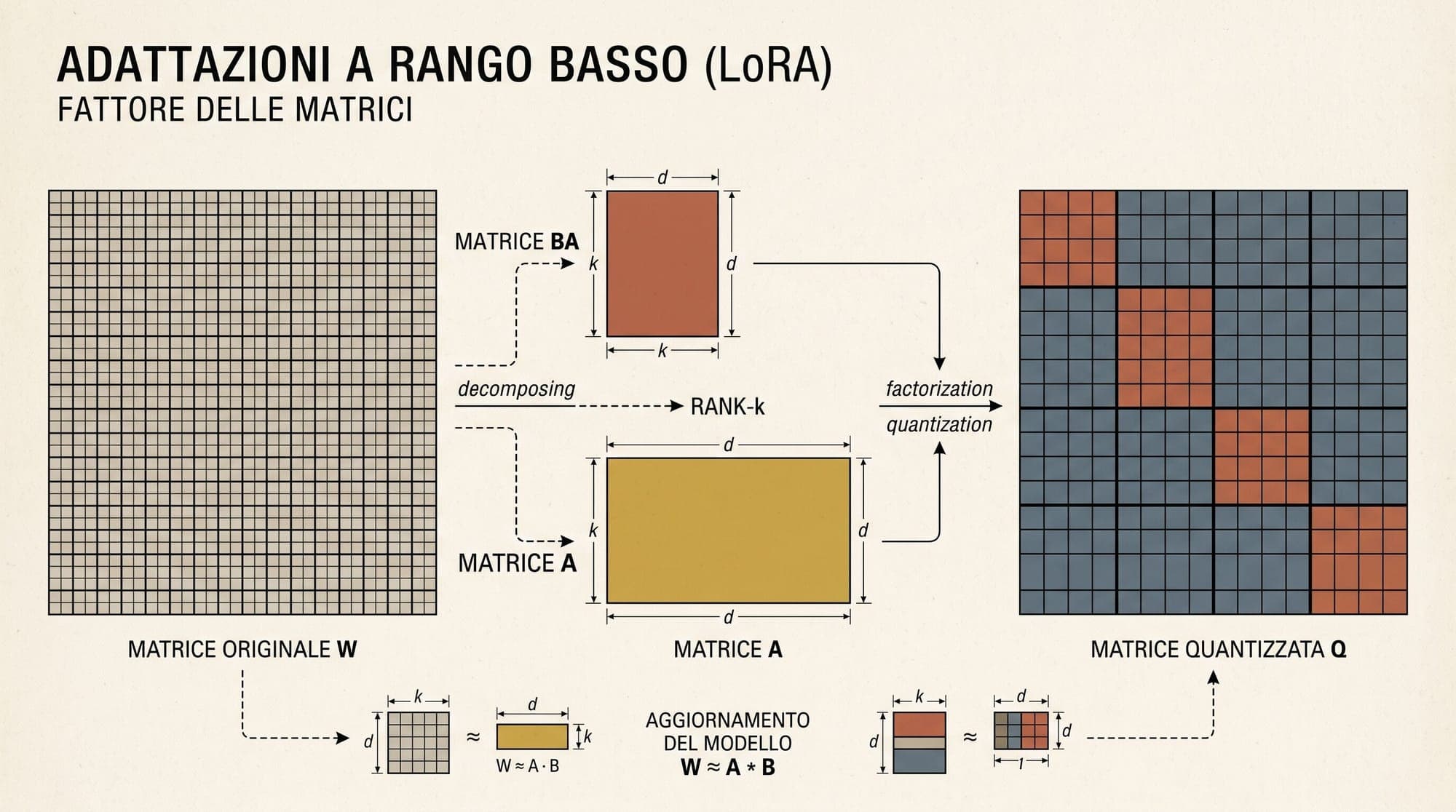
  • Low-Rank Adaptation (LoRA) and QLoRA: Mathematical Foundations, Intrinsic Rank Parameterization, NF4 Quantization, and Double Quantization Mechanics

    Low-Rank Adaptation (LoRA) and QLoRA: Mathematical Foundations, Intrinsic Rank Parameterization, NF4 Quantization, and Double Quantization Mechanics Parameter-efficient fine-tuning (PEFT) has become the standard operational methodology for adapting large language models to domain-specific tasks, downstream instruction following, and structured tool use. Full-parameter fine-tuning of frontier architectures requires updating and tracking optimizer states for tens or hundreds of billions of parame

    1 min
  • Low-Rank Adaptation (LoRA) and QLoRA: Mathematical Foundations, Intrinsic Rank Dynamics, 4-Bit NormalFloat Quantization, and Memory-Efficient Fine-Tuning

    Fine-tuning large language models on custom datasets presents a significant hardware challenge. While running inference on a 70-billion parameter model requires only the model weights in memory, full-parameter fine-tuning (FPFT) demands an order of magnitude more resources. During standard 16-bit mixed-precision training with optimizers such as AdamW, each parameter requires 2 bytes for the static weight, 2 bytes for the gradient, 4 bytes for the 32-bit master weight copy, and 8 bytes for the fi

    1 min
  • Low-Rank Adaptation (LoRA) and DoRA: Mathematical Foundations, Intrinsic Dimensionality, and Directional Weight Decomposition

    Low-Rank Adaptation (LoRA) and DoRA: Mathematical Foundations, Intrinsic Dimensionality, and Directional Weight Decomposition Full-parameter fine-tuning of large language models presents prohibitive memory requirements during training. Standard full fine-tuning requires updating every weight matrix in a model, demanding storage not only for the model parameters themselves, but also for activation tensors, backward gradients, and first- and second-moment optimizer states. For a 70-billion-parame

    1 min
  • Parameter-Efficient Fine-Tuning Beyond LoRA: How Adapters, Prefix Tuning, Prompt Tuning, and (IA)3 Adapt Frozen LLMs

    Parameter-Efficient Fine-Tuning Beyond LoRA: How Adapters, Prefix Tuning, Prompt Tuning, and (IA)3 Adapt Frozen LLMs While Low-Rank Adaptation (LoRA) and its weight-decomposed variant (DoRA) serve as the prevailing standard for adapting large language models, parameter-efficient fine-tuning (PEFT) encompasses a broader taxonomy of mathematical approaches. The core objective of PEFT is to adapt multi-billion-parameter foundation models to specialized downstream tasks while updating only a fracti

    1 min
  • Weight-Decomposed Low-Rank Adaptation (DoRA): How Decoupling Magnitude and Direction Closes the LoRA Gap

    Weight-Decomposed Low-Rank Adaptation (DoRA): How Decoupling Magnitude and Direction Closes the LoRA Gap Parameter-efficient fine-tuning (PEFT) has become the standard operational paradigm for adapting large language models to domain-specific downstream tasks. Among existing PEFT methodologies, Low-Rank Adaptation (LoRA) remains the default implementation across industry and academia due to its minimal parameter footprint and zero inference overhead. However, empirical studies consistently reve

    1 min
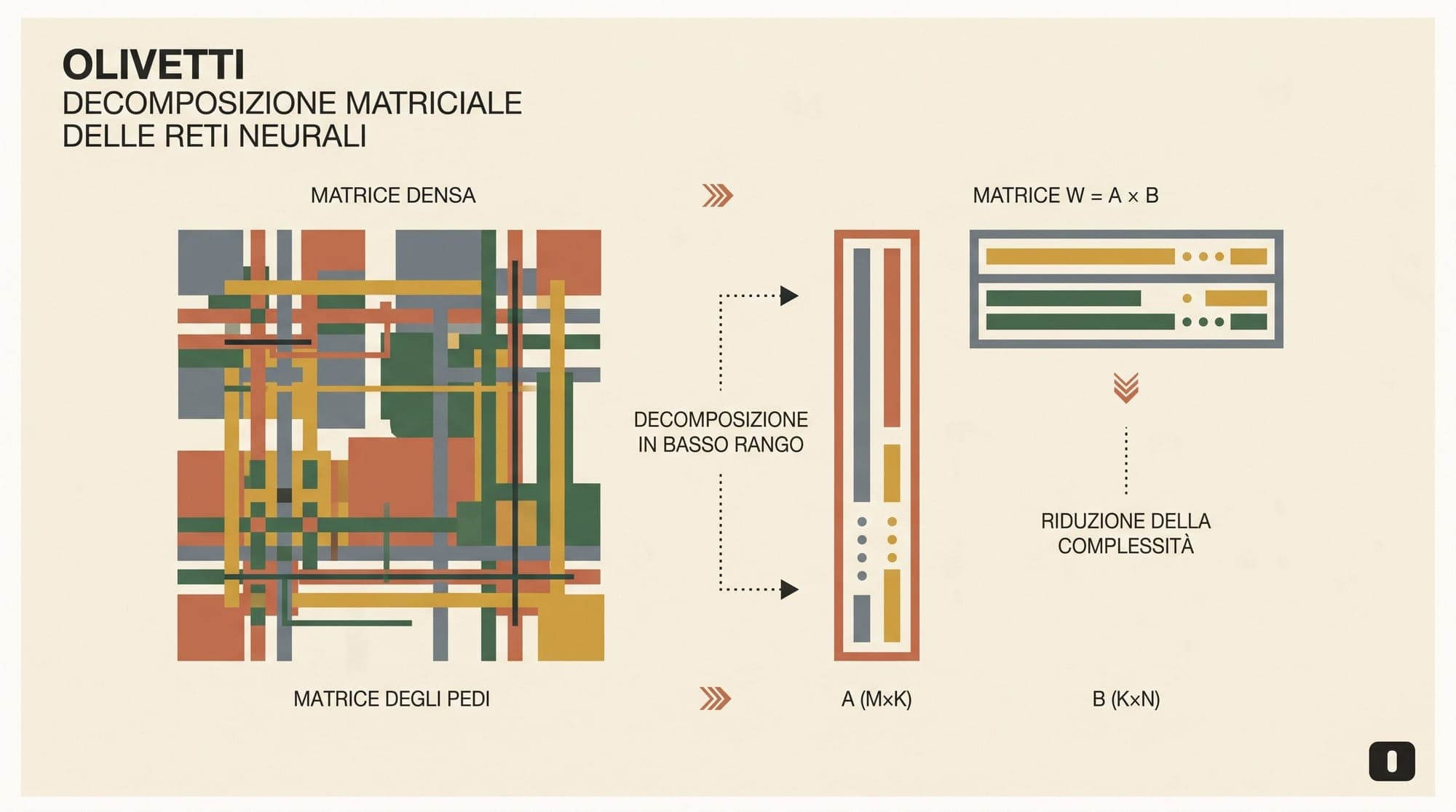
  • Low-Rank Adaptation (LoRA): How Matrix Decomposition Made LLM Fine-Tuning Accessible

    Full-parameter fine-tuning of modern foundation models requires substantial compute and memory infrastructure. Adapting an open-weight 70-billion-parameter model using standard 16-bit precision and first-order adaptive optimizers like AdamW demands well over 1 terabyte of GPU memory. Low-Rank Adaptation (LoRA) bypassed this hardware bottleneck by framing task-specific weight updates as low-rank matrix decompositions. By freezing pre-trained weights and training small auxiliary rank decompositio

    1 min