
Trained neural networks are wasteful by design. Most of the weights in a large model contribute so little that deleting them barely moves the answer — that has been the working assumption behind every pruning and distillation pipeline in production. In March 2018, two MIT students, Jonathan Frankle and Michael Carbin, posted a paper that made a much sharper claim: the waste was not created by training. A small, fully trainable network was already present at initialization, hiding inside the dense one like a winning ticket in a roll of scraps. The paper landed at ICLR 2019, won the conference's Outstanding Paper award, and has been cited by more than 6,000 papers since.
Seven years on, the lottery ticket hypothesis is one of the most studied, most qualified, and most quietly reinterpreted ideas in deep learning. This is what it claims, what held up, and what it actually changed.
The experiment: train, prune, rewind, retrain
Frankle and Carbin did not start from philosophy. They started from a pruning technique. Take a dense network and delete the weights with the smallest magnitudes — the ones contributing least to the output. Then keep going: train the pruned network, prune again, repeat. This procedure, iterative magnitude pruning (IMP), steadily shrinks the network while the surviving weights keep training.
The twist is the final step. Instead of continuing from the trained pruned weights, they reset every surviving weight back to its random initialization value and trained the sparse skeleton from scratch, in isolation.
The result was the paper's headline. On small vision tasks — LeNet-class networks on MNIST, ResNets on CIFAR-10 — the pruned subnetworks that trained from their original initialization, which they called winning tickets, were less than 10–20% of the size of the dense network, yet reached test accuracy comparable to (often better than) the full network, in at most the same number of training iterations. Larger tickets even learned faster than the dense original.
The control experiment mattered more than the headline. Take the same sparse structure — the same connections, the same graph — but fill it with a fresh random initialization, and performance fell apart. Structure alone was not enough. As the authors put it, the winning tickets "have won the initialization lottery": specific random numbers, drawn before any training, made those connections trainable.
What the hypothesis actually claims
Stated precisely, the lottery ticket hypothesis says: a randomly initialized, dense neural network contains a subnetwork that, when trained in isolation, can match the test accuracy of the original network after training for at most the same number of iterations.
Three implications followed, and they are the reason the paper lit up the field:
- Initialization is destiny, partially. Random weights are not interchangeable filler. Some draws of random numbers set up a network to learn; others merely look the same size.
- Dense networks are redundancy. If a 20%-size ticket matches the full model, the other 80% is capacity the task did not need. Overparameterization, the expensive habit of modern deep learning, becomes a lottery: buy more tickets, find better ones.
- Training is partly a search. Dense SGD may work not because every weight is needed, but because a wide net gives the optimizer more subnetworks from which to recover a good one.
That last reading — training as a process that stumbles onto a lucky substructure rather than sculpting the whole net — is the one that everything after 2019 argued about.
Scaling ran into the first wall
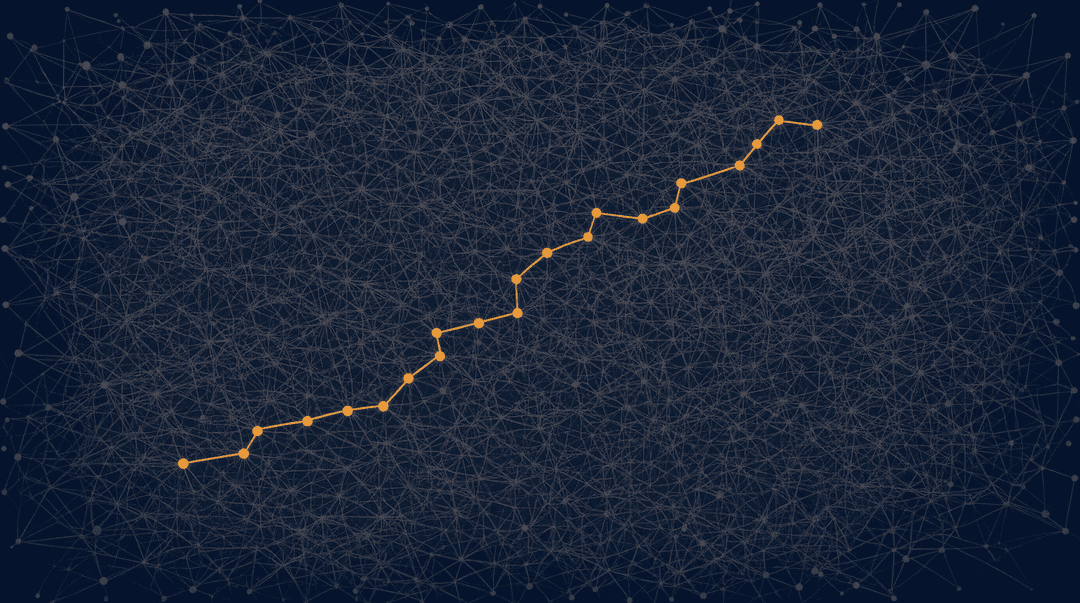
The original paper's own fine print predicted the trouble. The authors reported that their IMP results were sensitive to the learning rate, and that winning behavior got harder to find as networks grew.
Frankle, with collaborators, then wrote the follow-up study of what happens at scale. In "Stabilizing the Lottery Ticket Hypothesis," training ImageNet-size networks (ResNet-50, Inception-v3) from the initial weights frequently failed, at any pruning level, because early SGD noise destabilized the pruned nets. The repair: rewind surviving weights not to step zero but to a point a few iterations into training. Late rewinding "produces stabler winning tickets," and tickets only reached full accuracy when they were stable to SGD noise — which happens at initialization for small nets but only early in training for big ones.
That is already a retreat from the slogan. On large models, the ticket is not what you drew at initialization; it is what you drew in the first few steps. The pure form of the hypothesis — the winner was there all along, before training began — does not survive contact with ImageNet.
Born or made: the controls that muddied the story
If the hypothesis says special numbers make trainable subnetworks, the obvious probe is to destroy the numbers and keep everything else. Uber AI's "Deconstructing Lottery Tickets: Zeros, Signs, and the Supermask" did exactly that and found the phenomenon is far messier than "lucky weights."
Their results, in sequence: zeroing pruned weights genuinely matters; when weights are reinitialized, signs matter — copying only the sign pattern of the original initialization lets a re-randomized ticket train; and masking behaves like training. The sharpest finding was the supermask: apply a learned binary mask to an untrained, randomly initialized network and you get 86% on MNIST and 41% on CIFAR-10 without training at all. In other words, the structure the lottery algorithm picks out carries much of the capability, and the specific weight values carry less than Frankle and Carbin's control suggested.
Follow-ups pulled the rug further. Morcos et al. found winning tickets drawn on one dataset and optimizer transferred well to other datasets and optimizers — tickets drawn from large natural-image datasets performed close to native tickets on Fashion-MNIST, CIFAR, ImageNet, and Places365, suggesting the "lucky initialization" encodes something generic, not task-specific luck. And a later line of layer-permutation work concluded that at moderate sparsity, "when layers play the lottery, all tickets win at initialization" — random subnetworks are often fine.
Frankle's own 2023 dissertation states the settled position plainly: strict initialization dependence is real but matters at extreme levels of sparsity; below the extreme, the network's architecture and the pruning structure do much of the work. The honest summary of seven years of replication is that the lottery ticket hypothesis was true with an asterisk and false with an asterisk, depending on how far you prune.
Theory: strong tickets, weak guarantees
Two theoretical results gave the idea a firmer footing — and then quietly replaced its practical claim.
The "strong" lottery ticket hypothesis, conjectured by Ramanujan et al. and proven for ReLU networks by Malach, Dziugaite, Roy and Soudeny at ICML 2020, shows a stronger statement than Frankle and Carbin needed: for every target network with bounded weights, a sufficiently over-parameterized network with random weights contains a subnetwork that roughly matches the target's accuracy — without any further training. Overparameterization provably buys you a universal substrate of near-target subnetworks.
But the proofs guarantee existence, not findability: they do not say the subnetworks that magnitude pruning surfaces are trainable, nor that any efficient algorithm finds the good tickets. The 2024 survey of the field by Zhao et al. maps exactly where the empirical and theoretical claims still diverge — which is the real intellectual legacy: the community now knows, with proofs, that a trained model's capability is not spread evenly across its weights, and does not know how to find the dense part cheaply.
BERT plays the lottery — skeptics included
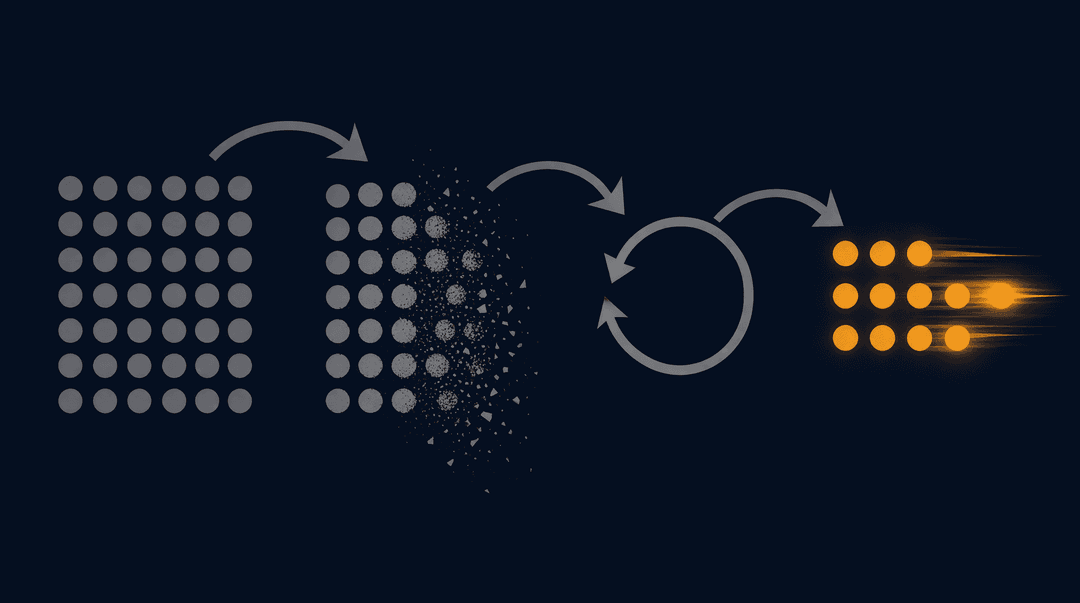
Because IMP's practical procedure (train dense, prune, rewind, retrain) is exactly the overparameterized-redundancy story LLM practitioners live inside, the hypothesis was tested on language models almost immediately — and the results are why it matters today for anyone thinking about model size.
Chen, Frankle et al. (NeurIPS 2020) found subnetworks matching full-model performance inside fine-tuned BERT and, more consequentially, "universal" transferable subnetworks inside pre-trained BERT across multiple GLUE downstream tasks; a parallel CV study summarized the finding as transferable sparse matching subnetworks at 40% to 90% sparsity drawn from pre-trained initialization. EarlyBERT then observed that structured winning tickets emerge within the first few steps of BERT pre-training, so cheaply that you can draw the ticket early and train the rest of the schedule sparse — a genuine efficiency result, not just a replication.
The skeptics got the last word on interpretation. The Gradient's "When BERT Plays the Lottery, All Tickets Are Winning" reported that randomly selected subnetworks of pre-trained BERT performed comparably to the chosen ones at moderate sparsity, and that the "good" subnetworks were not stable across random seeds or GLUE task families — evidence that pre-trained transformer quality is broadly distributed across components, not locked into a single lucky ticket. On the formal side, Otsuka (AAAI 2026) extended strong-ticket existence results to the module that now runs the world: multi-head attention.
What survives, and what it changed for LLMs
Nobody at trillion-parameter scale runs iterative magnitude pruning. Training dense to find the ticket, rewinding, and retraining multiplies the largest line item in an AI budget by a factor nobody will pay. The hypothesis's descendants all route around that cost, and three of them are load-bearing in practice:
- Pruning after pre-training. Every production pruning pipeline — magnitude pruning, Wanda, SparseGPT, semi-structured 2:4 sparsity — is the practical ancestor of the lottery ticket observation: trained models contain a smaller model that keeps the accuracy, so delete weights once and accept the damage. Our explainer on weight pruning covers how modern one-shot methods do it; the difference from the original lottery claim is simply when the ticket gets cashed — after training, instead of before.
- Sparse training. Dynamic sparse-training lines, surveyed by Zhao et al., and results like EarlyBERT treat the redundancy observation as an efficiency bet: if the trained model will contain a small model anyway, let the topology discover it during pre-training and skip the dense detour entirely.
- Interpretability and calibration. "Capability concentrates in a sparse substructure" is the premise under which sparse autoencoders and circuit analysis make sense, and it is why model redundancy keeps reappearing in double-descent discussions: overparameterization is both free and necessary, and the lottery framing explains why those two sentences are not contradictory.
The claim itself survives in weakened, honest form: redundancy exists at initialization; special initializations genuinely help at extreme sparsity; provably capable subnetworks exist in sufficiently wide random nets. The claim's slogan form — "your network already contains its own pruned, better self, and pruning will find it" — survives mainly as a warning about what has not been shown.
Takeaways
- The lottery ticket hypothesis (Frankle & Carbin, ICLR 2019): dense randomly initialized networks contain sparse subnetworks that match full accuracy when trained in isolation, at under 10–20% of the parameters — but only from their original initialization.
- Scaling broke the pure form: on ImageNet-size models, tickets only trained well when rewound a few steps into training, not to initialization.
- Supermask and transfer work relocated the capability: at moderate sparsity, structure and signs carry most of the signal; strict initialization dependence bites mainly at extreme sparsity.
- Theory proved a stronger existence claim (overparameterized random nets contain near-target subnetworks untrained) without proving anyone can find the good tickets cheaply.
- For language models, pre-trained BERT does contain matching subnetworks — including universal transferable ones — but skeptics showed many random draws win too.
- Its real legacy: production pruning, early-emerging sparse training, and the framing that overparameterization is a redundancy budget the optimizer spends.
Sources
- The Lottery Ticket Hypothesis: Finding Sparse, Trainable Neural Networks — Frankle & Carbin (arXiv:1803.03635)
- ICLR 2019 OpenReview page (Outstanding Paper)
- Stabilizing the Lottery Ticket Hypothesis / The Lottery Ticket Hypothesis at Scale — Frankle et al. (arXiv:1903.01611)
- Proving the Lottery Ticket Hypothesis: Pruning is All You Need — Malach et al., ICML 2020 (PMLR v119)
- Deconstructing Lottery Tickets: Zeros, Signs, and the Supermask — Zhou et al. (NeurIPS 2019)
- One ticket to win them all: generalizing lottery ticket initializations across datasets and optimizers — Morcos et al. (arXiv:1906.02773)
- When Layers Play the Lottery, All Tickets Win at Initialization (arXiv:2301.10835)
- On Sparse, Trainable Neural Networks — Jonathan Frankle, MIT 2023 dissertation
- The Lottery Ticket Hypothesis for Pre-trained BERT Networks — Chen, Frankle et al. (arXiv:2007.12223)
- The Lottery Tickets Hypothesis for Supervised and Self-Supervised Pre-Training in CV Models — Chen et al., CVPR 2021
- EarlyBERT: Efficient BERT Training via Early-bird Lottery Tickets — ACL 2021
- When BERT Plays the Lottery, All Tickets Are Winning — The Gradient
- A Survey of Lottery Ticket Hypothesis — Zhao et al. (arXiv:2403.04861)
- The Strong Lottery Ticket Hypothesis for Multi-Head Attention Mechanisms — Otsuka, AAAI 2026
- Understanding the Lottery Ticket Hypothesis — AI Alignment Forum
- The Lottery Ticket Hypothesis — Pillow Lab blog
