
Every lab ships a multilingual model. Every translation vendor now runs its quality checks through one. But ask the same difficult question in a language other than English and the answer degrades. This is not anecdote. When the applied AI lab LILT translated a multi-turn reasoning benchmark from English into Arabic, German, and Korean and ran it against three frontier models (GPT-5.2, Claude Opus 4.6, and Gemini 3.1 Flash-Lite), English accuracy landed between 50.69% and 53.74%, and every target language dropped below its English score. The gap is consistent, it survives the largest models, and it has four distinct causes.
The training data is lopsided
Language models learn from text that exists in volume, and the volume is not distributed the way speakers are. The Center for Democracy & Technology calls this the resourcedness gap: the asymmetry in high-quality digitized text available per language. English sits at one extreme. Many languages used predominantly in the Global South have thin or machine-translated digital corpora, and multilingual models often lean on translated text that contains errors or vocabulary native speakers do not actually use, CDT's report found.
The open datasets make the skew explicit. Meta's FineWeb, one of the most influential public pretraining corpora, is a 15-trillion-token dataset built from 96 Common Crawl snapshots, and it is English-only by construction: a fastText language classifier dropped every document whose English probability fell below a threshold. Open labs that cannot afford proprietary multilingual data typically train on corpora like this one, then bolt on other languages later.
Inside the model, English is the working language
Even when a model answers in Korean, evidence suggests parts of the computation run in English. In Do Llamas Work in English? (ACL 2024), Chris Wendler and colleagues probed LLaMA 2's internal representations with a logit lens and found that on translation, cloze, and completion tasks the model's mid-layer activity resembles English far more than the input language, consistent with a "translate first, then think" strategy. A NeurIPS 2024 study formalized the same pipeline (How do Large Language Models Handle Multilingualism?): convert the query toward English, reason in English in intermediate layers, then realign the output with the query language. Follow-up work by Rachel Schut and Noam Gal found that key decisions are made in a representation space closest to English regardless of input and output language, even in open multilingual models.
The practical consequence is a tax in both directions: every non-English request pays for an implicit translation step, and factual knowledge that the model absorbed mostly from English sources has to be retrieved through that English-aligned layer. Weakness in the pivot propagates into the answer.
The tokenizer charges non-Latin scripts more
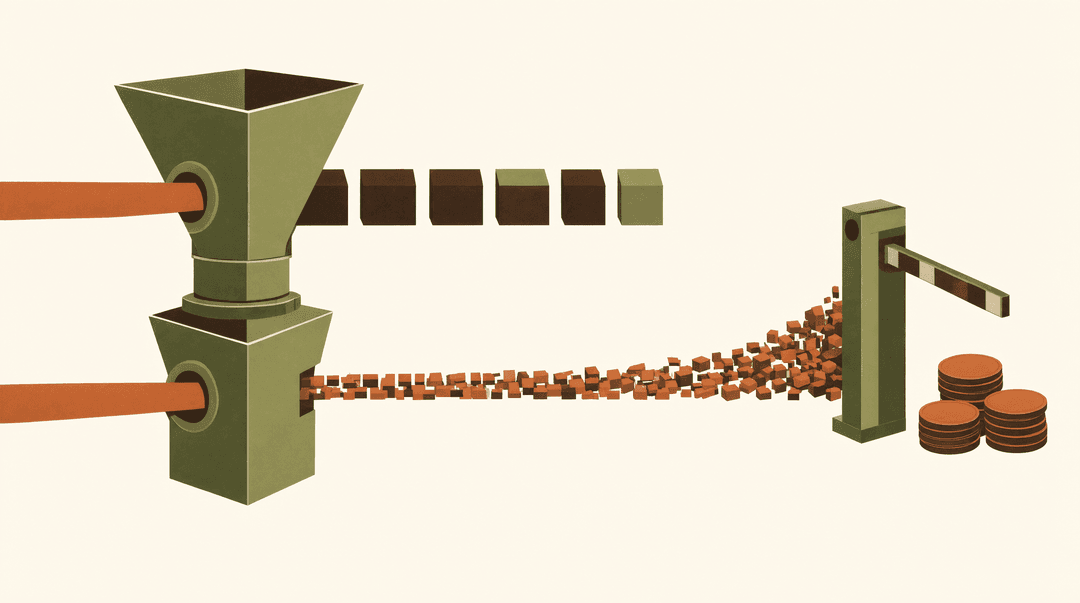
Before any of the above matters, the text has to be cut into tokens, and tokenizers trained mostly on Latin-script data cut other languages into smaller, more numerous pieces. A 2023 study led by Samuel Ahia measured this in Do All Languages Cost the Same? (EMNLP 2023): ChatGPT's tokenizer needed up to five times more tokens to convey the same information in non-Latin-script Indic languages, and API prices tracked the token count almost 1:1.
The effect has been quantified again more recently. A 2026 study by the Coalition for Language Equity in AI Research, reported by Rest of World, found that among the 20 most-used languages online the most expensive used between 1.5 and 5 times more tokens than the cheapest, and across 200 languages the gap grew to 17 times in one model. Script mattered more than speaker count: Asturian, with few speakers and no Common Crawl presence, got off lightly because it is Latin-script, while Burmese, Tibetan, Khmer, Lao, and Ol Chiki were consistently the most disadvantaged. More tokens means higher bills, slower generation, and, in a 128,000-token context window, materially less text a Kannada or Burmese user can fit than an English user.
Adding languages costs capacity
Multilinguality also trades against model size. Google Research's ATLAS study (arXiv:2510.22037) put the number of languages into the scaling law alongside parameters and data. Their finding: each added language imposes a mild capacity tax, offset by substantial positive cross-lingual transfer, but training with a multilingual vocabulary and fully multilingual data carries a compute-efficiency cost that falls hardest on English. For low-resource languages the constraint flips: they are data-constrained, not compute-constrained, which is why simply making a model bigger does not fix Swahili or Odia. A model cannot learn a language it has 30 billion tokens of, no matter how many FLOPs you give it.
What is being done about it
The levers map onto the causes. Data: per-language curation at scale, as in DatologyAI's 20-trillion-token ÜberWeb corpus, which reports better accuracy at a given FLOP budget across 13 languages than uniform mixing. Capacity: the NeurIPS 2024 neuron-level study showed that fine-tuning language-specific neurons with just 400 documents improved high-resource languages by 3.6% and low-resource languages by 2.3% on average without hurting the others. Tokenization: newer vocabularies shrink the gap, though recent measurements show current tokenizers still over-fragment compact non-Latin scripts. And post-training: LILT's attribution analysis found model-side causes (tokenizer inefficiency plus English-centric reasoning) drove over 70-80% of multilingual failures, which is why it argues for targeted post-training rather than translation-layer fixes.
For anyone shipping AI into non-English markets, the working conclusions are narrow and testable. Benchmarks translated from English measure translation artifacts as much as reasoning, so local review is part of evaluation, not a polish step. Aggregate multilingual scores hide language-level collapse, so demand per-language numbers. And the same prompt in your language is a different product than the same prompt in English: it costs more tokens, burns more of the context window, and lands on a model whose internal default is not your language.
Sources
- LILT, The Origin of Multilingual Performance Gap, March 2026
- Center for Democracy & Technology, Lost in Translation: Large Language Models in Non-English Content Analysis, May 2023
- Hugging Face, The FineWeb Datasets, NeurIPS 2024
- Chris Wendler et al., Do Llamas Work in English?, ACL 2024
- Tencent et al., How do Large Language Models Handle Multilingualism?, NeurIPS 2024
- Rachel Schut, Noam Gal, Do Multilingual LLMs Think in English?, 2025
- Samuel Ahia et al., Do All Languages Cost the Same? Tokenization in the Era of Commercial Language Models, EMNLP 2023
- Rest of World, The Tokenizer Tax, November 2026
- Google Research, ATLAS: Practical scaling laws for multilingual models, 2025 (paper: arXiv:2510.22037)
- Niklas Muennighoff et al., Scaling Data-Constrained Language Models, JMLR 2025
- DatologyAI, ÜberWeb: Insights from Multilingual Curation for a 20-Trillion-Token Dataset, 2026
- Is Sanskrit the Most Token-Efficient Language?, 2026
