
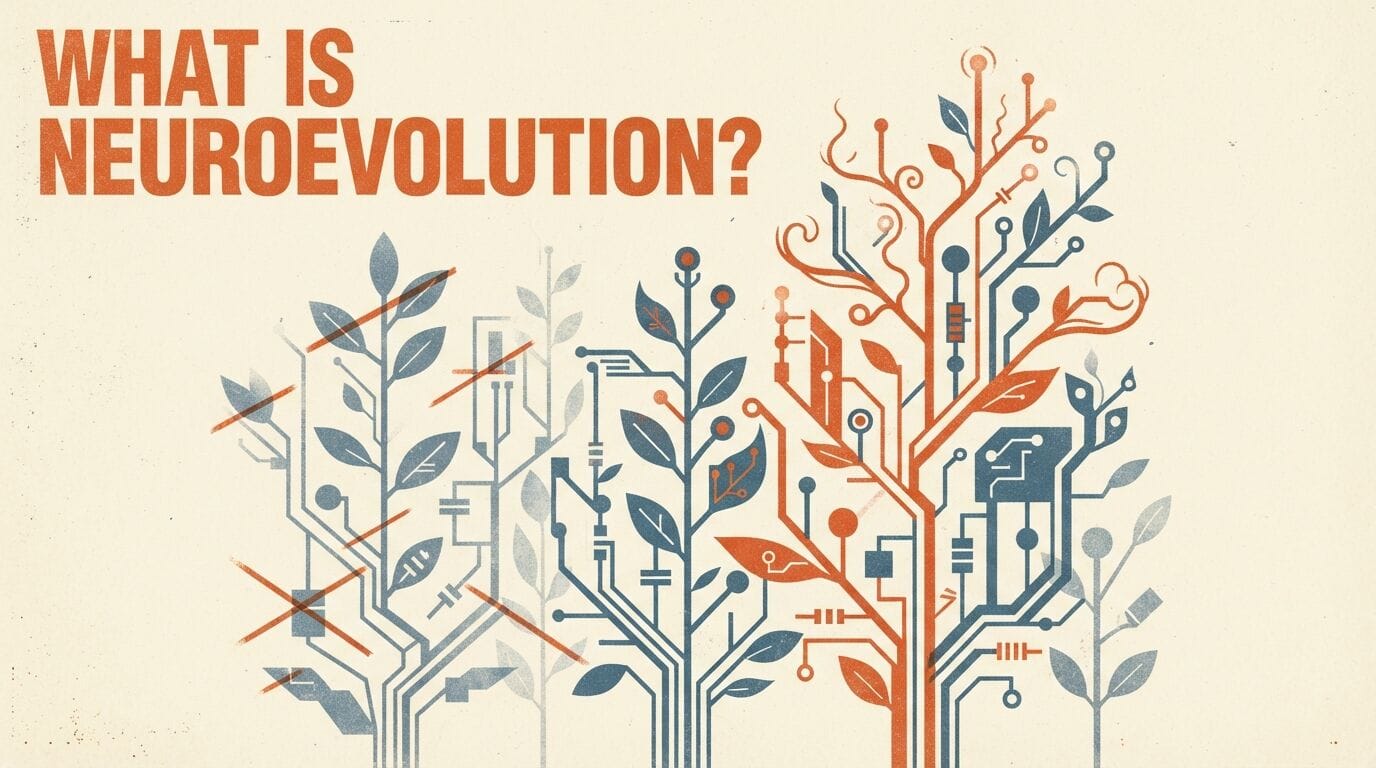
Almost everything written about how language models learn points to gradient descent: compute the direction that reduces the error, nudge billions of weights a little way down that slope, repeat. There is another lineage in machine learning that never computes a gradient at all. It keeps a population of candidate solutions, scores each one, throws away the weak ones, and reproduces the strong with small changes. For years, frontier labs treated it as a curiosity from the cybernetics era. In 2025, Google DeepMind used it to design algorithms that optimize the training of its own Gemini models, and a DeepMind-Sakana paper published in Nature Machine Intelligence built competitive language models by evolving combinations of existing ones, with no gradient-based training at all. This post explains what that machinery is, why gradients beat it once, and what changed.

What neuroevolution is
Neuroevolution means applying evolutionary algorithms to neural networks. The recipe has four parts. First, a population: many versions of the thing you want to improve, which can be network weights, network structures, merge recipes, or programs. Second, a fitness function: a score that says how good each candidate is, from total reward in a simulation to benchmark accuracy to kernel latency. Third, selection: keep the high scorers. Fourth, variation: produce the next generation by mutating survivors (small random perturbations) or recombining pairs of them. Iterate until the budget is gone.
Two families dominate. Evolution strategies (ES) perturb a single parameter vector, evaluate the offspring, and update the distribution that produced them. Genetic algorithms (GA) run tournament selection over structured candidates and use crossover, which is how you evolve things like network topologies, where the number of parts changes from generation to generation.
One honest caveat comes from OpenAI, whose 2017 blog post on evolution strategies caused a small stir: despite the word evolution, the method "has very little to do with biological evolution." The abstraction is loose. What survives is whatever the fitness function rewards, and there is no heredity in the biological sense. It is best read as a class of black-box stochastic optimization: a million numbers go in, one score comes out, and the algorithm probes the space by sampling.
Why gradients won the first round
Backpropagation, formalized for multilayer networks in Rumelhart, Hinton and Williams' 1986 Nature paper, gives every weight an explicit instruction: this is the direction you personally moved the error. Evolutionary search gets one number per whole organism and no information about which of the million parameters deserved credit. That asymmetry, called credit assignment, is why gradient descent dominated supervised learning.
The arithmetic is unforgiving. OpenAI reported in the same 2017 post that using ES to train on MNIST digit recognition could be "as much as 1,000 times slower than using backpropagation." Where you can compute the exact gradient of the loss, sampling candidates is a waste of budget.
Neuroevolution research kept going anyway. NEAT, published in 2002 in Evolutionary Computation 10(2), argued that evolution could "both optimize and complexify solutions simultaneously": it grew networks from minimal structure, evolving topology alongside weights and protecting each structural innovation through speciation, something fixed-architecture gradient descent cannot do because the parameter count is set before training starts.
The 2017 wake-up call
The modern revival starts with reinforcement learning, where the gradient you want is the gradient of expected reward, and you cannot compute it exactly; you estimate it from sampled episodes. That makes sampling methods competitive again.
OpenAI's 2017 paper showed ES matching the final performance of policy-gradient methods on MuJoCo physics benchmarks and Atari. The wall-clock numbers were the headline: a 3D humanoid walker trained in 10 minutes on a cluster of 80 machines with 1,440 CPU cores, where A3C on 32 cores took about 10 hours; Atari performance comparable to A3C with training cut from one day to one hour on 720 cores. The trick was that ES workers only need to exchange scalars, so it parallelizes almost for free. The price: in the blog's data-axis comparisons against TRPO, ES was less efficient "but no worse than about a factor of 10," and it still did not touch supervised learning, where exact gradients are cheap.
Google published a parallel result that year: a hierarchical walking policy trained with augmented random search, described as "a simple evolutionary optimization method," chosen because the two-level policy stack was not end-to-end differentiable and standard gradient RL algorithms like PPO and SAC simply could not be used.

From weights to whole designs
The next shift was to point evolution at structures around the network, where there is no gradient path at all.
Esteban Real and colleagues at Google evolved AmoebaNet-A, described in the paper as the first evolved image classifier to surpass human-crafted designs, reaching what the authors reported as a then state-of-the-art 83.9% / 96.6% accuracy on ImageNet at scale. Their modification was regularization by age: tournament selection favors younger genotypes, so a lucky early architecture cannot dominate the whole search. The paper also reported that evolution found good architectures faster than a reinforcement-learning search method with the same hardware, especially in the early stages.
AlphaCode ran the same logic over candidate programs. For competitive programming problems on Codeforces, DeepMind's system did not fine-tune its way to an answer; it sampled an enormous population of programs from a transformer and then filtered by observed behavior on test inputs, keeping an average ranking of top 54.3% in simulated competitions with more than 5,000 human participants. Generation was cheap because sampling is what language models do; selection did the work that a gradient normally would.
Evolving models, not weights
In February 2025, Akiba and colleagues published Evolutionary Model Merge in Nature Machine Intelligence. Instead of training, the method combines existing open models in parameter space and data-flow space, then evolves the combination recipes against benchmark scores. Sakana's write-up is blunt about what it means: the evolved models were produced "without the need for any gradient-based training." The flagship result, a 7B-parameter Japanese math model built from Mistral-7B, shisa-gamma, WizardMath and Abel models, topped a wide array of Japanese benchmarks, exceeding some previous 70B-parameter Japanese models, without being explicitly optimized for most of them. The search space is the open-weights commons: Hugging Face hosted more than 500,000 models at the time of writing, and the recipe style has since been implemented in mainstream tools like mergekit and Optuna Hub.
AlphaEvolve: putting an LLM in the mutation step
AlphaEvolve, announced in May 2025, is where the two histories meet. It is an evolutionary coding agent: Gemini Flash proposes broad sets of program mutations, Gemini Pro contributes deeper suggestions, automated evaluators verify and score each candidate, and the winners seed the next generation. The candidates are entire codebases, not weight vectors.
The reported results are concrete, because every fitness number is measurable. A scheduling heuristic it found for Borg has run in production for over a year and continuously recovers, on average, 0.7% of Google's worldwide compute resources. A Verilog rewrite it proposed was integrated into an upcoming Tensor Processing Unit. Evolving a matrix-division strategy sped up a kernel in Gemini's architecture by 23%, cutting Gemini training time by about 1%, and AlphaEvolve found up to a 32.5% speedup on a FlashAttention kernel by editing low-level GPU instructions that compilers usually leave alone. On the math side, it found a way to multiply 4x4 complex-valued matrices with 48 scalar multiplications, beating the algorithm that had been the best known since Strassen in 1969, and applied to more than 50 open problems it rediscovered state-of-the-art results in roughly 75% of cases and improved the best known results in about 20%, including a new lower bound for the 11-dimensional kissing number via a configuration of 593 spheres.
The inversion is worth noticing. In classic neuroevolution, mutation is blind noise. In AlphaEvolve, the mutation engine is a frontier model that has read a lot of code. Evolution supplies the selection pressure; the LLM supplies the creativity. DeepMind notes the loop is self-supporting: some of the algorithms AlphaEvolve discovered are used in the training of the very Gemini models that power AlphaEvolve.
What to take away
Three rules separate the method from the reputation.
Gradients still run the core. Language models are pretrained and fine-tuned with backpropagation; OpenAI's 1,000-times-slower MNIST result explains why nobody is evolving a 235B-parameter weight vector by perturbation.
Evolution thrives where scores exist but gradients do not. Kernel latency, unit-test pass rates, scheduling throughput, benchmark suites, merge recipes: all measurable, none differentiable. As AI systems became measurable at everything they do, the black-box condition that made evolution weak for MNIST turned into the condition that makes it strong for design.
The organism got cheaper. Early ES evolved weight vectors directly. Real et al. evolved architectures. AlphaCode evolved programs. EvoLLM-JP evolved recipes over models that already exist. AlphaEvolve evolved entire codebases. At every step, the unit of selection moved from expensive weights to cheap artifacts, and a cheap artifact can be scored a thousand times per generation.
The sample cost is still the honest weakness, and it is real: OpenAI's own MNIST number has not been repealed. What changed is that a scoring loop with an LLM proposing the variations is no longer obviously the slow way round. It is how one of the largest AI labs in the world now optimizes its data centers, its chips and, indirectly, its own training runs.
Sources
- Rumelhart, Hinton & Williams, Learning representations by back-propagating errors, Nature 323, 1986
- Stanley & Miikkulainen, Evolving Neural Networks through Augmenting Topologies, Evolutionary Computation 10(2), 2002
- Salimans, Ho, Chen, Sidor & Sutskever, Evolution Strategies as a Scalable Alternative to Reinforcement Learning, arXiv 2017, and OpenAI's blog post, 2017
- Google Research, Agile and Intelligent Locomotion via Deep Reinforcement Learning, 2017
- Real, Liang, So & Le, Regularized Evolution for Image Classifier Architecture Search, AAAI 2019
- Li et al., Competition-Level Code Generation with AlphaCode, Science 378, 2022
- Akiba, Shing, Tang, Sun & Ha, Evolutionary optimization of model merging recipes, Nature Machine Intelligence 7, February 2025; Sakana AI's announcement
- Google DeepMind, AlphaEvolve: A Gemini-powered coding agent for designing advanced algorithms, May 2025
