

Encryption has two old jobs. It protects data that sits still, on a disk or in a database, and it protects data that moves, across a network or between two services. It has never protected data while a processor works on it. To multiply two matrices, compare two genomes or generate the next token, the values must be decrypted into plain text somewhere a machine can reach them. For most of computing history that gap was accepted as the cost of doing business. Confidential computing is the attempt to close it, and the AI industry has quietly become its best customer.
The Confidential Computing Consortium, a Linux Foundation project founded in 2019 by Alibaba, Arm, Google Cloud, Huawei, Intel, Microsoft and Red Hat, puts it in one sentence: confidential computing is "the protection of data in use by performing computation in a hardware-based, attested Trusted Execution Environment." Everything interesting is packed into that definition. This explainer unpacks it piece by piece: what the hardware actually does, why model weights and prompts both want it, what it costs in performance, and where the physics still leaks.
The vault inside the processor
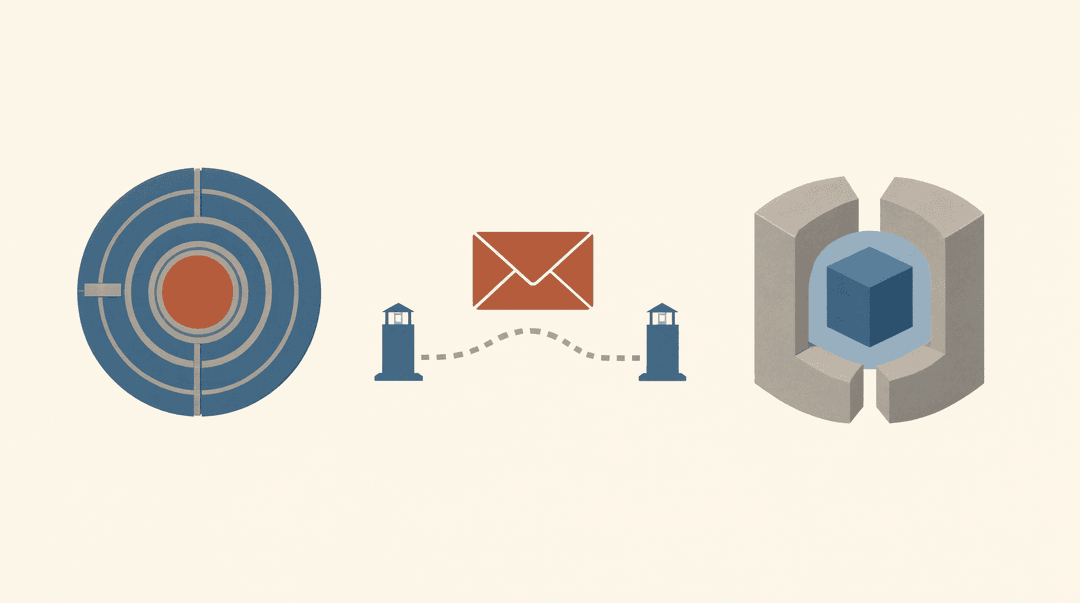
A Trusted Execution Environment (TEE) is a region of a processor that the rest of the machine cannot read. Not the operating system, not the hypervisor, not the administrator with root access. Only the chip itself sits above the code that runs inside.
Two design traditions built the modern market. Intel's Software Guard Extensions (SGX), introduced in 2013, encrypts small application-level enclaves and excludes even a kernel debugger from their memory. AMD's Secure Encrypted Virtualization (SEV), announced in 2016 and hardened into SEV-SNP in 2020, takes the whole virtual machine: every guest's memory is encrypted per-VM, so an existing workload can move in without code changes. Intel's TDX does the same for its chips, Arm extends the idea with Realms on its server CPUs, and AWS built its own variant, Nitro Enclaves, on the virtualization hardware of its servers from October 2020 onward. The practical difference between enclave and confidential-VM styles is what you have to rewrite: SGX-style isolation demands a purpose-built application, lift-and-shift isolation demands almost nothing but runs a larger trusted base.
None of this depends on math alone. Memory encryption is only half of it. The hardware also signs a statement about what is running inside it, an attestation report, so a third party can verify the vault is genuine and untampered before handing it anything secret. That combination, isolation plus proof, is what separates a TEE from "please trust our sysadmins."
Why AI grew two problems this technology solves
For a decade, TEEs served narrow niches: payment keys, DRM, one short-lived wave of blockchain smart contracts. The LLM era gave them two much bigger customers, with opposite demands.
The enterprise problem is the prompt. A hospital, a bank or a defense contractor wants to run sensitive data through a model it does not own, on hardware it does not control. Encryption at rest and TLS in transit still leave the raw request, the intermediate activations and the output in plain text inside the cloud provider's memory, readable in principle by anyone with enough privilege on the host. Microsoft's pitch for Azure confidential computing, announced in 2019, was exactly this: data processed "with the assurance that it is always under customer control."
The lab problem is the weights. Frontier model files are among the most valuable objects in the economy, and they are decrypted into GPU memory on servers that someone else administrates. NVIDIA's own framing of the risk is blunt: "for model providers, the biggest risk is the theft of proprietary model weights by the infrastructure owner." The same hardware answer fits both sides because the trust gap is symmetric: neither party wants the operator of the physical machine in its circle of trust.
The GPU breaks out of the CPU's cage
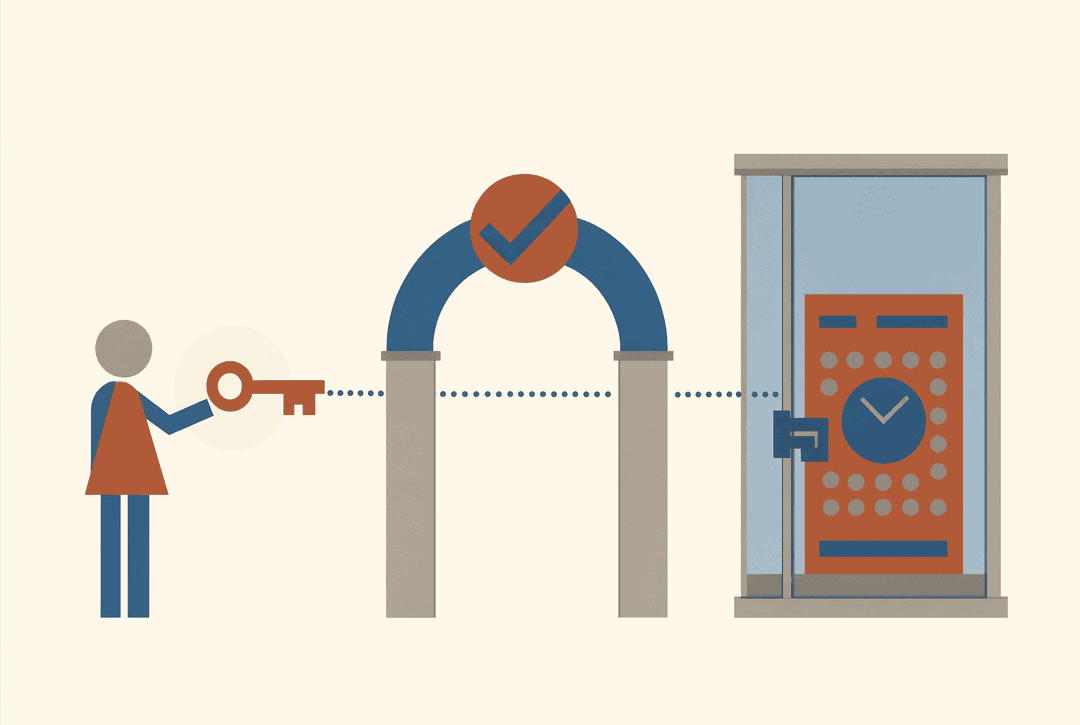
The original TEEs lived on CPUs, which became a joke for AI: the part doing the actual multiplication sat outside the vault. NVIDIA's H100 changed that as the first GPU with hardware support for confidential computing. When booted in CC-On mode, the GPU runs a measured secure boot, opens an encrypted SPDM session with the CPU's TEE, and generates a cryptographically signed attestation report of its own firmware and state. Model weights, activations and the KV cache sit in protected GPU memory, and traffic crossing the PCIe bus between CPU and GPU passes through encrypted bounce buffers. The client checks the report, and only if it verifies does a key broker release the decryption keys for the model image. The weights never exist in plain text outside the verified chip.
This is what confidential AI deployments look like in production today. Azure's confidential H100 virtual machines went GA in late 2024 alongside a confidential inference service for OpenAI models, starting with Whisper. Google's Private AI Compute, described in late 2024 for its consumer Gemini services, runs the frontend in AMD-based confidential VMs and the TPUs on a hardened platform with zero shell access for any operator, Google's own included. The Linux Foundation's consortium now pitches the technology directly at agent workloads: encrypted memory for agent state, attestation before any secret is released, protection against "model weight theft ... by malicious insiders or compromised infrastructure." Vendors moved with it: Fortanix launched a confidential AI inference stack in March 2026, VAST Data announced a DataEnclave product in September 2026 on NVIDIA's third generation of confidential compute (Hopper, Blackwell, Rubin), and NVIDIA used its CES 2026 keynote to push rack-scale encryption as an enterprise AI security feature.
What it costs
The question every infrastructure buyer asks is whether the vault slows the model down. The published measurements say: usually less than you fear, with bad cases.
The widely cited September 2024 benchmark of LLM inference on H100s in TEE mode found overhead under 7% for typical queries and traced the cost to CPU-GPU data transfer, not the encryption itself: time-to-first-token took 19% longer on a small model while inter-token latency took only 7.7% longer, and larger models and longer sequences saw near-negligible penalties. An IISWC 2025 comparison of CPU and GPU TEEs found CPU enclaves impose under 10% throughput overhead and GPU TEEs 4 to 8%, shrinking as batches grow. NVIDIA's own Blackwell numbers, on DeepSeek-R1 across eight B200s, claim 96 to 98% of baseline token throughput retained with 1.2 to 4.3% per-token latency overhead. The consistent pattern across studies: confidentiality is cheap per token when the GPU is busy and expensive when a single request waits on secure transfers, and optimizations that add CPU-GPU round trips, such as speculative decoding, can triple the penalty in the worst regime.
What the vault does not protect
Honesty requires the list of holes, and it is a long one.
The physics leaks. SGX's promise of isolation was picked apart by a decade of side-channel research: page-table attacks let the OS steer enclave execution, and the 2019 Foreshadow attack used a speculative execution flaw to read enclave memory outright and extract the attestation keys themselves, letting attackers forge "genuine" enclave proofs. In 2025, the TEE.fail researchers went further: a memory-bus interposer built from secondhand parts for under $1,000 let them observe DDR5 traffic and exploit deterministic encryption to extract attestation keys from Intel SGX, Intel TDX and AMD SEV-SNP systems whose attestation status was fully trusted. The practical lesson is that TEE guarantees are per-generation cat-and-mouse games against physical access, not absolute walls.
The perimeter ends at the package. Confidential computing secures chips, not the wires between them. Traffic crossing PCIe is encrypted with a cost, and at cluster scale the seams multiply: a USENIX Security 2025 survey of AI workloads found the hard open problems are attestation and key management across whole accelerators racks, secure interconnects and device memory, exactly the parts a single-GPU TEE paper glosses over. Multi-GPU and multi-node confidential training therefore carries weaker guarantees than the marketing suggests.
And the trust moved rather than vanished. A TEE makes Intel, AMD or NVIDIA part of your trusted computing base, and it says nothing about the code inside the vault. A confidential deployment proves which model image runs where; it does not prove the operator is honest, the pipeline is clean, or the output is good. Fully homomorphic encryption, which computes on ciphertext directly, would remove the hardware trust assumption, but nothing close to LLM-scale performance exists. One Meta researcher's public objection to confidential-AI marketing captures the limit well: a TEE can stop a remote cloud operator from reading your data, but it is a systems integration of known primitives, not a new privacy guarantee.
The takeaway
Confidential computing replaces a contract with a measurement. The old answer to "will the cloud see my prompts or my weights" was an agreement, an audit and a compliance badge. The new answer is a signed report from the silicon, verifiable before the keys are handed over, at a single-digit percent cost in the regime enterprises care about. That is a real change, and a bounded one: side channels, interconnect gaps and the vendors' own roots of trust keep the promise conditional. For AI specifically, the interesting consequence is structural. If both ends of the inference transaction can verify the hardware instead of each other, the frontier model and the regulated data can finally meet on someone else's machine.
Sources
- Confidential Computing on NVIDIA H100 GPUs for Secure and Trustworthy AI, NVIDIA Technical Blog
- Building a Zero-Trust Architecture for Confidential AI Factories, NVIDIA Technical Blog
- Enabling Private High-Performance Production AI Inference with NVIDIA Confidential Computing, NVIDIA Technical Blog
- Confidential Computing Consortium formation press release, Linux Foundation
- Confidential Computing Consortium definition and agentic AI response
- Introducing Azure confidential computing, Microsoft Azure Blog
- Azure Confidential Computing Overview and product portfolio, Microsoft Learn
- Azure AI Confidential Inferencing announcement, Mark Russinovich
- Google Private AI Compute technical brief (PDF)
- Confidential Computing on NVIDIA Hopper GPUs: A Performance Benchmark Study (arXiv 2409.03992)
- Confidential LLM Inference: Performance and Cost Across CPU and GPU TEEs, IISWC 2025
- How does NVIDIA Confidential Computing impact Inference and Training Performance, Tinfoil
- Trusted Hardware for AI Workloads, USENIX Security 2025
- TEE.fail: Breaking Trusted Execution Environments via DDR5 Memory Bus Interposition
- Foreshadow: Extracting the Keys to the Intel SGX Kingdom, USENIX Security 2018
- Confidential computing platform-specific details, Red Hat
- Enhancing AI inference security with confidential computing, Red Hat Emerging Technologies
- Getting Started with AWS Nitro Enclaves, AWS Compute Blog
- Arm Confidential Compute Architecture
- Trusted execution environment, Wikipedia
- Fortanix Confidential AI press release, March 2026
- VAST DataEnclave announcement, September 2026
