
In October 2024 the Nobel Prize in Physics went to John Hopfield and Geoffrey Hinton "for foundational discoveries and inventions that enable machine learning with artificial neural networks." Hopfield's share was awarded for a paper he published in 1982: a model of memory in which a network of simple on-off neurons settles into stored patterns like a ball rolling into a valley. For four decades it was a respected museum piece, quietly displaced by models that could be trained with gradients. Then, in 2020, a group of researchers proved something odd. The central mechanism of every modern large language model, the attention operation, is mathematically identical to one update step of Hopfield's 1982 network. The museum piece turned out to be a blueprint.
What the 1982 network is
Hopfield's model is a recurrent network of N binary neurons, each either firing or silent, usually written as +1 or -1. Every neuron is connected to every other neuron, and the connections are symmetric: the weight from neuron i to neuron j equals the weight from j to i. That symmetry sounds like a minor bookkeeping choice. It is the whole trick, because it lets you describe the network with a single number, an energy function, that can only go down as neurons update.
The network updates one neuron at a time. Neuron i looks at the weighted sum of all other neurons' states, and flips to +1 if that sum is positive, -1 if it is negative. Each such flip either lowers the total energy or leaves it unchanged, and Hopfield showed the network must therefore come to rest in a local minimum of the energy landscape. The network has no clock, no training loop, no loss being optimized at runtime. It just relaxes.
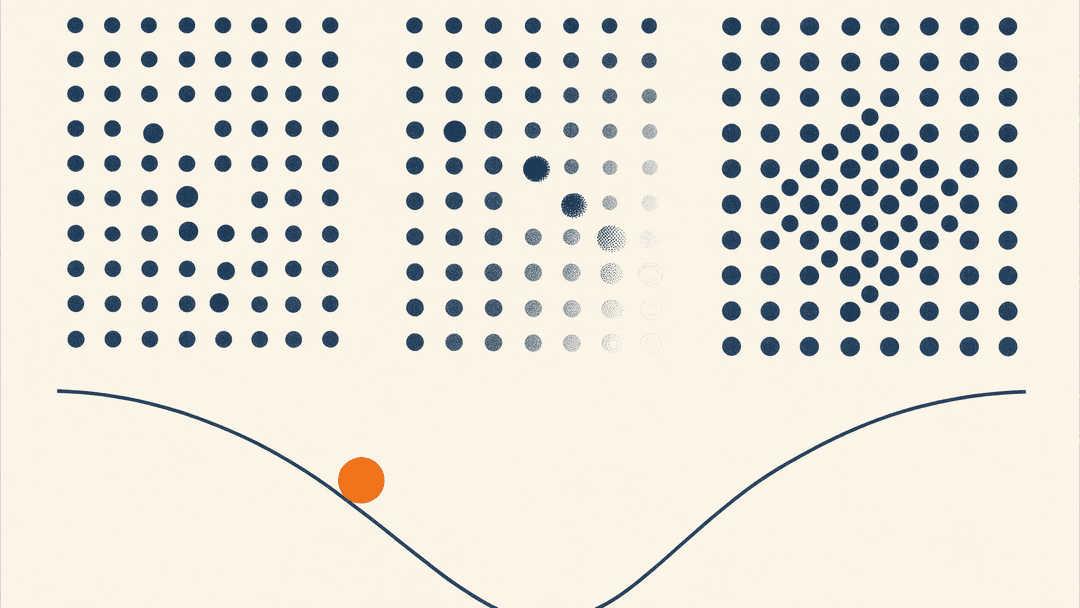
Memories are the resting states. To store a pattern, Hopfield used a Hebbian rule, often summarized as "neurons that fire together wire together": if two neurons are on in the same stored pattern, strengthen their connection; if one is on and the other off, weaken it. Retrieval is then dynamics rather than lookup. Present the network with a partial or corrupted version of a stored pattern, and the relaxation process carries the state downhill into the nearest local minimum. You do not address memory by location. You address it by resemblance. That is why this class of models is called associative or content-addressable memory, and it is the reason the brain-inspired framing mattered: human recall works more like cue-and-completion than like a computer's RAM.
The capacity problem
The classic model has two hard limits. The first is storage. With the simple Hebbian rule, a network of N neurons holds roughly 0.138N retrievable patterns, per the analysis of the statistical mechanics of the model. A 1,000-neuron network remembers about 138 items and starts confusing them beyond that. The second is infrastructure. Binary units, hand-written learning rules, and no differentiable path through the dynamics made the model a poor fit for the gradient-trained, backpropagated networks that took over machine learning from the late 1980s onward. Wikipedia's summary of the situation is blunt: classical Hopfield networks are rarely used in modern machine learning.
Dense associative memory: fixing the capacity
In 2016, Dmitry Krotov and Hopfield himself published a change to the energy function that broke the linear ceiling. Instead of summing pairwise interactions between neurons, Dense Associative Memory for Pattern Recognition lets the energy depend on a steeper function of the overlap between the current state and each stored pattern, for example the overlap raised to a power k. The practical consequence: the network can store and reliably retrieve many more patterns than it has neurons, with capacity growing polynomially with network size rather than linearly. The same paper noticed something else that would matter later: the retrieval step in these models looks a lot like the hidden layer of an ordinary feedforward network. Krotov and Hopfield sketch a duality between associative memories and deep networks with one hidden layer.
A 2017 follow-up by Demircigil and colleagues pushed further, showing that with an interaction function that grows exponentially, storage capacity grows exponentially with the dimension of the stored patterns, provided each neuron still participates in only a small number of patterns. The bottleneck of 1982 was not physics. It was the choice of energy function.
Attention turns out to be Hopfield retrieval
The 2020 paper Hopfield Networks is All You Need, from Hubert Ramsauer and colleagues at the Linz Institute of Technology with Sepp Hochreiter, carried this line to its punchline. The authors define a modern Hopfield network with continuous, vector-valued states and an update rule: take the similarity of the current cue against every stored pattern, pass those similarities through a softmax, and return the weighted average of the stored patterns. They show this network stores an exponentially large number of patterns in the pattern dimension, converges to the stored pattern in a single update, and has exponentially small retrieval error.
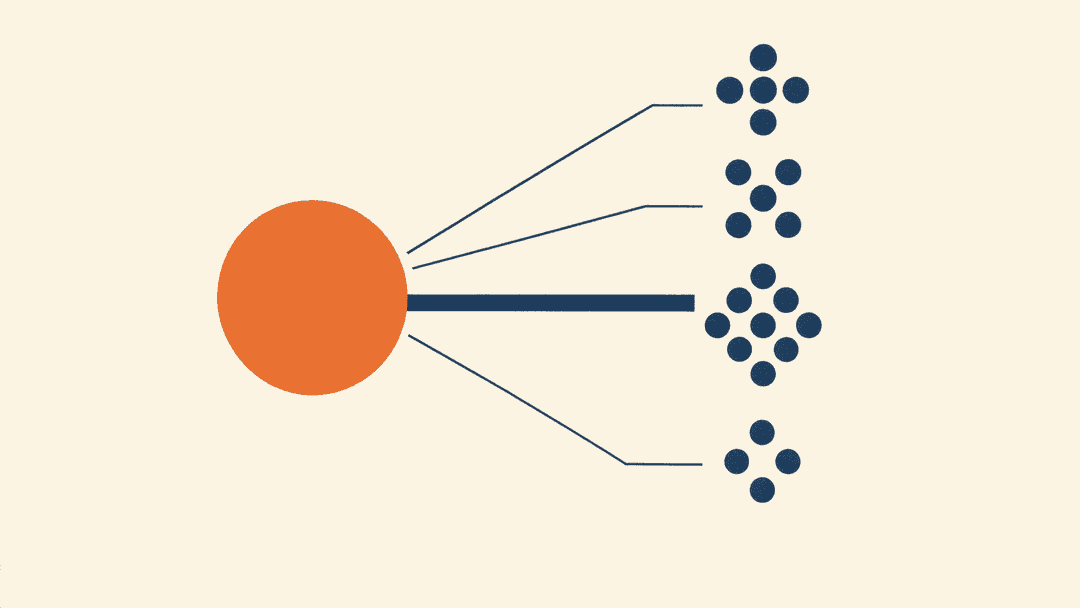
Then they observe the identity. Transformer attention computes exactly this: a query vector scores itself against key vectors, a softmax converts the scores into weights, and the output is a weighted average of value vectors. Set the stored patterns equal to the keys and the cue equal to the query, and attention is one retrieval step of a modern Hopfield network.
The equivalence works the other direction too. The paper uses the energy-function view to characterize what trained attention heads actually do. Looking at BERT, the authors find that first-layer heads mostly average over all tokens (the global minimum of the energy landscape), while heads in higher layers settle into metastable states that average over a subset of tokens, the regime where gradients flow most strongly.
Two cautions keep the claim honest. First, this is an identity of operations, not a lineage: Vaswani and colleagues did not derive the transformer from Hopfield's papers in 2017; the equivalence was proven afterward. Second, it covers the attention operation alone. Residual connections, layer norms, MLP blocks and training procedure are outside the correspondence.
What the equivalence buys
Since 2020 the Hopfield view has been used as design guidance rather than trivia. The Energy Transformer, from Benjamin Hoover, Dmitry Krotov and colleagues, rebuilds transformer attention as a sequence of layers that each descend an explicitly engineered energy function, reporting competitive results on image completion, graph anomaly detection and graph classification. It is what a transformer looks like when you take the Hopfield interpretation seriously and make the whole network a dynamical system minimizing one global energy.
The identity also imports a literature of limits. A 2024 paper by Cao et al. analyzes the computational expressiveness of modern Hopfield networks through circuit complexity and shows that constant-depth versions are confined to the class TC0: they cannot solve certain structurally hard problems, such as the word problem for the symmetric group S5, without being unrolled. Chain-of-thought style sequential updates, the paper shows, push the same models past that ceiling. The result rhymes uncomfortably with a familiar empirical observation: reasoning tokens buy transformers capabilities that single forward passes do not.
Why it deserves a place in your mental model
Most explainers present attention as a lookup: a query asking for information, keys being matched, values being returned. The Hopfield framing says the lookup is retrieval from associative memory, the same computation a damaged photograph triggers in a 1982 neural model: present a partial cue, land on the most similar stored item. It explains why attention returns blends rather than single items when a cue is ambiguous (metastable states), why sharpness of retrieval is a temperature-like dial (the scaling inside the softmax), and why attention looks like content-addressable memory rather than RAM.
Hopfield's Nobel came with a warning attached: in the press conference after the award he said he was "very unnerved" by recent advances in AI capabilities. His 1982 paper's most durable legacy may be that the field kept it long enough to notice it had been shipping attention all along.
Sources
- https://www.nobelprize.org/prizes/physics/2024/summary/
- https://en.wikipedia.org/wiki/John_Hopfield
- Hopfield, J. (1982). Neural networks and physical systems with emergent collective computational abilities. PNAS. https://www.pnas.org/doi/10.1073/pnas.79.8.2554
- Hopfield network. Wikipedia. https://en.wikipedia.org/wiki/Hopfield_network
- Krotov, D., Hopfield, J. (2016). Dense Associative Memory for Pattern Recognition. https://arxiv.org/abs/1606.01164
- Demircigil, M. et al. (2017). On a model of associative memory with huge storage capacity. https://arxiv.org/abs/1702.01929
- Ramsauer, H. et al. (2020). Hopfield Networks is All You Need. https://arxiv.org/abs/2008.02217
- Hoover, B. et al. (2023). Energy Transformer. https://arxiv.org/abs/2302.07253
- Cao, Y. et al. (2024). Modern Hopfield Networks Require Chain-of-Thought to Solve NC1-Hard Problems. https://arxiv.org/abs/2412.05562
