
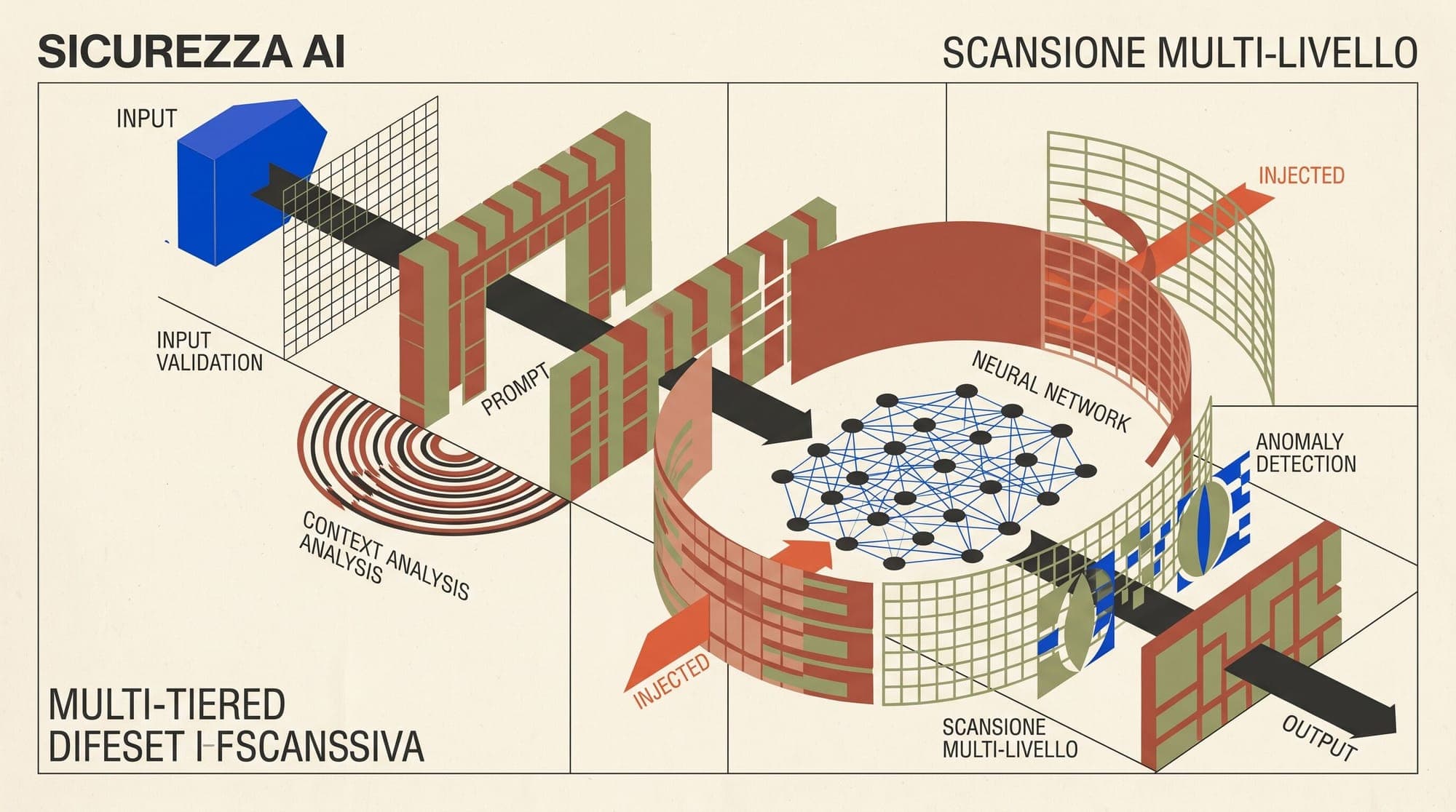
Prompt injection remains one of the primary operational vulnerabilities facing production Large Language Model (LLM) deployments. As systems expand from isolated chat interfaces into autonomous agents with access to databases, web browsing, APIs, and file systems, the blast radius of an unmitigated injection attack shifts from offensive output generation to unauthorized tool invocation and systemic data exfiltration.
Standard input sanitization methods developed for traditional software engineering fail against prompt injections because LLMs process system instructions and user-supplied data within the same token stream. To mitigate direct attacks (such as instruction bypasses and jailbreaks) as well as indirect attacks (where malicious instructions are embedded within retrieved documents, emails, or API responses), engineering teams deploy dedicated defense frameworks.
This analysis evaluates four leading open-source prompt injection defense systems: Rebuff, Vigil, LLM Guard, and Meta Prompt Guard. We examine their underlying detection mechanics, scanning pipelines, latency overhead, and trade-offs in production environments.
The Core Defense Modalities
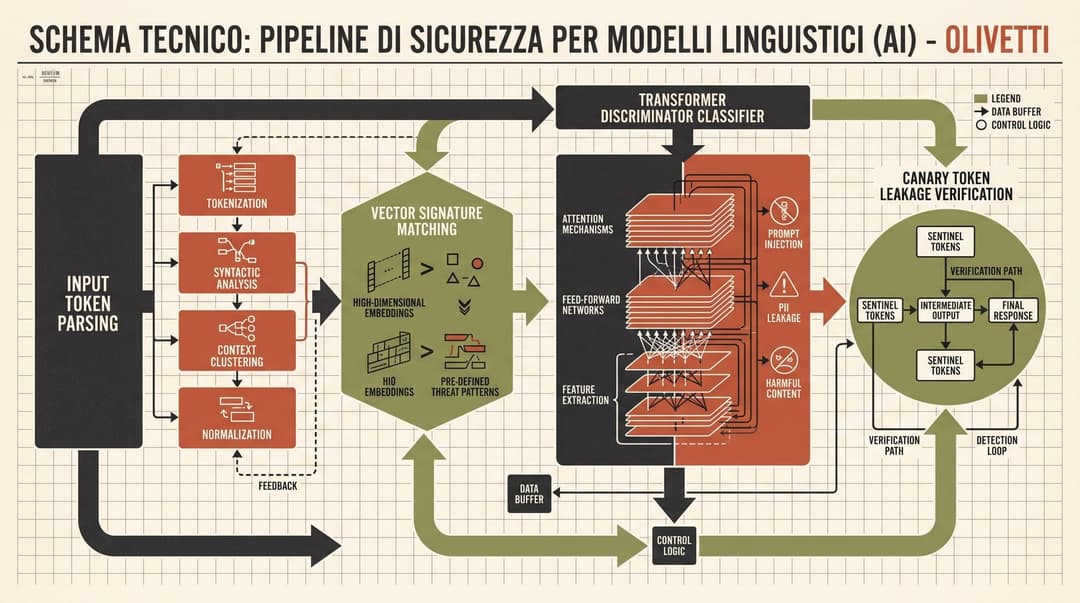
Modern prompt injection defense frameworks employ a combination of five distinct technical mechanisms:
- Heuristic and Rule-Based Matching: Regex patterns and YARA signatures designed to catch known jailbreak framing, structural markers, and common evasion keywords.
- Vector Similarity Search: Embedding incoming queries and comparing cosine similarity against curated databases of known malicious injections and jailbreak templates.
- Specialized Transformer Classifiers: Lightweight discriminative encoder models (typically based on DeBERTa-v3 or RoBERTa architectures) fine-tuned on binary or multi-class injection and jailbreak datasets.
- Secondary LLM Evaluators: Prompting a fast secondary language model (or judge) to inspect the candidate input for adversarial intent prior to execution by the primary model.
- Canary Tokens: Injecting dynamic, cryptographically random strings into the system prompt and monitoring the final model completion to detect prompt leakage and instruction overwriting.
Each framework configures and chains these modalities differently, yielding distinct latency, throughput, and error profiles.
Framework Architectures
1. Rebuff
Rebuff is an open-source, self-hardening prompt injection detection framework originally integrated into the LangChain and Protect AI security ecosystems. It structures defense into four sequential layers:
- Heuristic Filtering: A fast regex and rule engine that screens out common adversarial structural patterns.
- Vector Database Lookup: An embedding similarity check against a database of previously recorded prompt injection attacks.
- LLM-Based Analysis: A call to a dedicated secondary model (such as GPT-3.5 or Claude) tasked with evaluating whether the input attempts an injection attack.
- Canary Token Insertion: Dynamic insertion of secret canary tokens into the system prompt, coupled with an output validator that detects if the token leaks into generated responses.
Rebuff's defining architectural feature is its self-hardening mechanism: when an injection bypasses early layers but triggers canary leakage in the output, the original input is automatically vectorized and committed to the vector database, preventing identical and near-neighbor variations from succeeding in future requests.
2. Vigil
Vigil is a modular security scanner developed by deadbits that assesses both inputs and outputs across customizable scanner modules. It is available as an importable Python library and as a standalone REST API service.
Vigil's default detection pipeline integrates four primary scanners:
- YARA Scanner: Evaluates inputs against compiled YARA signature rules targeting instruction bypass phrases, prefix injections, and common roleplay jailbreak formats.
- Vector Database Scanner: Computes embeddings of incoming text and performs approximate nearest neighbor search across vector indexes (supporting Chroma and Pinecone) seeded with known attack vectors.
- Transformer Scanner: Runs incoming text through dedicated sequence classification models (such as
deepset/deberta-v3-base-injection). - Prompt-Response and Canary Checkers: Analyzes semantic drift between prompt and completion and inspects output text for predefined canary tokens.
Vigil's architecture emphasizes configurable confidence scoring and modularity, allowing operators to disable heavy scanners or adjust confidence thresholds per scanner.
3. LLM Guard
LLM Guard is a security toolkit developed by Protect AI providing over 35 distinct input and output scanners. While Rebuff and Vigil focus primarily on prompt injection and jailbreaks, LLM Guard functions as a broader runtime firewall covering data loss prevention (DLP), personally identifiable information (PII) anonymization, toxicity, and code injection.
For prompt injection specifically, LLM Guard provides a dedicated PromptInjection input scanner:
- Encoder-Based Discrimination: The scanner relies on fine-tuned transformer classifiers, including
protectai/deberta-v3-base-prompt-injection-v2, to generate a probability score for malicious intent. - Configurable Thresholding: Operators define strict numerical cutoffs (e.g., threshold 0.5) to balance detection sensitivity against false rejection rates.
- Integrated Pipeline Execution: Input scanners run in sequence with memory vaults, enabling PII redaction and prompt injection checks within a single unified pre-inference step.
LLM Guard is designed for high-throughput environments and can run embedded in application runtimes or as a containerized microservice behind an API gateway.
4. Meta Prompt Guard
Meta Prompt Guard (part of Meta's Purple Llama safety initiative, including Prompt-Guard-86M and Llama Prompt Guard 2) takes a focused, model-centric approach. Instead of providing an orchestration framework with vector databases or rules, Meta ships a specialized 86-million-parameter encoder model based on mDeBERTa-v3-base.
Key architectural characteristics include:
- Three-Way Classification: The model outputs logits across three discrete labels:
benign,injection(direct or indirect instruction tampering), andjailbreak(attempts to bypass safety filters). - Minimal Parameter Footprint: At 86M parameters, the model requires under 200MB of memory in FP16 precision, allowing it to execute locally on CPU or share GPU memory with primary serving runtimes.
- Single-Pass Execution: Eliminates external dependencies such as vector databases, secondary LLM API calls, or regular expression parsing.
Comparative Evaluation and Trade-offs
Choosing a prompt injection defense architecture requires balancing detection recall, false positive rates, operational complexity, and latency overhead.
Latency and Throughput Overhead
- Meta Prompt Guard: Lowest latency overhead. Running inference on an 86M parameter encoder adds 2ms to 8ms on GPU and 15ms to 40ms on standard CPU cores. It introduces zero network overhead.
- LLM Guard (PromptInjection Scanner): Low latency overhead. Running its DeBERTa-v3 base classifier adds approximately 10ms to 25ms on GPU and 30ms to 70ms on CPU. Additional input scanners (e.g., PII anonymization, toxicity) add additive latency.
- Vigil: Moderate latency overhead. The combined YARA rule matching and vector database retrieval step adds 15ms to 50ms, plus 15ms to 30ms for transformer evaluation, resulting in 30ms to 80ms total overhead per scanned input.
- Rebuff: Highest latency overhead when secondary LLM evaluation is enabled. While heuristic and vector checks take under 40ms, querying an auxiliary LLM judge adds 300ms to 1500ms of network and generation latency per request, making it impractical for latency-critical user-facing applications unless reserved for high-risk inputs.
Detection Accuracy and False Positive Dynamics
Empirical evaluations, including comparative benchmarks published on arXiv (Enhancing Security in LLM Applications), highlight critical trade-offs between precision and recall:
- Vector Search Limitations: Vector similarity matching excels at catching verbatim and near-paraphrased variants of public jailbreaks. However, semantic embeddings often fail against novel syntactic encodings, multi-turn payload splitting, or obfuscated payloads (such as base64, leetspeak, or token fragmentation).
- Transformer Classifier Generalization: Specialized models like DeBERTa-v3 (used in LLM Guard and Vigil) and Prompt Guard demonstrate strong out-of-distribution generalization across zero-shot adversarial patterns. However, they are sensitive to input length and can exhibit higher false positive rates on benign technical prompts containing programming syntax or prompt-engineering instructions.
- The False Positive Bottleneck: In production enterprise applications, a 1% false positive rate translates to hundreds of blocked legitimate user workflows daily. Meta Prompt Guard and LLM Guard allow fine-tuning decision thresholds to align with organizational risk tolerance.
Production Implementation Strategy
In enterprise architectures, relying on a single defense layer is insufficient. Production deployments benefit from a tiered defense-in-depth pipeline:
- Tier 1: Fast Structural and Pre-filtering Checks: Run regex/YARA rules to intercept known evasion sequences and exploit patterns with sub-millisecond overhead.
- Tier 2: Dedicated Discriminator Inference: Route clean inputs through a dedicated small encoder model (such as Meta Prompt Guard 86M or LLM Guard's DeBERTa classifier) to block direct injections and jailbreaks before LLM dispatch.
- Tier 3: Context Boundary Isolation for RAG: For indirect prompt injection defense, wrap external retrieved data in strict delimiter tags (e.g., XML blocks) and enforce structural prompt templates that instruct the model to treat retrieved contents strictly as passive data.
- Tier 4: Canary Token Verification: Insert dynamic canary tokens into system prompts for privileged tools or internal administrative agents to catch prompt extraction and instruction overrides post-generation.
- Tier 5: Principle of Least Privilege in Tool Design: Ensure downstream API integrations and database execution tools enforce strict schema validation, read-only permissions, and confirmation gates for destructive actions rather than relying solely on upstream prompt filtering.
Sources
- Protect AI Rebuff Repository
- Deadbits Vigil Repository
- Protect AI LLM Guard Documentation and Codebase
- Meta Purple Llama Prompt Guard Model Card
- Hugging Face Meta Prompt Guard 86M Repository
- Enhancing Security in LLM Applications: A Performance Evaluation of Early Detection Systems (arXiv)
- LangChain Blog: Rebuff Detecting Prompt Injection Attacks
