

The bet that failed
In the second half of 2025, three well-funded companies made the same wager: that consumers would abandon Chrome and adopt a new browser rebuilt around an AI assistant. OpenAI shipped ChatGPT Atlas, a standalone macOS browser with agent mode and browsing memory, in October 2025. Perplexity had already launched Comet for desktop in July 2025 and made it free to all users in October. The Browser Company pushed Dia, its AI-first browser, with a $20/month Pro tier from August 2025.
By November 2026, the scoreboard is blunt. OpenAI retired Atlas on August 9, 2026, less than ten months after launch, and folded its capabilities into the ChatGPT desktop app, a Chrome extension, and a cloud browser that runs on OpenAI's own servers. The Browser Company announced on October 22, 2026 that Arc, its previous flagship, will stop working on December 22, 2026 as it consolidates on Dia. Meanwhile Chrome's share of page views rose to 68.79% worldwide in October 2026, up from roughly 65% through most of 2024, according to StatCounter.
The pattern is consistent: the agent survived, the standalone browser did not. What won is the extension. Anthropic's Claude in Chrome, Google's Gemini in Chrome with auto browse, OpenAI's ChatGPT Chrome extension, and Microsoft's Copilot in Edge all put an agent inside the browser people already use, on profiles with the logins already stored.
{: alt="Diagram of three agentic browser architectures: standalone browser, extension inside an existing browser, and cloud-hosted browser"}
The three shapes, compared
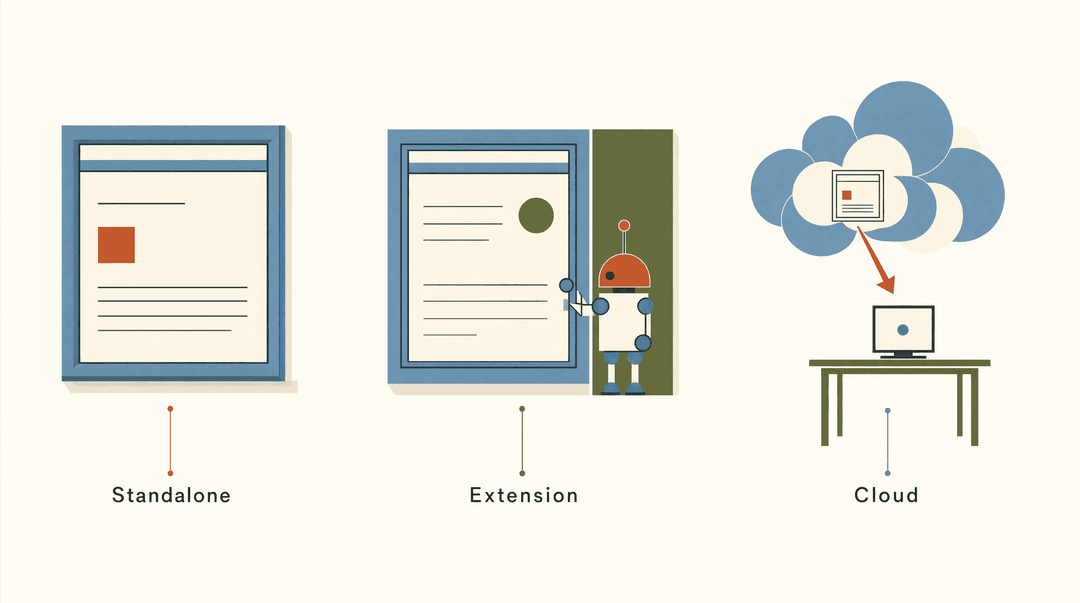
The market settled into three architectures, each with a different cost to the user.
Standalone AI browsers replace Chrome entirely. The two survivors are Perplexity Comet and Dia, with Opera Neon as a smaller third player. Comet runs on macOS, Windows, iOS and Android and remains free at the core, with Perplexity Pro at $20/month and Max at $200/month raising limits. Dia split its AI from its browsing in August 2026: the browser is now free with no AI, while the Better Answers plan costs $10/month and Better Days costs $100/month for 20x usage. Dia reached Windows 11 in October 2026. Opera Neon, open to the public since December 11, 2025, runs a $19.90/month Standard plan for its built-in agents (Neon Chat, Neon Do, Neon Make) and is unusual in offering a free plan that exposes the browser to your own external agents over MCP and a command-line interface.
Agents inside existing browsers keep Chrome as the substrate. Claude in Chrome began as a research preview for 1,000 Max subscribers in August 2025 and now requires any paid Claude plan, from Pro at $20/month. It drives the tabs you already have open, with an explicit permission boundary per site. Gemini in Chrome went further in January 2026 when Google began rolling out auto browse, a Gemini 3 powered agent that books, shops and files on your behalf, gated to Google AI Pro and Ultra subscribers in the US, with an Android version announced at I/O 2026. The ChatGPT Chrome extension arrived as Atlas's successor: it reads the current page and hands longer jobs to OpenAI's cloud browser.
The in-app browser and the cloud browser are the newest shape, and the one OpenAI chose. The rebuilt ChatGPT desktop app embeds a multi-tab browser with downloads and login support, while tasks delegated to agents execute in a remote browser on OpenAI infrastructure. The user installs nothing that pretends to be Chrome. This is the architecture a company gets when it concludes, in the framing around Atlas's retirement, that the browser is a feature rather than the destination.
Why standalone lost
Three reasons show up in the companies' own postmortems.
Switching cost exceeds the AI delta. Reviewers found that Atlas, built on Chromium, offered no performance advantage over Chrome for ordinary browsing, and the novelty did not offset moving passwords, extensions and muscle memory. When OpenAI killed Atlas, bookmarks, tabs and history did not transfer automatically, a migration tax users correctly read as risk.
The security bill is not linear. The Browser Company's Arc shutdown notice said keeping a browser secure takes constant, dedicated work that is only increasing in the age of AI. Running two browser codebases, Arc and Dia, became hard to justify after Atlassian bought The Browser Company for $610 million in 2025.
Distribution beats product. An extension inherits Chrome's roughly 69% share, the user's logged-in sessions and the enterprise policies already in place. A standalone browser inherits nothing. OpenAI's application chief Fidji Simo told teams to cut "side quests," and the standalone browser was the largest one. The Verge noted the ChatGPT browser experiment ended while the company was still announcing browser-based agentic work, inside other products.
The open wound: prompt injection

{: alt="Illustration of indirect prompt injection: an agent reads a page while hidden instructions in a note try to command it"}
Every shape of agentic browsing shares one unresolved problem. An agent that reads pages and acts on them cannot yet reliably distinguish your instructions from a webpage's instructions, which means any page is a potential command injection.
Brave's security team demonstrated in August 2025 that text hidden in a Reddit post could trick Comet into reading a user's email from another logged-in tab, kicking off account recovery and exfiltrating the code, after a single "summarize this page" request. Perplexity patched, and Brave later confirmed the fixes were defeated. Trail of Bits, hired by Perplexity before Comet's launch, reported four distinct injection techniques that extracted private Gmail data in testing. In March 2026, Zenity Labs disclosed PleaseFix, a family of vulnerabilities that let attacker content such as a calendar invite trigger zero-click agent compromise with local file access in Comet.
Vendors are responding with layers rather than a fix. Perplexity says it now fine-tunes a Qwen3-30B model to scan raw HTML for injection attempts before the assistant ever sees the page, and has open-sourced the BrowseSafe-Bench attack dataset used to train it. Google's auto browse asks for sign-off on consequential actions. Claude in Chrome requires per-site permission and keeps agent actions visible. As of late 2026, no vendor claims a general solution, and the research cadence, roughly one new disclosure class per quarter, suggests none is imminent. Treat "the agent can act while you are away" as the highest-risk feature in this category, not the most convenient one.
Choosing in late 2026
A practical decision guide, by constraint rather than by brand:
- Already live in Chrome and want the least friction: turn on Gemini in Chrome if you have Google AI Pro or Ultra. The agent is built into the browser you use, and auto browse requires no new software.
- Want an agent tied to one assistant: Claude in Chrome or the ChatGPT extension, both priced inside existing subscriptions from $20/month.
- Live in research and delegation, and accept switching: Comet, the only fully cross-platform standalone option, with a real free tier.
- Want your own agents to drive a browser programmatically: Opera Neon's free MCP plan is the only mainstream browser that treats external agents as first-class users.
- Want the browser to be nowhere in the picture: OpenAI's cloud browser model, where agents run tasks on server-side pages and you never hand a local profile to a model.
The one option that almost nobody should pick is the 2025 version of the bet: replacing your browser to get an assistant. That product category is closing in real time, one retirement notice at a time.
Sources
- The Verge: The ChatGPT browser is already dead
- TechCrunch: OpenAI is shutting down Atlas, but its AI browser ambitions are still growing
- TechCrunch: Arc browser sunsets December 22 as The Browser Company doubles down on Dia
- TechCrunch: Anthropic launches a Claude AI agent that lives in Chrome
- TechCrunch: The Browser Company launches a $20 monthly subscription for its AI-powered browser
- StatCounter: Browser Market Share Worldwide, October 2026
- Brave Blog: Agentic Browser Security, Indirect Prompt Injection in Perplexity Comet
- Simon Willison: Agentic Browser Security
- Trail of Bits: Using threat modeling and prompt injection to audit Comet
- Zenity Labs: PleaseFix, Perplexity Comet Zero-Click Agent Hijack
- Ars Technica: Google begins rolling out Chrome's Auto Browse AI agent today
- Google Blog: Chrome gets new Gemini 3 features, including auto browse
- Chrome for Developers: 15 updates from Google I/O 2026
- Google: AI in Chrome
- Opera Neon: subscription plans
- Opera Neon: Your AI agents can use Opera Neon free of charge
- Dia: plans
- PCMag: Anthropic Rolls Out Its Chatbot Claude as a Chrome Extension
- WSJ: ChatGPT Atlas vs. Perplexity Comet, We Tested AI Browsers
