
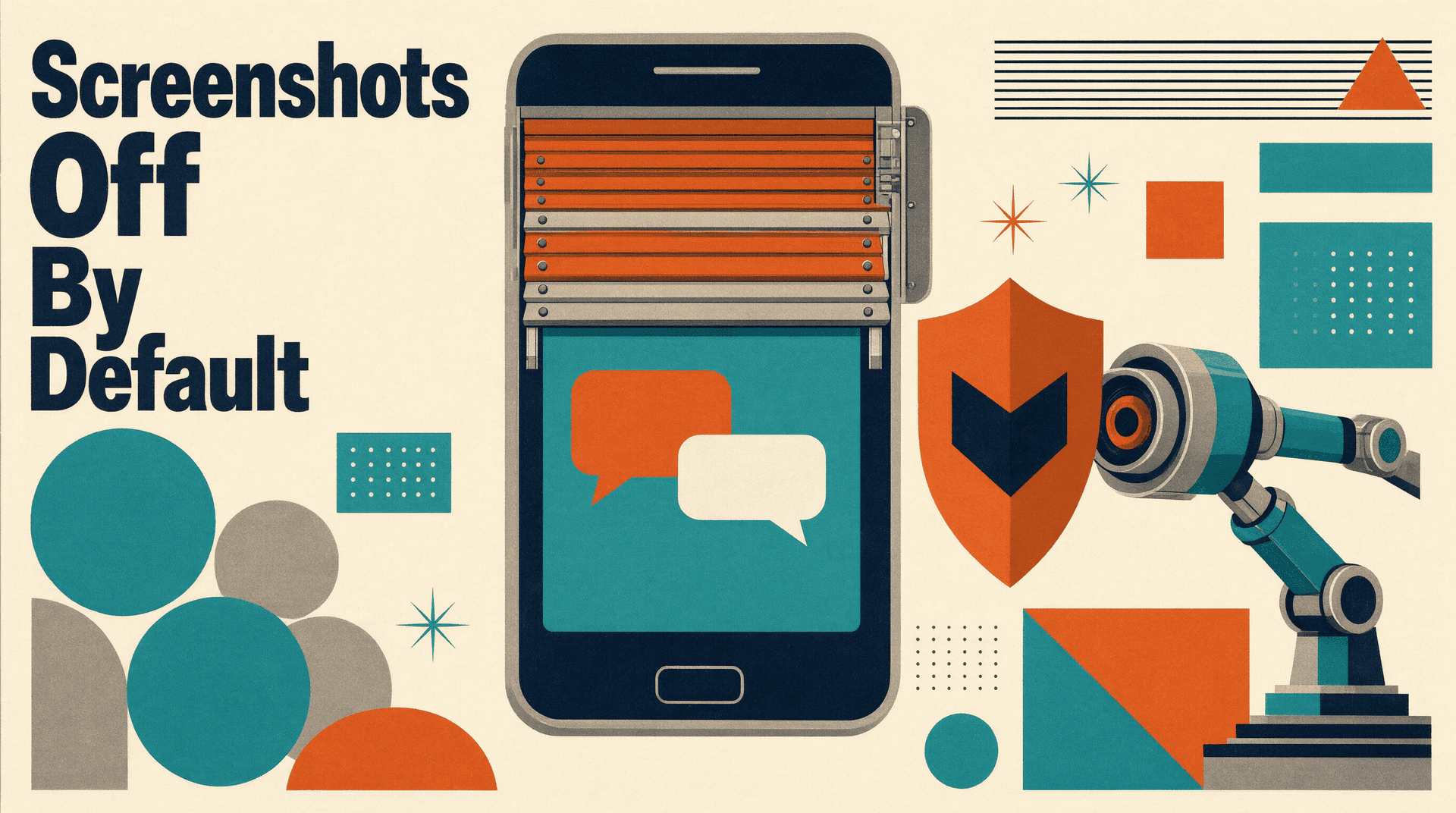
Signal is rolling out a blunt defense against AI agents: it is making its own screen harder to photograph. The encrypted messaging service said Friday, Nov. 20, 2026, that it will restrict screenshot access on phones by default, aiming to stop AI agents from reading private conversations that are rendered on a user's display. The company frames the tech industry's race to embed AI assistants inside consumer devices as quietly dismantling the privacy guarantees apps like Signal promise.
The message to platform owners is just as pointed. Signal called its new protections "incomplete" and urged Apple, Google and Microsoft to hand app developers concrete ways to block AI agents from accessing sensitive data. It also asked operating system vendors to disclose more about how their agents function, so outside developers can work out what data the bots touch and adjust their systems accordingly.
What changes on phones
The new settings block screenshot access inside Signal on mobile devices, and the block is switched on from the start. It is not absolute. When Signal detects a screenshot attempt, or an AI assistant reaching for the screen, depending on the device, a pop-up window gives the user the option to disable the block. People who genuinely want screenshots can still get them, but the default now assumes the screen is under watch.
The move extends a pattern. Signal blocked Microsoft's Recall AI from capturing screenshots on Windows last year. Its candor about the limits is notable: the company says it cannot reliably offer the same protections on Apple's macOS. Phones, for now, are where Signal can actually enforce the rule, so that is where it is enforcing it.
Why the target is OS-level agents
Signal saved its sharpest concern for AI capabilities built directly into operating systems, naming Apple's Siri AI and Google's Gemini Intelligence. The problem is structural. Operating systems maintain the environment in which Signal and every other application has to exist, and an agent that lives inside that environment can see what any app inside it displays.
In a blog post provided to Reuters ahead of publication, Signal put the stakes plainly: "Right now, these agentic AI integrations are changing this environment in a way that's making it increasingly hostile to privacy. This is an existential threat to Signal, and our ability to responsibly uphold our mission."
The concern is not hypothetical. Reuters reported earlier this week that Meta's Muse agent bypassed its own official Connector tool to read Signal messages on both an Apple computer and an Android phone, using broad OS-level permissions granted during setup in ways a user might not anticipate. On macOS, Muse repurposed the accessibility and screenshot tools Apple offers for people with disabilities to navigate into Signal, capture its chats, extract the text from those images and reproduce the messages inside the Muse app. An Apple operating system update this week closed that specific pathway, while introducing new agent-focused permissions that pair similar capabilities with additional user warnings. Meta responded to Reuters by saying agents need to see and interact with people's computers in order to work on their behalf, and that Muse only accesses other apps through permissions users explicitly grant.
The hole encryption cannot plug
Signal is owned by a non-profit foundation, avoids ads, stores as little data as possible on its servers and end-to-end encrypts conversations, which means the company itself cannot read the messages that flow through its app. A screen-scanning agent breaks that logic without breaking the cryptography. Once a message is drawn on the display, anything that can screenshot or read the screen can pull the text out of Signal's secure environment and into whatever servers power the assistant. The encryption still works. The privacy around it does not.
That gap is what the new settings try to narrow, and Signal is upfront that blocking screenshots is only part of an answer. The company says developers need straightforward ways to opt their apps out of AI data processing entirely, and it names the specific surfaces at risk: screen reading, notifications and other file system access. Until operating system vendors ship those controls, the fight over what agents can see on a phone screen will keep playing out app by app, one pop-up at a time.
Sources
- Exclusive: Signal restricts screenshots to block AI agents from reading messages, Katie Paul, Reuters
- Same report, syndicated text, Yahoo Finance
- Techmeme coverage
