
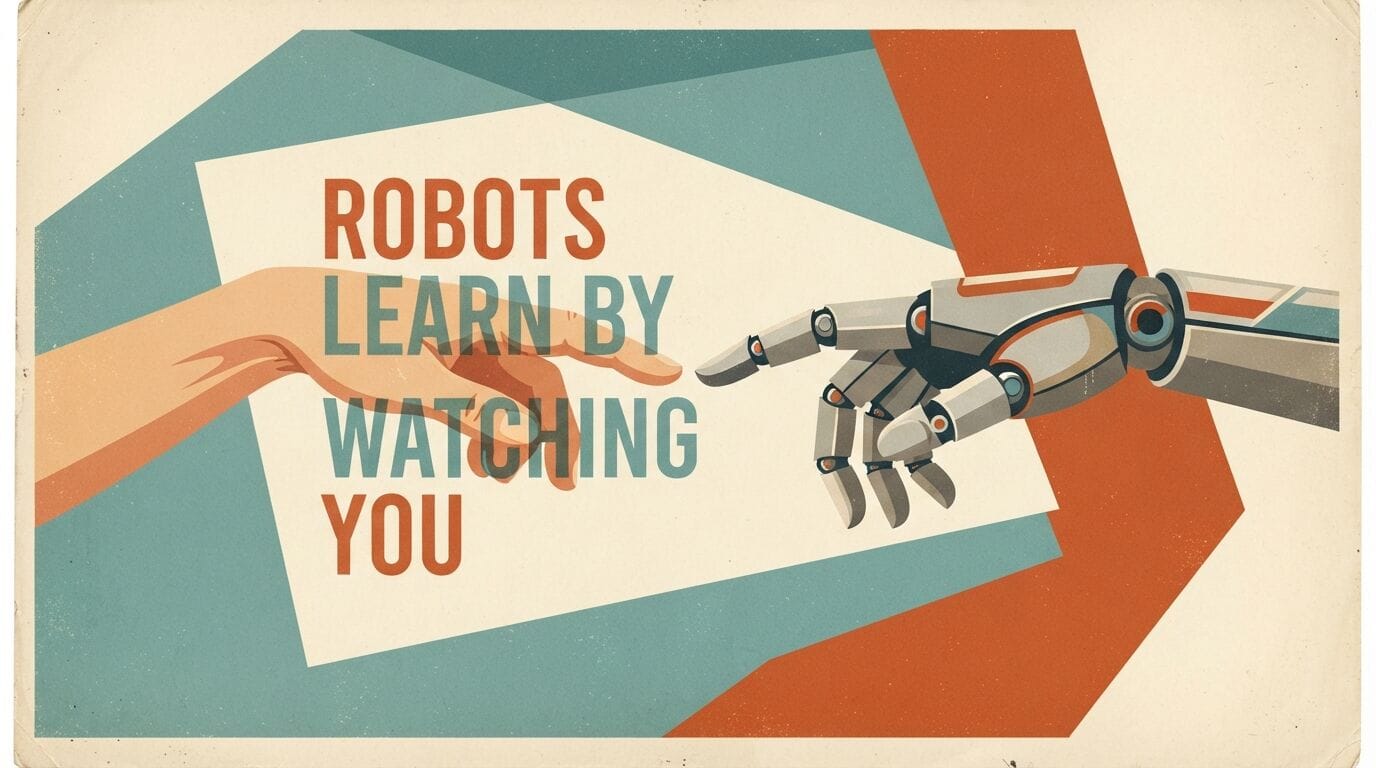
As of late 2026, the primary resource for robot learning has shifted from scarce robot-hours to vast amounts of human video. Large foundation models like NVIDIA's GR00T 2 and Dyna Robotics' DYNA-2 now pretrain predominantly on first-person human footage, using robot data only for grounding and evaluation, as these models learn physics and task structures directly from unlabelled human actions. This shift moves the industry bottleneck from raw hardware hours to capturing diverse, high-quality human video with consistent standards.
Robots Are Learning From Video of You, Not Video of Themselves
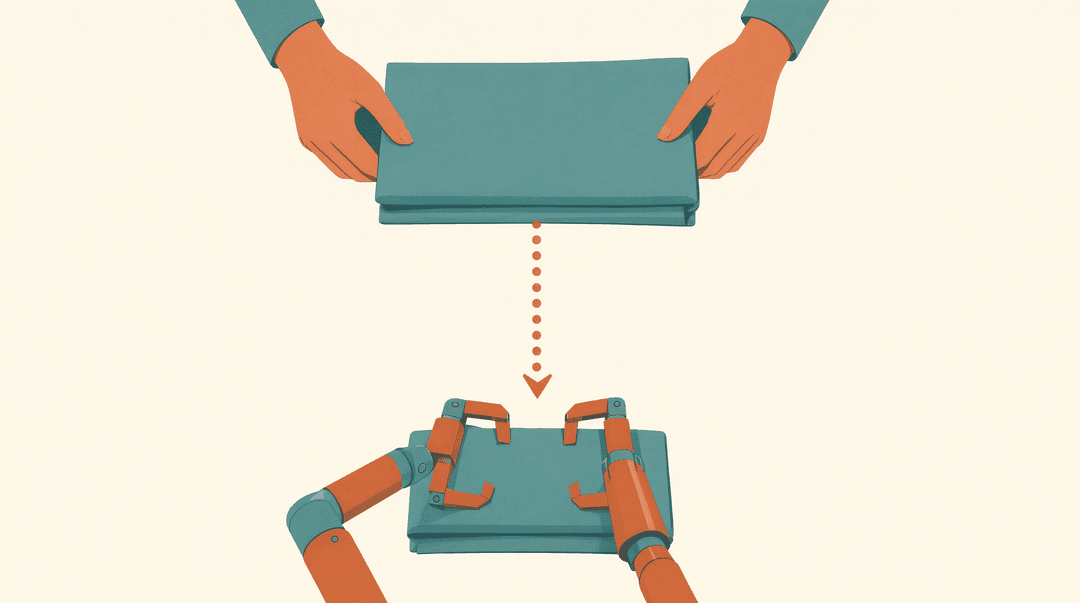
For the first decade of robot learning, the scarce resource was robots. Training a manipulation policy meant teleoperation: a human operator sitting at a console, driving a real arm through a real task, while every sensor reading and motor command got recorded. Data was priced per robot-hour, and the field's scaling bottleneck was the fleet itself.
Somewhere in the last twelve months, that stopped being the story. The largest robot foundation models of late 2026 are pretrained mostly on footage of people doing things, with robot data demoted to a grounding and evaluation layer. NVIDIA's GR00T 2, presented November 9, 2026 at the Conference on Robot Learning in Austin, lists 402,730 hours of first-person human video in its pretraining mix, against 23,500 hours of robot teleoperation and 10,184 hours of handheld gripper demonstrations. Dyna Robotics says its DYNA-2 world-action model, announced August 10, 2026, pretrained on over one million hours of egocentric human video with no robot data in pretraining at all. Generalist AI's GEN-0, announced November 4, 2025, reported 270,000-plus hours of real-world manipulation data growing by more than 10,000 hours per week.
The question worth asking is not whether the hours are real, but what evidence there is that this substitution works, and what it means for how robot capability is bought and sold in 2026.
What changed in the architecture, not just the dataset
Human video has always existed in robot research. What changed is that models learned to use video without action labels. The current generation of world-action models (WAMs) predict future video frames and robot actions jointly, so a clip of a person folding laundry teaches physics and task structure even though nobody recorded the arm torques. GR00T 2 is built on NVIDIA's Cosmos world models and, per NVIDIA, learns from tasks shown only by humans, only through a handheld UMI gripper, or only via wearable data gloves, then transfers them to robots that never practiced those tasks. NVIDIA's DreamZero paper frames the predecessor problem plainly: state-of-the-art vision-language-action (VLA) models "excel at semantic generalization but struggle to generalize to unseen physical motions in novel environments."
Physical Intelligence, the lab behind the π family of VLAs, reported in December 2025 that human-to-robot transfer emerged in its models once they had diverse robot pretraining, and Figure reported in September 2025 that humanoid navigation could be learned from egocentric human video alone. Google DeepMind went the other direction in July 2026, shipping Gemini Robotics 2 as a whole-body VLA plus Gemini Robotics ER 2, an orchestration model that plans multi-step tasks and hands motor execution down to VLAs, with an on-device variant it says adapts to a new robot embodiment in hours.
The measured results, with the caveats attached
The cleanest public number is an NVIDIA ablation: pretraining four models on none, 1%, 10% and 100% of the human video corpus raised real-robot task progress across 72 tasks from 50% to 70%. On 50 tasks the test robot had never practiced, NVIDIA reports the model completed 40 at least once with zero demonstrations, reaching 71% average success with one demonstration per task and 95% with five, where the five-demo fine-tune took under three minutes of data and about half an hour of training on a single RTX 5090.
Read those as vendor-reported results from the developer's own evaluations, which is what nearly all of them are. A widely read researcher's synthesis of CoRL 2026 makes the uncomfortable version of this point: attendance roughly doubled to about 4,800, submissions tripled, and the conference's closing debate spent much of its time on whether the field's specialized VLA recipe is being leapfrogged by general frontier models. In one study presented there, a general-purpose agentic LLM wired directly to simulated robots completed 66% of tasks against 28% for the best purpose-built robot foundation model. The same synthesis notes Boston Dynamics' position that frontier models remain "not reliable enough for a production line without fine-tuning," and DeepMind's own speaker calling them slow and heavy.
The other soft spot is hour comparability. An hour of daily-life egocentric video, an hour of manipulation video annotated with 3D hand pose (NVIDIA's EgoScale recipe used 20,854 action-labeled hours), and an hour of UMI handheld data with a calibrated gripper carry very different training signal. Vendor corpora mix these layers, and press releases count them in the same units.
Where the open part of the field sits
Alongside the commercial models, the open track is substantial. OpenVLA, a 7B-parameter VLA trained on roughly 970,000 robot demonstrations, is still the standard baseline. Physical Intelligence open-sourced π0 and its FAST action tokenizer in February 2025. Hugging Face's LeRobot has become the default toolkit for teams training their own policies. NVIDIA released a 100,000-hour slice of GR00T 2's human video on Hugging Face under CC BY 4.0, with model weights promised in December 2026.
On the product side, the access models are still forming. Physical Intelligence opened a Pi API beta on October 13, 2026, offering fine-tuning and cloud inference on partner robots, with deployments its partners describe ranging from strawberry harvesting to server assembly. DeepMind's Gemini Robotics On-Device 2 is gated behind a trusted-tester waitlist. Figure, which demonstrated Helix 2.5 across 30 rented Bay Area homes with no prior data in any of them per the company's own September 2026 post, still sells nothing to households; CEO Brett Adcock's stated 2026 milestone is home alpha testing measured by human-intervention rates.
What to actually take away
Three things, none of them breathless.
First, the unit of robot training has flipped. The expensive input is no longer robot-hours but rights-cleared, diverse, consistently captured human video. Collection companies now sell exactly that, and the stated bottleneck has moved from raw hours to "diversity, capture standards and action-relevant signal."
Second, every headline success rate in this space is a vendor self-evaluation until an independent lab or customer replication says otherwise. The 40-of-50 and 95% numbers are real announcements, not audited results.
Third, the benchmark threat is genuine: if frontier models improve general physical reasoning faster than the field improves specialized VLAs, much of the robot-learning stack becomes an integration problem rather than a modeling problem. That was the mood at CoRL 2026, which is itself a report, not a measurement.
Robots learning by watching humans is the late-2026 story. Robots learning reliably enough to be left alone is still the actual product problem, and nobody outside a demo video has proved it yet.
Sources
- NVIDIA GR00T 2 project page
- Field Motion, Human Video Scaling in Robotics (2026)
- Bybotix, NVIDIA GR00T 2 and Isaac Lab 3.0 at CoRL 2026
- The Robot Report, Google DeepMind says Gemini Robotics 2 enables full body control
- Google DeepMind, Gemini Robotics 2 brings whole body intelligence to robots
- Google DeepMind, Gemini Robotics On-Device 2 model card
- Google, Introducing Gemini Robotics ER 2
- Physical Intelligence, pi0.5 blog
- Physical Intelligence, Emergence of Human to Robot Transfer in VLAs
- Physical Intelligence news index (Pi API beta, pi0.7)
- Figure on Helix 2.5, 30 homes
- Figure, Project Go-Big
- Generalist AI, GEN-0
- Dyna Robotics, DYNA-2 announcement
- Shivaram Kumar Jagannathan, CoRL 2026 synthesis
- npaka, Notable Research at CoRL 2026
- Physical AI Handbook, VLAs explained
- Robonomy, Robot Foundation Models in 2026
Frequently asked questions
Which robot models rely mostly on human video for pretraining?
NVIDIA's GR00T 2, announced November 9, 2026, lists 402,730 hours of human video in its mix. Dyna Robotics' DYNA-2, announced August 10, 2026, pretrained on over one million hours of egocentric human video with no robot data in pretraining.
How do robots learn from human video without action labels?
Current world-action models (WAMs) predict future video frames and robot actions jointly. This allows them to extract physics and task structure from clips of people performing tasks, even when specific arm torques or motor commands were not recorded during the human demonstration.
What are the limitations of using human video for robot training?
Vendor-reported results often lack independent verification, and comparing 'hours' of different video types (e.g., daily life vs. annotated manipulation) can be misleading due to varying signal quality. Additionally, frontier models may still be too slow or heavy for immediate production line use without significant fine-tuning.
Who is behind the open-source developments mentioned?
Physical Intelligence open-sourced π0 and its FAST action tokenizer in February 2025. OpenVLA serves as a baseline VLA model, and Hugging Face's LeRobot is a default toolkit. NVIDIA also released a 100,000-hour slice of GR00T 2's human video on Hugging Face under CC BY 4.0.
