Reasoning Models in Production: Architecture, Thinking-Token Management, Latency Budgets, and Downstream Agent Handoffs
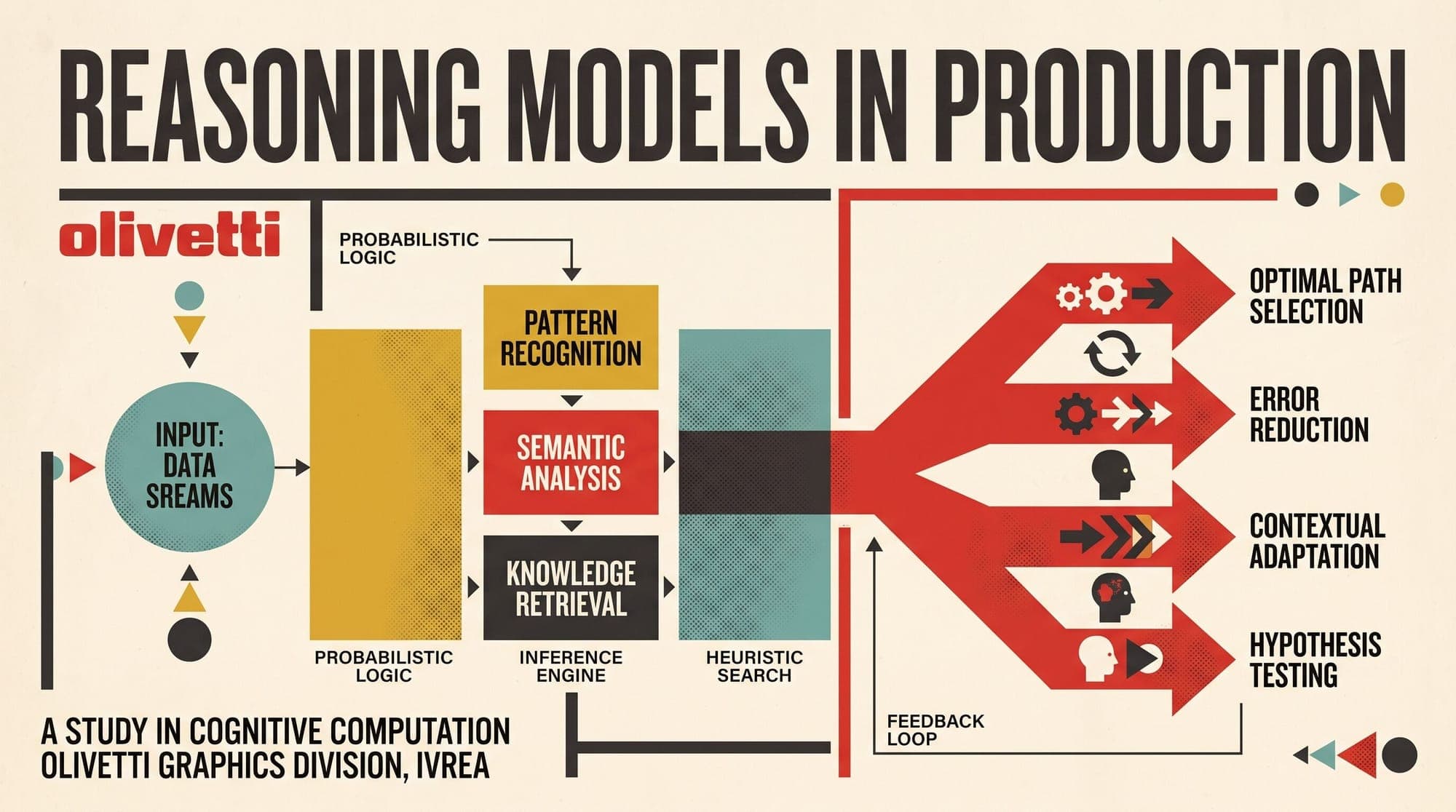
The deployment of frontier reasoning models, including DeepSeek-R1, OpenAI o1 and o3, and Anthropic Claude Extended Thinking, marks a fundamental shift in how inference compute is allocated. Rather than generating immediate autoregressive token streams directly to the user or downstream caller, reasoning models dedicate hundreds or thousands of intermediate tokens to planning, error verification, counterfactual search, and self-correction before producing a final response.
While this inference-time compute scaling unlocks state-of-the-art performance on competitive programming, formal mathematics, and complex multi-step orchestration, it breaks standard production LLM engineering assumptions. Treating reasoning models as standard drop-in endpoints introduces severe latency spikes, unpredictable token billing, UI streaming freezes, and severe context bloat in multi-turn agent pipelines.
Engineering robust production systems around reasoning models requires dedicated infrastructure for thinking-token budgeting, dual-stream user experience handling, context pruning, and complexity-based dynamic routing.
The Anatomy of Thinking Tokens
In traditional autoregressive language models, input tokens are processed in a single prefill phase, followed by a decode phase that produces user-visible output tokens. Reasoning models introduce an intermediate deliberation phase between prefill and final output.
Implementations fall into two primary architectural patterns:
- Tag-Delimited Open Chains (e.g., DeepSeek-R1, Qwen QwQ): The model emits raw text tokens wrapped within structural XML tags such as
<think>and</think>. All reasoning tokens are generated within the standard output token vocabulary, visible in the raw generation stream, and consumed sequentially. - First-Class API Thinking Blocks (e.g., Anthropic Claude, OpenAI o-series): The provider encapsulates reasoning tokens into separate data blocks or hides them behind proprietary internal evaluation steps. Anthropic returns distinct content blocks of type
thinking, accompanied by cryptographic signatures to verify that the reasoning trace was generated unmodified by the model. OpenAI emits hidden reasoning tokens that are accounted for in token usage payloads but suppressed from the text response payload.
Across both paradigms, reasoning tokens are billed at the full output token rate. In many workloads, a query requesting a three-sentence answer may consume 4,000 thinking tokens to derive the solution, resulting in an output cost orders of magnitude higher than expected.
Latency Budgets and Time-to-First-Content-Token
In standard LLM serving, Time-to-First-Token (TTFT) represents the latency required to execute the prompt prefill and return the initial completion token. In reasoning models, a critical operational distinction emerges between Time-to-First-Thinking-Token (TTFT-T) and Time-to-First-Content-Token (TTFT-C).
When a reasoning model engages in extensive deliberation, TTFT-C can extend from hundreds of milliseconds to 10 to 45 seconds. For interactive user-facing applications, this creates perceived interface deadlocks unless the architecture supports progressive disclosure.
Standard LLM:
[Prefill (~200ms)] -> [Content Token 1] -> [Content Token 2] -> [End]

Reasoning Model:
[Prefill (~200ms)] -> [Thinking Token 1 ... 4000 (~12s)] -> [Content Token 1] -> [End]
To manage this latency budget, production systems must implement strict thinking controls:
- Anthropic
budget_tokens: Specifies an explicit ceiling on internal reasoning compute (minimum 1,024 tokens up to 128,000 tokens). Settingbudget_tokens: 2048provides sufficient deliberation for moderate code refactoring without allowing the model to wander into multi-minute loops. - OpenAI
reasoning_effort: Exposes categorical tiers (low,medium,high) that scale internal sampling effort and reasoning token ceilings. - Open-Weight Stop-Sequence Injection: For self-hosted models like DeepSeek-R1 running on vLLM or SGLang, token generation can be monitored with regex-based stream parsers to terminate generation or inject forced
</think>closing tags if the reasoning trace exceeds predefined token quotas.
Empirical evaluations show diminishing returns when increasing thinking budgets beyond task-specific thresholds. Simple entity extraction and formatting tasks plateau immediately, while complex algorithmic debugging exhibits log-linear error reduction up to approximately 8,000 reasoning tokens before stalling.
Dual-Stream Streaming and Progressive UX
Exposing reasoning models over standard Server-Sent Events (SSE) or WebSocket connections requires decoupling thought streams from answer streams. Passing raw <think> text directly into a monolithic chat bubble results in confusing markdown rendering, broken code snippets, and degraded user trust.

A production-grade dual-stream gateway parses incoming chunks in real time and emits typed events to the frontend:
// Edge Gateway Stream Parser Example
interface StreamEvent {
  type: 'thought_delta' | 'content_delta' | 'status_update' | 'usage';
  data: string | object;
}

export async function* parseReasoningStream(responseStream: ReadableStream): AsyncGenerator<StreamEvent> {
  let inThinkingPhase = false;
  let buffer = '';

  for await (const chunk of responseStream) {
    buffer += chunk;

    // Handle XML tag transitions for open-weight models
    if (buffer.includes('<think>')) {
      inThinkingPhase = true;
      buffer = buffer.replace('<think>', '');
      yield { type: 'status_update', data: 'Thinking through problem...' };
    }

    if (buffer.includes('</think>')) {
      inThinkingPhase = false;
      const [thoughtRemainder, contentStart] = buffer.split('</think>');
      if (thoughtRemainder) {
        yield { type: 'thought_delta', data: thoughtRemainder };
      }
      buffer = contentStart || '';
      yield { type: 'status_update', data: 'Generating response...' };
    }

    if (buffer.length > 0) {
      if (inThinkingPhase) {
        yield { type: 'thought_delta', data: buffer };
      } else {
        yield { type: 'content_delta', data: buffer };
      }
      buffer = '';
    }
  }
}
On the client side, thought deltas feed into an expandable, muted accordian component, displaying an active timer and subtle progress animation. When content_delta events begin arriving, the interface shifts visual focus to the primary response while keeping the complete reasoning audit trail accessible for user inspection.
The Downstream Agent Handoff Dilemma
One of the most severe architectural pitfalls in multi-agent orchestration is context pollution caused by unpruned reasoning chains.
When an orchestrator or reasoning subagent completes a step, its generation history contains both the thinking trace (e.g., 3,500 tokens) and the final tool invocation or conclusion (e.g., 150 tokens). If the full conversation trajectory is appended verbatim to the session history for subsequent agent turns, two major failures occur:
- Context Window and KV Cache Saturation: Multi-turn conversations rapidly consume available context limits. Five consecutive agent turns with unpruned thinking traces can easily consume 20,000 to 40,000 tokens of context, drastically increasing time-to-first-token (TTFT) and KV cache memory allocation on serving clusters.
- Prompt Cache Invalidation and Cost Multiplication: Passing non-deterministic, long thinking traces into subsequent prompts prevents efficient prompt prefix sharing, forcing full re-computation of the prompt prefix across consecutive turns.
Pruning Strategies for Agent Workflows
Production agent harnesses implement three distinct handoff strategies:
- Complete Thought Stripping: The agent framework retains the reasoning trace in local observability logs for telemetry but strips all
<think>...</think>content orthinkingblocks before serializing the message history back to the database or passing it to subsequent agent steps. Only the final structured answer and executed tool calls enter working memory. - Hierarchical Scratchpad Summarization: If the reasoning trace contains intermediate findings essential for future steps, a lightweight model compresses the 4,000-token trace into a 200-token structured bulleted summary before memory insertion.
- Signed Block Preservation: When using Anthropic Claude with tool use across multiple turns, the API requires returning previous
thinkingblocks with their cryptographic signatures to maintain prompt caching efficiency and model alignment across tool-use loops. In this architecture, raw thinking blocks are sent exclusively to the model API while stripped views are rendered to user interfaces.
Complexity-Based Dynamic Routing
Deploying reasoning models for 100% of incoming traffic is economically unsustainable and introduces unnecessary latency. Most enterprise workloads follow a power-law distribution where 70% to 85% of queries consist of straightforward lookups, standard API formatting, or basic summarization that do not benefit from extended inference search.
To optimize serving unit economics, production systems deploy a two-tier routing gateway:
Incoming Request
      │
      ▼
[Fast Complexity Classifier (SLM / Embedding Router)]
      │
      ├── Low Complexity (75% of queries) ──► Standard Fast LLM ($0.15 / 1M tokens, 400ms latency)
      │
      └── High Complexity (25% of queries) ──► Reasoning Model ($1.50 - $15 / 1M tokens, 12s latency)
Routing implementations leverage lightweight scoring mechanisms:
- Zero-Shot Heuristic and Embedding Classifiers: Semantic routers (such as embedding-based k-NN classifiers or FastText models) categorize prompts based on intent keywords (e.g., mathematical proofs, multi-file code diffs, architectural analysis vs. factual FAQ lookup).
- Small Language Model (SLM) Triage: A sub-billion-parameter local model evaluates the prompt and outputs a binary routing decision with latency under 30 milliseconds.
- Dynamic Speculative Escalation: Requests initially execute against a low-cost model with a deterministic verification check (e.g., unit test execution, JSON schema validation, or confidence scoring). If verification fails, the system automatically falls back and re-dispatches the task to a high-budget reasoning model.
Implementing tiered routing typically reduces aggregate API expenditures by 60% to 80% while dramatically lowering average p50 latency across the entire user base.
Structured Outputs and Tool Calling Interactions
Integrating reasoning models with structured output engines and tool calling introduces unique constraints. In standard models, grammar-constrained decoding (such as XGrammar or Outlines) masks out invalid vocabulary tokens at each step to enforce strict JSON schemas.
With reasoning models, applying grammar masks from token index zero catastrophically degrades performance because it prevents the model from emitting free-form chain-of-thought tokens inside its scratchpad.
Production engines resolve this through phased grammar activation:
- Unconstrained Deliberation Phase: During the thinking phase (within
<think>tags or native thinking blocks), all vocabulary logits remain unmasked, allowing the model to explore hypotheses, draft pseudo-code, and evaluate edge cases. - Constrained Emission Phase: Once the closing tag (
</think>) is encountered or the model transitions to the tool/answer payload, the grammar compiler activates, strictly enforcing schema validation on the generated JSON arguments.
By combining phased grammar enforcement, dual-stream event parsing, context pruning, and intelligent routing, engineering teams can harness the transformative reasoning power of frontier models while maintaining low latency, predictable costs, and robust reliability in production.
Sources
- DeepSeek-R1: Incentivizing Reasoning Capability in LLMs via Reinforcement Learning - DeepSeek AI (2025)
- OpenAI Reasoning Models Guide and Best Practices - OpenAI Documentation
- Extended Thinking with Claude in Amazon Bedrock - AWS Documentation
- vLLM Serving Engine Repository and Reasoning Parsers - vLLM Project
- SGLang: Fast Serving Engine for Large Language Models and Reasoning Models - SGLang Project
- XGrammar: Flexible and Efficient Grammar-guided Generation Engine - MLC-AI