

Production 3D generative AI has shifted away from slow optimization-based paradigms toward high-throughput feed-forward architectures and scalable flow-matching diffusion models. Early text-to-3D pipelines relied on Score Distillation Sampling (SDS) through 2D diffusion priors, requiring hundreds of optimization steps and minutes of GPU compute per asset. Modern systems synthesize textured 3D representations in seconds from a single reference image or text prompt.
Engineering teams integrating open-source 3D generators into production pipelines face distinct architectural trade-offs across representations, inference latency, hardware memory, and downstream format compatibility. Selecting the right foundation model requires understanding how representations such as triplanes, sparse voxels, FlexiCubes, and 3D Gaussian Splats dictate both generation fidelity and runtime economics.
This comparison analyzes four leading open-source 3D generative architectures: Microsoft TRELLIS, Tencent Hunyuan3D 2.0, Stability AI and Tripo AI's TripoSR, and Tencent ARC's InstantMesh.
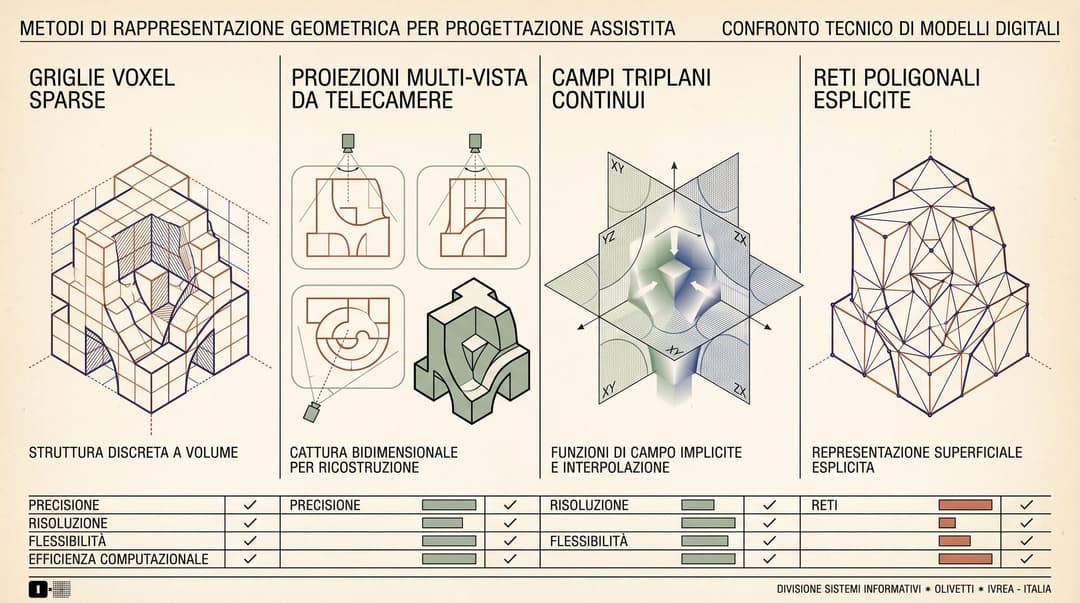
Core 3D Representations and Geometric Paradigms
The primary differentiator among modern 3D generators is their native internal representation. The choice of intermediate data structure governs training stability, multi-view consistency, and the fidelity of extracted surface geometry.
Structured Latents (SLAT)
Introduced by Microsoft in TRELLIS, Structured Latents anchor spatial features within a 3D sparse voxel grid. Dense multi-view visual features extracted via DINOv2 are projected onto active spatial voxels and averaged. Rather than constraining the network to generate one rigid format, SLAT acts as a unified intermediate latent that decodes into multiple downstream formats (3D Gaussians, continuous radiance fields, or explicit polygon meshes) without retraining the base generative model.
Decoupled Mesh and UV Diffusion
Tencent's Hunyuan3D 2.0 decouples shape generation from texture synthesis. Instead of optimizing geometry and color simultaneously within a continuous volumetric field, the pipeline first generates an untextured bare polygon mesh, automatically unwraps UV coordinates, and then executes a conditioned multi-view diffusion model to synthesize high-resolution texture maps directly onto the surface.
Triplane Neural Radiance Fields
Popularized by Large Reconstruction Models (LRM) and implemented in TripoSR, the triplane formulation decomposes 3D space into three orthogonal 2D feature planes (XY, XZ, YZ). An image encoder maps visual tokens across these planes via cross-attention. A lightweight multi-layer perceptron queries point coordinates by projecting onto each plane, extracting density and color before running Marching Cubes to produce an explicit mesh.
Multi-View Diffusion with FlexiCubes
Tencent ARC's InstantMesh uses a two-stage hybrid framework. A multi-view diffusion model (such as Zero123++) first synthesizes four to six canonical viewpoint images. A sparse-view transformer reconstructor then decodes these images into two simultaneous representations: 3D Gaussian Splats for fast volumetric preview and a tetrahedral grid optimized via NVIDIA FlexiCubes. FlexiCubes introduces differentiable iso-surface extraction with learnable dual vertices, allowing gradient-based surface supervision using depth and normal maps.
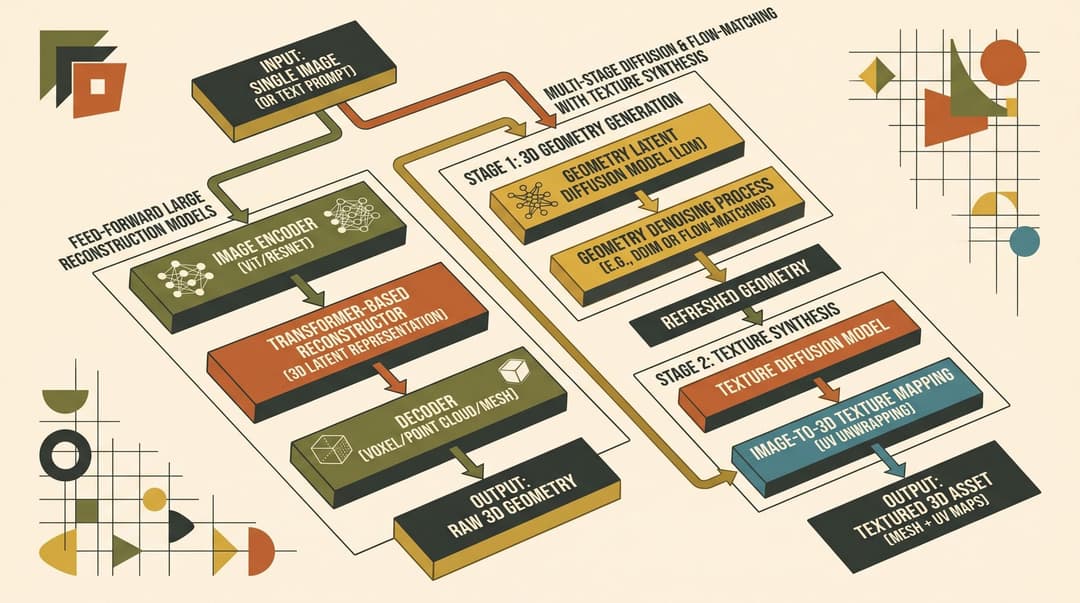
Architectural Deep Dive
Microsoft TRELLIS: Scalable Flow Matching on Sparse Latents
Microsoft's TRELLIS scales 3D generation using rectified-flow transformers operating directly on sparse voxel tokens. The model family ranges up to 2 billion parameters and is trained on curated datasets of over 500,000 3D assets.
Key architectural mechanics:
- Rectified Flow Backbone: Utilizes flow-matching dynamics to transform Gaussian noise into structured 3D latents across 25 to 50 sampling steps.
- Sparse Voxel Transformers: Employs spatially sparse 3D convolutions and sparse attention blocks, focusing compute strictly on active object voxels rather than empty space.
- Multi-Head Decoders: A single SLAT output passes into format-specific decoders. A 3DGS decoder predicts position offsets, opacity, spherical harmonics, and covariance matrices. A NeRF decoder predicts continuous density fields. A mesh decoder applies Dual Marching Cubes for watertight surface topology.
- Local Editing Support: Because SLAT maintains explicit 3D spatial grounding, localized bounding-box conditioning allows regional geometry modification and variant generation without global regeneration.
Tencent Hunyuan3D 2.0: Two-Stage Geometry and PBR Texture Synthesis
Tencent's Hunyuan3D 2.0 targets high-fidelity digital content creation by isolating shape formulation from surface rendering.
Key architectural mechanics:
- Hunyuan3D-DiT (Geometry Stage): A Diffusion Transformer trained via flow matching that synthesizes coarse-to-fine untextured surface meshes from single-image or text embeddings.
- Automated Parameterization: The generated mesh undergoes automated topology cleaning and UV unwrapping to generate non-overlapping texture coordinate atlases.
- Hunyuan3D-Paint (Texture Stage): A multi-view diffusion network conditioned on the input image, surface normal projections, and geometric position maps. It synthesizes seamless texture maps that wrap precisely around the geometry, avoiding texture seams and projective stretching artifacts.
Stability AI & Tripo AI TripoSR: Sub-Second Feed-Forward Reconstruction
TripoSR is designed specifically for ultra-low latency single-image 3D reconstruction, generating watertight meshes in under 0.5 seconds without iterative diffusion sampling.
Key architectural mechanics:
- DINOv2 Image Backbone: An input RGB image is processed by a frozen ViT-B/16 or ViT-L/14 image encoder to extract global and patch-level visual tokens.
- Image-to-Triplane Decoder: A stacked cross-attention transformer updates a set of learnable triplane positional queries using the image tokens, directly generating three 64x64 or 128x128 feature planes.
- Implicit NeRF Head: A tiny coordinate-based MLP evaluates spatial coordinates against triplane features to determine volume density and RGB radiance.
- Direct Marching Cubes: Surface geometry is extracted using Marching Cubes at a fixed spatial resolution (typically or ).
Tencent ARC InstantMesh: Sparse-View Reconstruction with Differentiable Iso-Surfaces
InstantMesh combines multi-view 2D diffusion priors with a feed-forward reconstruction model optimized directly for mesh extraction.
Key architectural mechanics:
- Multi-View Diffusion Feeder: Leverages Zero123++ to generate six pose-consistent novel views surrounding the target object in a single forward pass.
- LRM Reconstructor: A transformer-based sparse-view reconstructor consumes the multi-view feature tokens and outputs dual representations.
- FlexiCubes Geometric Supervision: Unlike standard Marching Cubes (which cannot propagate gradients into geometric parameters), FlexiCubes allows the network to be trained with explicit normal loss and depth rendering loss. This geometric supervision suppresses surface blobiness and preserves sharp hard-surface edges.
Production Serving, Latency, and Hardware Economics
Deploying 3D generative models in production requires evaluating inference throughput, GPU memory overhead, and complex custom CUDA kernel dependencies.
Inference Latency and Throughput
- TripoSR: Operates in 0.2 to 0.5 seconds per asset on a single NVIDIA A100 GPU. Because it relies on a single feed-forward pass without iterative denoising, it scales efficiently for synchronous user-facing applications.
- TRELLIS: Requires 8 to 12 seconds per asset on an A100 GPU for 30 flow-matching steps plus multi-head decoding.
- InstantMesh: Requires 8 to 15 seconds per asset, splitting compute between multi-view diffusion sampling (5 to 10 seconds) and feed-forward reconstruction (2 to 3 seconds).
- Hunyuan3D 2.0: Requires 20 to 35 seconds per asset across its two-stage pipeline, dominated by high-resolution texture map diffusion.
VRAM and Memory Footprint
- TripoSR: Fits comfortably in 6 GB to 8 GB of VRAM, making it deployable on entry-level edge nodes or consumer GPUs (RTX 4070 / 4080).
- InstantMesh: Requires 12 GB to 16 GB of VRAM during peak multi-view diffusion conditioning.
- TRELLIS: Demands 16 GB to 24 GB of VRAM for the 2B parameter model, requiring enterprise-grade hardware (NVIDIA A100, H100, or RTX 4090 with optimized CUDA allocators).
- Hunyuan3D 2.0: Demands 20 GB to 24 GB of VRAM when running both DiT and Paint pipelines in memory simultaneously, though sequential model offloading can reduce peak usage to 14 GB.
CUDA Dependencies and Runtime Ecosystems
Production deployment of these frameworks introduces specific compilation and containerization requirements:
- TRELLIS: Requires custom compilation of
spconv(spatially sparse convolution),nvdiffrast, anddiff-gaussian-rasterization. - Hunyuan3D 2.0: Requires PyTorch 2.2+, FlashAttention-2, and standard 3D mesh processing libraries (
trimesh,xatlas,pymeshlab). - TripoSR: Uses minimal custom dependencies, relying on standard PyTorch,
torchmcubes, and basic rendering utilities. - InstantMesh: Requires
nvdiffrastand PyTorch bindings for FlexiCubes tetrahedral grid evaluation.
Architecture Selection Guide for Production
- Choose TripoSR when: You require sub-second generation for real-time interactive previews, conversational 3D agents, or mobile-accessible microservices operating on bounded GPU budgets.
- Choose TRELLIS when: You need high geometric fidelity and multi-format flexibility, such as producing simultaneous 3D Gaussian Splats for web viewers and textured polygon meshes for simulation, or when localized 3D asset editing is required.
- Choose Hunyuan3D 2.0 when: Your pipeline feeds directly into game engines, e-commerce renderers, or VFX workflows that mandate clean UV unwrapping and high-frequency PBR texture maps.
- Choose InstantMesh when: You need clean hard-surface mesh boundaries and sharp geometric features without the high inference latency of full two-stage texture diffusion.
Sources
- Microsoft TRELLIS: Structured 3D Latents for Scalable and Versatile 3D Generation
- Microsoft TRELLIS Official Repository
- Tencent Hunyuan3D 2.0 Official Repository
- TripoSR: Fast 3D Object Reconstruction from a Single Image
- InstantMesh: Efficient 3D Mesh Generation with Sparse-View Large Reconstruction Models
- Flexible Isosurface Extraction for Gradient-Based Mesh Optimization (FlexiCubes)
