
Semantic Caching Engines in Production LLM Systems: Comparing GPTCache, RedisVL, Portkey, and Cloudflare AI Gateway
Standard exact-match caching strategies fail in large language model applications. Because natural language is inherently variable, users asking the exact same question will use different phrasing, punctuation, sentence structures, or synonyms. Exact string hashing (such as MD5 or SHA-256 caching over raw prompt strings) rarely yields hit rates above 3% to 5% in production conversational interfaces.
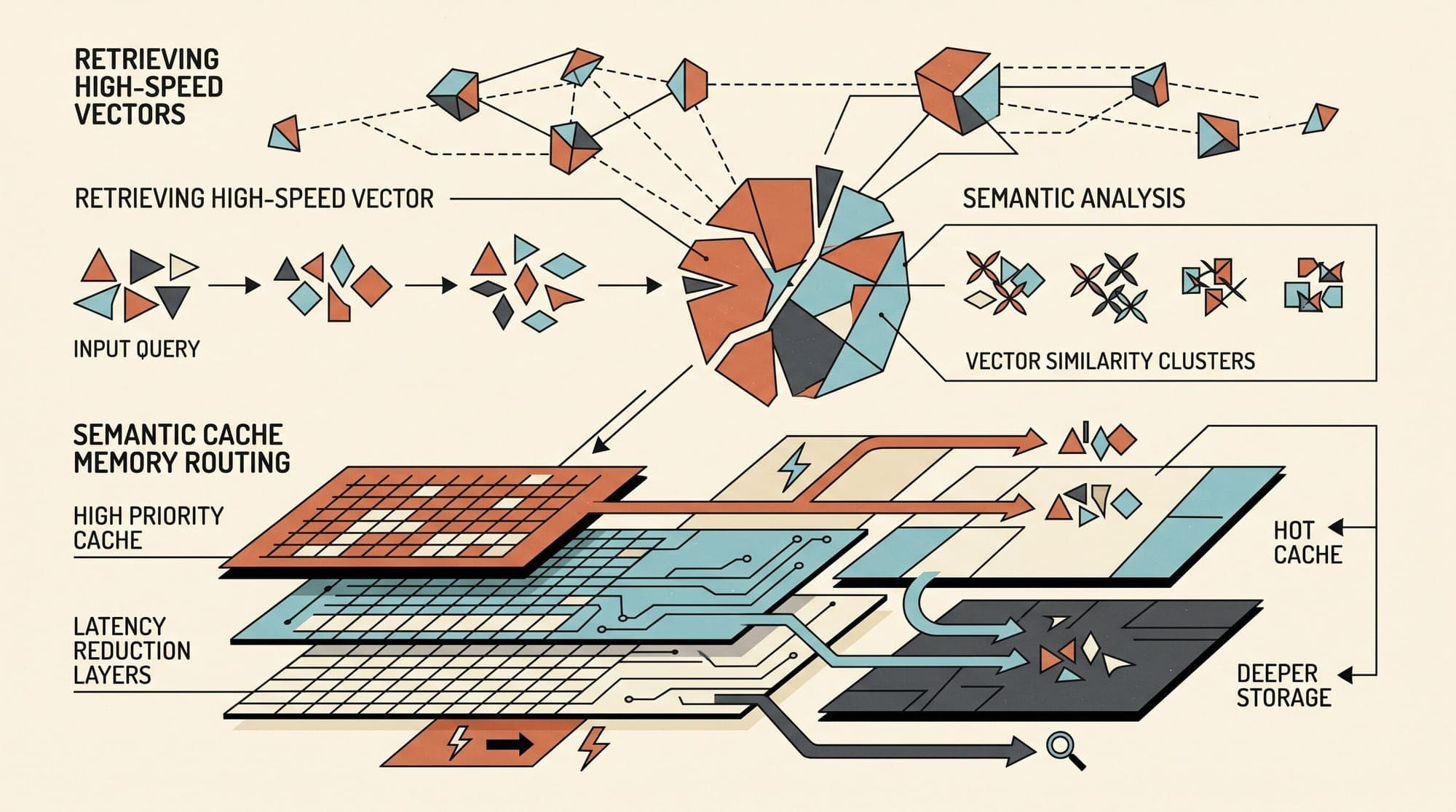
Semantic caching addresses this structural inefficiency by evaluating the semantic similarity of incoming queries in vector space. By transforming prompts into dense embeddings and querying an Approximate Nearest Neighbor (ANN) vector index, semantic caching systems can identify and return pre-computed responses when semantic distance falls below a defined threshold. In high-volume workloads, a well-calibrated semantic cache achieves 20% to 40% hit rates, cutting inference latency from seconds to tens of milliseconds while eliminating redundant token consumption.
Implementing semantic caching at scale requires navigating distinct architectural trade-offs across embedding latency, vector search indexing, distance threshold calibration, and multi-tenant isolation. Four major engines lead production adoption: the modular open-source framework GPTCache, the in-memory AI-native vector library RedisVL, the enterprise proxy-based Portkey Semantic Cache, and the edge-native Cloudflare AI Gateway.

The Semantic Cache Lifecycle
A production semantic cache replaces the standard direct client-to-LLM request loop with a multi-stage retrieval and gating pipeline:
- Preprocessing and Normalization: The incoming request is sanitized, stripping transient whitespace, system prompt boilerplates, and dynamic formatting tokens.
- Embedding Generation: The normalized query string is routed to an embedding model (such as
text-embedding-3-small,bge-small-en-v1.5, or an ONNX-runtime local embedder) to produce a dense vector representation. - ANN Vector Search: The query vector is evaluated against an index of previously cached prompt vectors using metrics such as Cosine Distance, Euclidean (L2) Distance, or Inner Product (Dot Product).
- Similarity Threshold Evaluation: The top-ranked vector candidate's distance score is compared against a pre-configured threshold. If the distance satisfies the threshold condition, the pipeline records a cache hit.
- Cache Hit Execution: The engine fetches the cached response payload from key-value or document storage and returns it to the client, bypassing upstream LLM inference entirely.
- Cache Miss and Ingestion: If the distance exceeds the threshold (or no candidate is found), the query is dispatched to the upstream LLM provider. Upon receiving the generation stream, the cache asynchronously indexes the new query embedding and stores the generated response alongside relevant metadata.
Incoming Request
       │
       ▼
┌─────────────────────────┐
│ Query Preprocessor      │
└────────────┬────────────┘
             │
             ▼
┌─────────────────────────┐
│ Dense Vector Embedder   │ (Latency: 10–25ms)
└────────────┬────────────┘
             │ Query Vector (d=768/1536)
             ▼
┌─────────────────────────┐
│ Vector Index Search     │ (HNSW / FLAT Index)
└────────────┬────────────┘
             │
             ├──────────────────────────┐
      Distance ≤ Threshold       Distance > Threshold
             │ (Cache Hit)              │ (Cache Miss)
             ▼                          ▼
┌─────────────────────────┐    ┌─────────────────────────┐
│ Fetch Cached Response   │    │ Upstream LLM Inference  │
│ from KV / Doc Store     │    │ (Latency: 500–3000ms)   │
└────────────┬────────────┘    └────────────┬────────────┘
             │                              │
             │                              ▼
             │                 ┌─────────────────────────┐
             │                 │ Store Vector + Response │
             │                 │ Asynchronously          │
             │                 └────────────┬────────────┘
             ▼                              │
       Return Response ◄────────────────────┘
Architectural Comparison of Core Engines
1. GPTCache (Zilliz)
GPTCache, developed by Zilliz, is a fully modular, open-source Python framework designed for deep customization within application code. It divides the caching pipeline into six decoupled primitives:
- Adapter: Intercepts requests across ecosystem clients including OpenAI, LangChain, and LlamaIndex.
- Pre-processor: Normalizes prompt strings, extracts user roles, and truncates variable content.
- Embedding Generator: Converts text to vectors using local models (FastText, ONNX Runtime, SentenceTransformers) or cloud APIs (OpenAI, Cohere).
- Vector Store: Indexes query vectors using FAISS, Milvus, Qdrant, Chroma, or PGVector.
- Cache Storage: Stores full prompt-response text, conversation metadata, and session contexts in SQLite, Redis, MongoDB, or PostgreSQL.
- Similarity Evaluator: Computes similarity scores using vector distance, k-reciprocal neighbor verification, or secondary cross-encoder rerankers (such as SBERT or Cohere Rerank) to filter false positives.
GPTCache provides the highest architectural flexibility of any open-source engine, allowing teams to pair an in-process FAISS index with an external PostgreSQL storage layer or run Milvus clusters for multi-node deployments. However, managing two distinct storage layers (a vector database for embeddings and a relational/KV database for response text) introduces operational overhead and distributed consistency challenges.
2. RedisVL SemanticCache (Redis)
RedisVL is Redis's AI-native vector library that implements SemanticCache directly on top of Redis Stack or Redis Enterprise. Unlike architectures that separate vector indexes from document storage, RedisVL unifies both layers within a single in-memory database.
Key architectural characteristics include:
- Unified In-Memory Indexing: Query vectors and response payloads are stored together in Redis Hashes or JSON documents. Redis indexes the vector field using either Hierarchical Navigable Small World (HNSW) graphs or brute-force FLAT vector scanning.
- Native Cosine Distance Metric: RedisVL defines semantic distance in Redis Cosine units ranging from
0.0(identical vectors) to2.0(diametrically opposed vectors). The defaultdistance_thresholdis set to0.1(equivalent to a cosine similarity of0.90). - Built-in TTL and Memory Management: Redis's native Time-To-Live (TTL) mechanisms automatically evict stale cache entries at the key level, preventing infinite storage growth without custom cron workers.
- Pre-Filtering and Partitioning: RedisVL supports
filterable_fields, allowing queries to be filtered by tenant ID, model name, application version, or user permissions before executing vector similarity calculations.
Because vector comparisons and payload retrieval occur inside the same Redis process memory, RedisVL delivers sub-2ms cache lookup latencies, making it one of the lowest-overhead self-hosted caching solutions available.
3. Portkey Semantic Cache
Portkey operates as an enterprise AI gateway proxy positioned between the client application and upstream LLM providers. Rather than requiring SDK modifications or local vector database configuration, Portkey manages semantic caching at the HTTP routing layer.
Key architectural characteristics include:
- Zero-Code Gateway Integration: Applications activate semantic caching by passing configuration headers or declarative routing configs (
{"cache": {"mode": "semantic"}}) to the Portkey reverse proxy. - Isolated User-Message Matching: Portkey isolates the semantic evaluation to the newest
userturn in a chat payload, ignoring dynamicsystemprompt templates and developer instructions. This ensures that modifications to system guardrails or role prompts do not invalidate cached responses for identical user intent. - Cascaded Dual-Mode Lookup: Requests pass through an exact-match hash check first. If a hash miss occurs, the gateway proceeds to vector embedding generation and cosine similarity matching (typically calibrated between
0.85and0.95). - Multi-Tenant Governance: Cache partitions can be scoped by organization ID, virtual key, or custom metadata tags, preventing data leakage across organizational boundaries.
Portkey eliminates infrastructure maintenance for vector indexes but introduces network hop latency between the client application, the Portkey gateway, and its underlying vector storage layer.
4. Cloudflare AI Gateway
Cloudflare AI Gateway brings response caching to Cloudflare's global edge network spanning more than 330 points of presence (PoPs).
Key architectural characteristics include:
- Edge Point-of-Presence Termination: Cache evaluations execute at the CDN edge closest to the requesting client, minimizing round-trip network latency.
- Hybrid Exact and Similarity Caching: Cloudflare combines exact-match caching with similarity caching via AI Search, utilizing Locality-Sensitive Hashing (MinHash/LSH) and Workers Vectorize to evaluate prompt similarity without requiring dedicated database round-trips.
- Declarative Header Control: Caching behavior is governed through standard HTTP response and request headers, including
cf-aig-cache-key,cf-aig-cache-ttl,cf-aig-cache-status(HITorMISS), andcf-aig-skip-cache. - Integrated Edge Infrastructure: Integrates natively with Workers AI, rate limiting, and Cloudflare DDoS protection, providing unified cost tracking and analytics across multiple model providers.
Cloudflare AI Gateway provides instant global distribution and zero operational maintenance, though its similarity search algorithms offer less granular distance tuning than dedicated vector databases.
Technical Comparison Matrix
| Feature / Metric | GPTCache | RedisVL (SemanticCache) | Portkey Semantic Cache | Cloudflare AI Gateway | | :--- | :--- | :--- | :--- | :--- | | Deployment Model | Embedded Python Library / Service | In-Memory Database Extension | Cloud / Hybrid AI Gateway Proxy | Globally Distributed Edge Proxy | | Storage Architecture | Decoupled (Vector DB + KV DB) | Unified In-Memory (Redis Hashes/JSON) | Managed Gateway Storage / BYO-DB | Cloudflare Edge Cache + Vectorize | | Supported Index Types | HNSW, IVF, FLAT (via Milvus/FAISS) | HNSW, FLAT | Managed Vector Index | MinHash / LSH / Vectorize | | Similarity Metrics | Cosine, L2, IP, Cross-Encoder | Redis Cosine Distance [0, 2] | Cosine Similarity [0, 1] | MinHash Jaccard / Cosine | | Default Threshold | Configurable (e.g. 0.80 score) | 0.10 Cosine Distance (0.90 Sim) | 0.85–0.90 Cosine Similarity | Configurable Edge Tolerance | | Lookup Overhead (P50) | 15–40ms (Local Embed + DB) | 8–18ms (Embed + Redis In-Memory) | 25–60ms (Gateway Hop + Vector DB) | 10–30ms (Global Edge PoP) | | Metadata Filtering | Supported via Vector Store API | Native Redis Pre-filtering Tag fields | Native Header / Virtual Key Scoping | Header Metadata Tagging | | TTL and Eviction | Handled by underlying DBs | Native Redis Key TTL / LRU / LFU | Managed max_age TTL Settings | cf-aig-cache-ttl Header | | System Prompt Isolation | Custom Pre-processor Logic | Manual Field Extraction | Built-in (Matches user turn only) | Cache Key Normalization | | Multi-Turn Dialog Support | Context History Concatenation | Session-Scoped Key Namespaces | Request-level Context Hashing | Session Tag Partitioning |
Vector Similarity Mathematics and Threshold Calibration
The core operational challenge in semantic caching is calibrating the similarity threshold to balance hit rate against response precision.
Mathematical Formulations
Given a normalized incoming query vector and a stored vector :
- Cosine Similarity:
When vectors are unit-normalized (), this simplifies directly to the inner product: .
- Normalized Cosine Distance:
Here, , where indicates identical orientation and indicates orthogonal vectors.
- Redis Cosine Distance:
In Redis Vector Search, distances range from to . A distance of indicates identical vectors, represents orthogonal vectors, and represents diametrically opposed vectors.
The Precision-Recall Trade-Off Curve
Hit Rate / Precision
  100% ┼───────────────────────────────── Precision (Accuracy of Returned Answers)
       │      \
       │       \
       │        \
       │         \────────────────────── Hit Rate (Percentage of Cached Queries)
       │
    0% ┼─────────────────────────────────
       0.70    0.75    0.80    0.85    0.90    0.95    1.00
Cosine Similarity Threshold- Overly Permissive Threshold ( or ): Yields high hit rates (35% to 55%) but introduces severe false-positive risks. Queries with opposing semantic intent (such as "How do I upgrade my subscription?" and "How do I cancel my subscription?") can map closely in dense embedding space, causing the cache to return incorrect instructions to the user.
- Overly Strict Threshold ( or ): Prevents semantic drift but collapses the hit rate down toward exact-match levels (5% to 8%), negating the economic utility of the embedding and vector search infrastructure.
- Production Recommended Operating Window: Most enterprise applications stabilize at a cosine similarity threshold between 0.88 and 0.93 (Redis Cosine Distance between 0.07 and 0.12).
Latency and Cost Economics
Semantic caching introduces a compute and latency tax on every request: the cost of generating an embedding and executing an ANN search. For semantic caching to be economically and operationally viable, the savings from cache hits must significantly outweigh the overhead incurred on cache misses.
Latency Budget Breakdown
| Request State | Preprocessing | Embedding Generation | Vector Search | LLM Generation (TTFT + Tokens) | Total Request Latency | | :--- | :--- | :--- | :--- | :--- | :--- | | Direct LLM Call (No Cache) | 0ms | 0ms | 0ms | 800–2,500ms | 800–2,500ms | | Semantic Cache Hit (RedisVL) | 1ms | 10–18ms | 1–3ms | 0ms (Bypassed) | 12–22ms (40x–100x Speedup) | | Semantic Cache Hit (Gateway) | 2ms | 15–25ms | 8–15ms | 0ms (Bypassed) | 25–45ms (20x–60x Speedup) | | Semantic Cache Miss | 1ms | 10–18ms | 2–5ms | 800–2,500ms | 813–2,523ms (~2% Latency Tax) |
On cache hits, latency drops from seconds to tens of milliseconds. On cache misses, the application pays an additional 12ms to 30ms latency penalty for embedding generation and vector lookup. In user-facing interactive workflows, this 2% miss penalty is imperceptible compared to standard LLM variance.
Serving Cost Breakeven Analysis
Consider a workload processing 1,000,000 requests per month using a frontier model (e.g. GPT-4o or Claude 3.5 Sonnet at ~$3.00/M input tokens and ~$15.00/M output tokens, averaging $0.005 per query):
- Baseline LLM Cost (No Cache): $1,000,000 \times \$0.005 = \mathbf{\5,000\text{/month}}
- Embedding Model Cost: Using
text-embedding-3-smallat $0.02 per million tokens (~100 tokens per prompt = $0.000002 per lookup): $1,000,000 \times \$0.000002 = \mathbf{\2.00\text{/month}} - Vector Infrastructure Cost (Redis / Vector DB): Shared in-memory instance at ~$150/month.
With a 30% cache hit rate:
- Direct LLM Invocations: $700,000 \times \$0.005 = \
- Total Operating Cost: $\$3,500 (\text{LLM}) + \$2 (\text{Embeddings}) + \$150 (\text{Infra}) = \mathbf{\3,652\text{/month}}
- Net Monthly Savings: $1,348 (27% net reduction), accompanied by 300,000 requests delivered in under 30ms.
Production Pitfalls and Mitigation Strategies
1. Temporal Drift and Time-Sensitive Queries
Prompts containing relative temporal references (such as "What is the stock price of Apple today?" or "Summarize the latest news from this morning") must never return static cached entries from previous days.
- Mitigation: Implement rule-based intent classifiers or regex pre-filters that detect temporal tokens (
today,yesterday,latest,current,now) and injectcf-aig-skip-cache: trueor set the Redis TTL to zero.
2. Multi-Turn Dialog Context Drift
In conversational agents, evaluating only the final user turn without conversational history causes catastrophic context collisions. For example, answering "What is its population?" after discussing Tokyo is semantically identical in isolation to answering "What is its population?" after discussing Iceland, but the correct responses are entirely different.
- Mitigation: Construct the semantic cache key from a concatenated summary of the last turns or hash the conversation history into a distinct partition key, restricting vector similarity searches strictly to identical dialog threads.
3. Multi-Tenant Data Leakage
If User A asks for confidential financial numbers or personal account summaries, returning User A's cached response to User B who asks a semantically similar question represents a severe security breach.
- Mitigation: Enforce strict tenant partitioning. Use RedisVL's
filterable_fieldswith@tenant_id:{user_tenant}or Portkey's virtual key workspace isolation to prevent cross-tenant vector retrieval.
4. System Prompt and Temperature Divergence
If an engineering team alters a model's system prompt to adjust output schemas (e.g., switching from markdown to JSON) or changes the sampling temperature from 0.0 to 0.8, existing semantic cache entries generated under the old prompt will return obsolete output structures.
- Mitigation: Hash the model name, temperature parameter, and system prompt text into a cache namespace identifier. Any change to system instructions automatically partitions queries into a fresh cache namespace.
Decision Framework: Selecting the Right Architecture
- Choose RedisVL when your architecture already incorporates Redis, when you require the absolute lowest retrieval latency (<15ms P50), and when you need tight programmatic control over TTLs, vector pre-filtering, and on-premises deployment.
- Choose GPTCache when building complex multi-modal pipelines, when experimenting with multi-stage verification (such as cross-encoder reranking over vector hits), or when integrating directly into local Python-centric agent frameworks.
- Choose Portkey Semantic Cache when you want an enterprise-managed gateway layer that operates transparently across multiple LLM providers without maintaining custom vector database infrastructure.
- Choose Cloudflare AI Gateway when your workload is deployed on Cloudflare Workers/Pages or requires global edge termination with integrated CDN caching, DDoS protection, and unified API billing.
Sources
- GPTCache Documentation & Architecture Specification
- GPTCache: An Open-Source Semantic Cache for LLM Applications (ACL Anthology)
- RedisVL SemanticCache Guide and API Reference
- Redis AI: What is Semantic Caching?
- Portkey Semantic Cache Architecture and Implementation
- Portkey Cache Configuration Documentation
- Cloudflare AI Gateway Caching Documentation
- Cloudflare AI Search & Similarity Caching



