
For most of the post-ChatGPT era, "labeling AI content" was a standards-body exercise: a signed metadata file here, a research watermark there, and a lot of platform promises. In 2026 that changed. Two jurisdictions turned provenance into a legal obligation, the largest AI vendors built compatible marking systems, and verification tools that were internal a year ago now face the public. What has been shipped is more real than the skeptics allow. What it can prove is narrower than the labels imply.
The year the marking obligation arrived
On 2 August 2026, Article 50 of the EU AI Act became applicable law. Providers of generative systems, including general-purpose ones, must mark synthetic audio, image, video and text in a machine-readable format that is detectable as artificially generated, using solutions that are "effective, interoperable, robust and reliable as far as technically feasible". Deployers must disclose deepfakes and AI-generated text published to inform the public on matters of public interest. The European Commission's guidelines and the accompanying Code of Practice on Transparency of AI-generated Content treat metadata standards plus invisible watermarking as the expected technical route. Systems already on the market before 2 August have until 2 December 2026 to bring their output marking into compliance, a grace period added by the July 2026 Digital Omnibus amendment.
California went a different route to a similar destination. SB 942, the AI Transparency Act signed in September 2024 and adjusted by AB 853 in October 2025, puts its core duties on "covered providers": anyone offering a publicly accessible generative AI system to more than one million users or devices in California in a rolling year. Those providers must embed a latent, machine-readable watermark in generated image, video and audio; offer users the option of a visible disclosure; and run a free, publicly accessible detection tool with a clear yes/no or probability result, reachable by upload, URL and API. The text of the watermark payload is specified: provider name, system name and version, date and time, a unique identifier, and whether the system created or altered the content. A bare "AI-generated" signal does not qualify. Penalties run $5,000 per violation, enforceable by the attorney general and local prosecutors, and an obligation for hosting platforms to preserve these signals begins 1 January 2027. Notably, the watermark duty covers image, video and audio, not text.
Two dates in August 2026, deliberately aligned, and a compliance deadline of 2 December: this is no longer a trust feature. It is a filing requirement.
The stack that got built
The engineering that arrived is a two-layer system, and the unusual part of 2026 is that the biggest competitors converged on the same two layers.
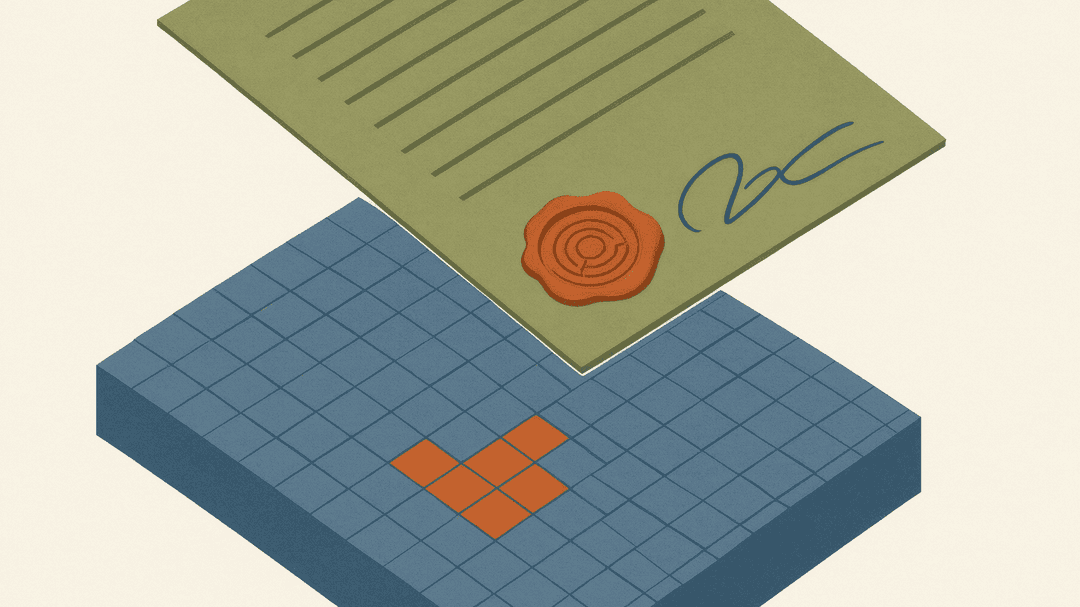
Layer one is C2PA, the Coalition for Content Provenance and Authenticity standard backed by Adobe, Microsoft, Intel, the BBC, Leica, Nikon, Sony, Google and OpenAI. A C2PA manifest is a signed metadata bundle that travels inside the file: which tool generated it, which tools edited it afterward, and a machine-readable digitalSourceType field drawn from the IPTC vocabulary that classifies an asset as fully generated, AI-enhanced, camera-captured or human-edited. A newer c2pa.ai-disclosure assertion extends that to model provenance and the degree of human oversight. OpenAI became a C2PA Conforming Generator Product, which is the mechanism that lets downstream platforms read, preserve and pass along what OpenAI's systems stamp.
Layer two is watermarking, and here the industry consolidation is stranger still: OpenAI licensed Google DeepMind's SynthID. Since May 2026, images generated through ChatGPT, Codex and the OpenAI API carry SynthID's invisible watermark; supported audio followed on 31 July; and on 5 October OpenAI said the work had expanded to text in the EU to comply with Article 50. Google, meanwhile, disclosed at I/O in May that SynthID verification and C2PA Content Credentials checks were coming to Search and Chrome, so a user can right-click an image and ask "was this generated with AI?" without leaving the browser. By October 2026 Google said SynthID had watermarked more than 180 billion images and videos plus roughly 240,000 years of audio since 2023, that its Search, Chrome and Gemini surfaces handle more than one million verification requests daily, and that the standalone SynthID Detector portal was open to everyone in English, with OpenAI, NVIDIA and Kakao already inside and Apple announced to join.
The design logic is explicit. Metadata carries rich context but is fragile: OpenAI's own announcement concedes it "can be stripped, lost through uploads and downloads, or broken by transformations like file format changes, resizing, or screenshots". A watermark survives those operations but carries almost no context. The layers are meant to fail independently, so a screenshot preserves a signal and a re-encode preserves a receipt.
What it catches, and what it does not
The distribution problem is now largely solved on the generation side. The files leaving the major labs are stamped. The honest questions are about everything else.
First, provenance is not detection, and the vendors say so. OpenAI's verification tool will not conclude that an image is not AI-generated when it finds no signals, because the absence of a receipt is not evidence of innocence. A photo from a camera with no C2PA support, a file from a model outside the partner list, or an image that passed through an aggressive messenger compression all return the same clean answer as a human photograph. The system proves participation. It does not prove absence, which is precisely what a deception investigation wants.
Second, watermark robustness is an arms race Google's own papers acknowledge. The SynthID-Image deployment paper describes a deliberate robustness-versus-quality trade-off and tests against 30 common transformations, while conceding that robustness across a wide range of threat models is "particularly tricky". The research community has moved faster than the product pages: a CVPR 2026 paper measuring prior removal attacks reports that a simple latent-optimization attack drove some image watermarking schemes' detector performance below 0.1 AUC, and 2026 preprints on view-synthesis erasure and learned residual-decomposition removals make the same structural point, that anything a detector reads from pixels, a model can learn to discard while keeping the picture. For text, an arXiv study of SynthID-Text found it resists word-level edits but degrades sharply under paraphrasing and back-translation, the cheapest attack imaginable, since the semantics survive and the token-level signal does not.
Third, the platform layer inherits both fragility and false positives. Meta's "AI info" label on Facebook, Instagram and Threads is driven by C2PA and IPTC signals, watermarks where present, and poster self-disclosure, with no published pixel detector. Since May 2026 YouTube also auto-labels from C2PA and its own detection, and TikTok reads C2PA alongside proprietary classifiers. Because the platforms read the standards slightly differently, the same file can be labeled on one surface and unlabeled on another. And the metadata read is trip-wide: in September 2026 users reported genuine photographs tagged as AI after only minor AI-assisted edits in tools like Canva, because the export stamped a credential the platform dutifully read. A label that fires on a crop-and-heal in an image editor tells you the tool chain, not the truth of the picture.

What this means if you ship generative products
The practical reading of the late-2026 state of the art: if your product generates images, video or audio and reaches California or the EU, your obligations are concrete and dated. Legacy systems need compliant marking by 2 December 2026. A free detection endpoint is not a PR gesture but a statutory component, and in California it must accept uploads, URLs and programmatic queries. C2PA conformance is the interop contract that keeps your labels alive past your own site. And if you are a platform or a security team consuming these signals, treat a negative verification result as "unknown origin", never as "human", because that is exactly what the vendors' own documentation says it is.
The 2026 provenance stack is real infrastructure: hundreds of billions of marked files, million-a-day verification, two enforcement regimes and a watermark license between the two biggest AI competitors. It is also, by construction, a membership system. Files from labs that joined get receipts. The argument the labels did not settle, and probably cannot, is what to conclude about the ones that did not.
Sources
- Advancing content provenance for a safer, more transparent AI ecosystem, OpenAI
- We're making it easier to identify AI-generated content globally, Google (blog.google, 7 October 2026)
- Google SynthID product page, Google DeepMind
- Google, OpenAI announce expansion of SynthID digital watermarks, Mashable (I/O 2026)
- Guidelines on transparency obligations for providers and deployers of certain AI systems, European Commission
- Code of Practice on Transparency of AI-generated Content, European Commission
- EU AI Act Article 50 transparency obligations and the 2 December marking grace period, Regulation AI
- SB 942: California AI Transparency Act, bill summary (Digital Democracy)
- California and artificial intelligence watermarking law, Data Protection Report
- California SB 942 explained, including AB 853 date changes, Clearpol
- SynthID-Image: Image watermarking at internet scale, arXiv 2510.09263
- Robustness Assessment and Enhancement of Text Watermarking for Google's SynthID, arXiv 2508.20228
- Towards Robust Content Watermarking Against Removal and Forgery Attacks, CVPR 2026
- RAVEN: Erasing Invisible Watermarks via Novel View Synthesis, arXiv 2601.08832
- A New Implementation Guide for Content Credentials, C2PA
- AI Labels by Platform 2026: Instagram, TikTok, YouTube, Stripshot
- Instagram AI Detection Review 2026, Kompozy
