
Federal prosecutors have made new arguments in a court filing in the criminal case against Abdulrahman Alfozan, a former OpenAI engineer charged with planting an audio recording device in an executive conference room at the company's San Francisco offices. The filing, reported on Oct. 19 by CNBC, the BBC and The Verge, asks a judge to keep him in custody until trial. It describes alleged contacts with a member of the Saudi royal family and says a member of the Saudi military paid for his wife and son to leave the United States after his arrest.
Alfozan has not been convicted of any crime. Everything below is either an allegation by prosecutors, a statement from his lawyer, or a statement from OpenAI, and each item is attributed to the source that reported it.
What he is charged with
According to the Justice Department's October 13 announcement, Alfozan, 35, "a national of the Kingdom of Saudi Arabia," was arrested on Oct. 9 and charged with "using or endeavoring to use an electronic, mechanical, or other device to intercept oral communications." The criminal complaint, filed Oct. 8 in the U.S. District Court for the Northern District of California, cites 18 U.S.C. § 2511(1)(b).
The department says that if convicted, he faces a maximum penalty of 5 years in prison and a $250,000 fine, followed by 3 years of supervised release. He made his initial appearance in federal court on Oct. 13, the day the complaint was unsealed.
He is charged with that one interception offense. The Justice Department release does not mention an espionage or trade secrets charge, and none of the outlets cited here report one.
The device timeline, as alleged
The core facts come from the complaint as summarized by the Justice Department, with additional details from the new filing as reported by CNBC.
- July 2025: Alfozan begins working at OpenAI as an engineer, according to the Justice Department.
- Before Sept. 28: He used "a productivity tool" to make multiple inquiries about OpenAI's building addresses, meeting rooms, meeting-room capacities and calendars, "leadership and exec" locations, and external partner meetings, the complaint alleges.
- Sept. 22 to 28: Photographs on his iPhone from these dates depict "at least one additional concealed device as well as what appear to be the input/output panels on televisions and other electronic devices in various locations in OpenAI buildings," according to the new filing as quoted by CNBC.
- Sept. 24 to 30: A chatbot account associated with his spouse, which "shared multiple identifiers and attributes with Alfozan's own chatbot account," submitted prompts "related to building, customizing, installing, audio recording, testing, obfuscating, and remote accessing a device," the complaint alleges. The Justice Department quotes prompts including "build[ing] a continuous audio recorder" and "encrypt[ing] the SD card."
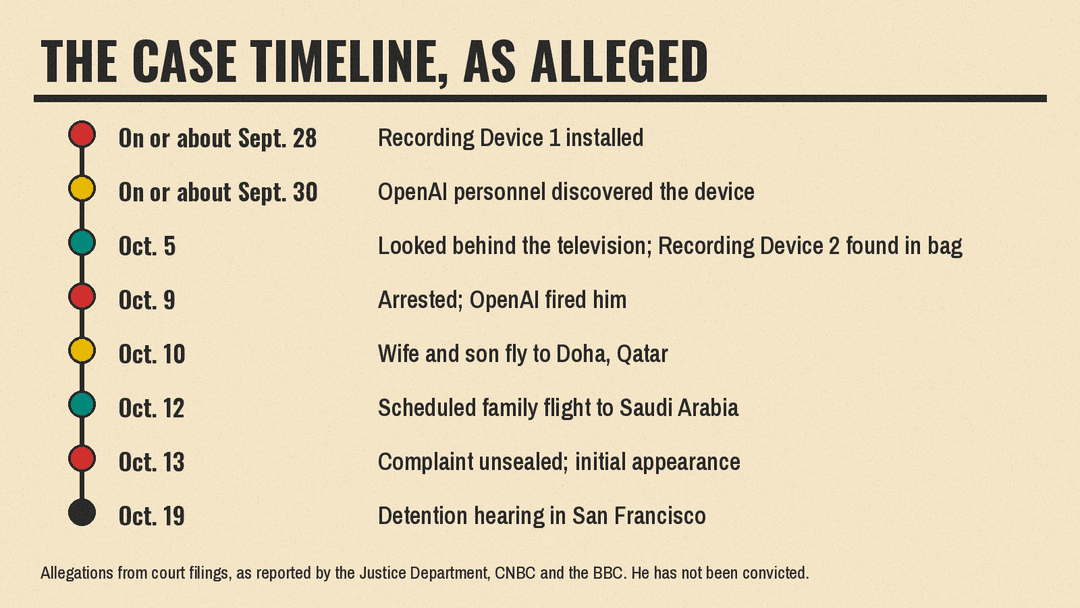
- On or about Sept. 28: The device, which the Justice Department calls Recording Device 1, was installed. OpenAI determined that it had been concealed in toilet paper and that its contents were encrypted. The new filing, as quoted by CNBC, says he "inserted a surreptitious audio recording device into a USB port on the back of a television in an executive OpenAI conference room."
- On or about Sept. 30: OpenAI personnel discovered the device. A camera was then installed in the room, CNBC and the BBC report.
- Oct. 5: Alfozan entered the executive conference room "and appeared to look behind the television," the complaint alleges. The same day, he left a bag unattended in a different room in an OpenAI building. Security personnel found his wallet and ID in it, along with "another recording device (Recording Device 2) similar to Recording Device 1," according to the Justice Department.
- Oct. 8: The criminal complaint is filed.
- Oct. 9: The FBI arrests Alfozan, according to the BBC. OpenAI fired him after the arrest, CNBC reports, and The San Francisco Standard reports that OpenAI said he was terminated the day he was arrested.
- Oct. 10: His wife and three-month-old son fly from San Francisco to Doha, Qatar, according to the filing as reported by CNBC and the BBC.
- Oct. 12: The date on which the family had been scheduled to fly to Saudi Arabia, according to CNBC.
- Oct. 13: The complaint is unsealed and he makes his initial appearance in court.
- Oct. 19: A detention hearing is scheduled in U.S. District Court in San Francisco.
The device itself was identified in court documents as a Seeed XIAO ESP32-S3 Sense, according to The San Francisco Standard. CNBC reports that the new filing says a deleted September note on his phone contained "links to various recording devices, including devices made by Seeed Studio, the manufacturer of the devices OpenAI found in its offices and the devices FBI agents found in the defendant's residence."
Why prosecutors call it a national security matter
The new filing says the alleged conduct "could pose a danger to the national security of the United States," CNBC reports. Prosecutors wrote that in the days around Sept. 28, "OpenAI executives met with government officials in that very room."
According to the filing, the conference room is frequently used for "discussions of highly confidential technical, commercial, and strategic information, including proprietary research, as well as nonpublic information about OpenAI's technical progress and strategic decisions, capabilities, priorities, government engagements, and commercial relationships."
In the Justice Department release, FBI Director Kash Patel said Alfozan "allegedly concealed a covert recording device inside his employer's executive conference room to secretly capture sensitive communications about the company's super intelligence technology." U.S. Attorney Craig H. Missakian said, "For us it is a matter of national security."
What the new filing alleges
The filing's purpose is to argue that Alfozan should be held without bail. The U.S. Attorney's Office for the Northern District of California is asking a judge to keep him detained, CNBC reports. Its main points, as reported:
- Contact with a Saudi royal. Prosecutors said Alfozan had been "in frequent communications via WhatsApp with a member of the Saudi Royal Family" throughout 2025 and 2026, CNBC reports. According to CNBC, prosecutors said he communicated with the royal as recently as Oct. 5, four days before he was arrested. The Verge also reports the Oct. 5 contact.
- Recruitment messages. The filing says the royal family member told Alfozan "that an artificial intelligence initiative was being launched in Saudi Arabia and wanted the defendant to join it." In May 2026, according to the filing, the individual told Alfozan that Saudi "needs you more" than the U.S., and Alfozan replied "100," which prosecutors say indicated he agreed. Prosecutors also wrote that "the individual repeatedly tried to recruit the defendant and asked when he planned to leave OpenAI," and that Alfozan "said he wouldn't leave until his stock vested."
- The family's flight. CNBC reports the filing says the Saudi government and then, shortly afterward, a member of the Saudi military booked separate flights for Alfozan's wife and son after his arrest. The flight to Doha on Oct. 10 was a business-class flight "paid for by the unidentified member of the Saudi military," according to CNBC. The BBC describes it as a one-way business class ticket "booked and paid for by a Saudi military official."
- Flight risk. Prosecutors argued that Alfozan has access to "ample resources ... and what appears to be considerable support from a foreign government that has (i) no extradition treaty with the United States; (ii) limitless resources; and (iii) the ability to provide extraordinary travel assistance," CNBC reports. "He has the connections needed not only to flee, but to build a new life in Saudi Arabia," prosecutors wrote. The BBC quotes them as arguing that "the defendant has little incentive to remain in the United States to see this case through."
- Plans to leave. The filing says a note on his phone titled "OpenAI leave" suggests he planned early pickup "of the devices he had installed or intended to install and then extending his planned parental 'leave to full,'" according to CNBC. It also says he "was pursuing other opportunities in Saudi Arabia," including the Misk Foundation's "2030 Leaders" program.
- Components at home. "The defendant's residence contained several electronic components similar to those in the customized devices the defendant installed in the OpenAI conference room," the filing says, as quoted by CNBC.
What the filing does not allege
Several limits on the new allegations are spelled out in the reporting.
- It does not say the royal directed the device. CNBC reports that "the filing does not say the Saudi royal directed Alfozan to install a recording device at OpenAI or steal information from the AI giant."
- It does not identify the royal. Prosecutors did not name the Saudi royal "or say how Alfozan knew that person," according to CNBC. The Verge refers to the person as "the unnamed royal."
- It does not identify the military official. CNBC refers to an "unidentified member of the Saudi military."
- It does not report what the device recorded. OpenAI determined that the device's contents were encrypted, according to the Justice Department. None of the sources cited here report what, if anything, was captured.
OpenAI has also said, according to The San Francisco Standard, that it has no indication that Alfozan improperly accessed or took model weights, source code, or customer data, and that it has not seen activity that compromised the safety of its products or customers' information.
The Saudi government did not immediately respond to BBC requests for comment. CNBC reports that the Saudi embassy in Washington has not responded to its requests for comment since the arrest was announced on Oct. 13.
The defense's position
Alfozan's lawyer, William Pernik, has filed his own request asking that Alfozan be released, according to CNBC. The request asks for home detention with GPS monitoring and a bond co-signed by others, "supported by the written undertaking of the Consulate General of the Kingdom of Saudi Arabia."
CNBC reports these arguments from the defense filing:
- "Nationality is not evidence of flight," Pernik wrote, and the planned travel to Saudi Arabia was for "family and immigration reasons."
- The wife's 60-day post-employment grace period for her own visa was expiring on Oct. 12, the original date of the family's flight, the lawyer said.
- "Mr. Alfozan was made aware of OpenAI finding the device per its own filings and OpenAI's public statements, approximately eight to ten days before he was arrested," Pernik wrote. "If his intention was to flee, he would have done so at that time."
- Alfozan regularly bought one-way tickets because he has learned they are more cost-effective than changing flights at the last minute, the lawyer said.
- The Saudi Consulate General confirmed in writing to the U.S. Pretrial Services Office that it "will not issue any travel documents" to Alfozan during his release, according to Pernik.
- "Fifty-four people, at least twenty-seven of them in the Bay Area, have written to the Court," Pernik wrote. "That is not the profile of a person with one foot out the door."
The defense arguments reported so far address detention and flight risk. None of the sources cited here report a response from the defense to the underlying charge.
What OpenAI has said
OpenAI said on X that after discovering the device, employees used the company's AI models to determine what it was and where it came from, and referred the matter to the FBI, according to The San Francisco Standard. The company said its technical surveillance countermeasures team found the device during a sweep of a conference room, and that it coordinated the timing of his firing with the FBI. It said it will continue to support the FBI's investigation, the Standard reports.
What happens next
The detention hearing is set for Monday, Oct. 19, before U.S. Magistrate Judge Alex G. Tse, according to The San Francisco Standard. The BBC reports he is scheduled to appear in federal court in San Francisco later on Monday. At the time of writing, no outcome from the hearing had been reported.
The hearing concerns whether Alfozan stays in custody pending trial, as prosecutors ask, or is released under conditions such as those his lawyer proposed. The BBC reports that the FBI investigation is ongoing. As of the Justice Department's Oct. 13 release, the case was proceeding on a criminal complaint.
Why it matters
The case involves an alleged attempt to record conversations inside an executive meeting room at a major AI company. Prosecutors are framing it as a national security matter, and the Justice Department release ties the prosecution to a presidential memorandum on "American superiority in super intelligence technology." The new filing adds allegations about contacts with a foreign government, while, as CNBC notes, stopping short of saying anyone directed the alleged recording. How the court weighs those claims at the detention stage is the next public test of the government's case.
Sources
- CNBC: OpenAI bugging suspect's conduct could pose danger to U.S. national security, feds warn (Oct. 19, 2026)
- BBC: Ex-OpenAI worker accused of planting device had Saudi support says court filing (Oct. 19, 2026)
- The Verge: OpenAI staffer accused of planting bug was allegedly in "frequent" communication with a Saudi royal (Oct. 19, 2026)
- U.S. Department of Justice: Saudi National Arrested for Installing Surreptitious Audio Recording Device at OpenAI (Oct. 13, 2026)
- Criminal complaint, United States v. Alfozan, N.D. Cal. (filed Oct. 8, 2026), hosted by Ars Technica
- The San Francisco Standard: OpenAI engineer arrested in bugging of executive conference room (Oct. 13, 2026)
