
The International Energy Agency's flagship annual forecast, published Thursday, landed with a warning aimed directly at the AI industry: data centers will consume twice as much electricity by 2030 as they do today, and three-quarters of that growth will come from artificial intelligence.
The World Energy Outlook 2026 (WEO-2026) puts the additional load from AI data centers at roughly 350 terawatt-hours per year by 2030, more than the whole of Great Britain consumes annually. Fewer than 100 major AI projects now in development would require a combined 50GW of power on their own, matching peak UK demand, and the agency expects global data center investment to hit $4 trillion by 2030.
Coal and gas, not renewables, are pacing the growth
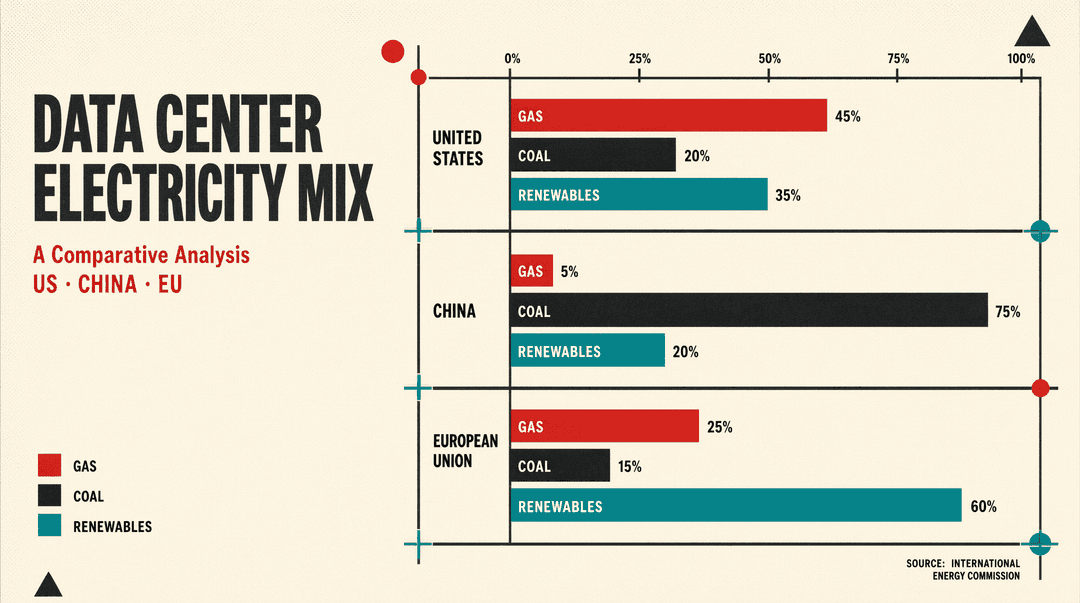
Despite data center developers having emerged as the world's biggest corporate buyers of renewable energy, the IEA expects fossil generation for the sector to grow faster. Its country breakdown:
- In the US, about 60% of electricity for data centers is expected to come from gas by 2030. Plans filed as of August called for roughly 180GW of new gas-fired capacity tied to US data centers, almost as much new gas capacity as the European Union has installed in total.
- In China, around half of the power for AI data centers is expected to come from coal by the end of the decade, with renewables supplying most of the rest.
- In the EU, data centers are expected to run on renewables for about 70% of their electricity, followed by nuclear and gas.
- Canada's planned data center gas generation is 11GW, and the rest of the world combined has put forward plans for just 4GW. American developers' appetite for gas is more than 16 times higher than Canada's.
Taken together, the agency forecasts data center carbon emissions rising 70% by 2030.
How the IEA counted an opaque industry
Data center capacity is notoriously hard to measure, and the WEO-2026 leaned on proxies. Annual global shipments of AI servers have climbed eighteen-fold since 2020. Space-based imagery was used to track construction of 93 large "AI factories" around the world. The agency estimates the existing global data center stock now stands at 120GW, 80% of it in China, the US and the EU, and expects another 120GW to be built by 2030 in its central case, three-quarters of it for AI.
The report frames all of this inside what the IEA calls the largest energy supply shock in history, the disruption to Middle East supply and shipping through the Strait of Hormuz, which is pushing countries toward electrification, domestic energy resources and new trade routes even as computing demand accelerates. In one striking milestone, the IEA finds that energy needed to cool buildings is now overtaking energy needed to heat them for the first time.
"I don't see any credible pathway for the energy world to return to the way it was before," IEA Executive Director Fatih Birol said.
For the AI sector, the practical implication is that the grid, not the chip supply chain, is increasingly the binding constraint on the buildout. The agency notes that electricity demand is set to grow even faster than recent trends to 2035, with data centers named alongside electric vehicles, heat pumps and air conditioning among the drivers. Every frontier lab that signed a gigawatt-scale deal this year should expect regulators, utilities and ratepayers in the host countries to be reading those numbers back to them.
Sources
- Datacentres to create 70% more carbon emissions by 2030, IEA report warns, The Guardian
- IEA sees data center boom pushing power grids to the limit, Bloomberg
- As an unprecedented shock reshapes the energy world, its duration will determine the scale of the change, IEA press release (WEO-2026)
- Data center electricity use could double by 2030, IEA says, CNBC
