
Nuclear technology developer TerraPower announced plans to finalize its first dedicated data center power project this year, positioning its Natrium sodium-cooled fast reactor architecture to meet the volatile power demands of artificial intelligence infrastructure.
The project, slated to break ground in 2027, marks the company's second commercial deployment following its initial facility currently under construction in Kemmerer, Wyoming. In January, Meta signed an agreement with TerraPower to purchase power from eight Natrium reactor units.

The Load-Ramping Challenge in AI Compute
Data center power architectures face substantial operational strain due to the variable electrical loads imposed by large language model training clusters and real-time inference serving. Unlike conventional steady-state enterprise workloads, GPU clusters experience rapid power swings as compute cycles surge during training checkpointing or bursty inference queries.
Traditional baseload power generation struggles to accommodate these swings:
- Conventional Nuclear Generation: Standard light-water reactors maintain high capacity factors (averaging 92.5 percent in the United States) but adjust output slowly, ramping at approximately 5 percent of rated capacity per minute according to the National Laboratory of the Rockies.
- Gas Turbines: Rapid thermal cycling under sudden load fluctuations accelerates mechanical wear on turbine components.
- Battery Storage Costs: Compensating for grid ramps using utility-scale battery banks introduces significant capital expenditures and maintenance overhead.
Molten Salt Thermal Buffering Architecture
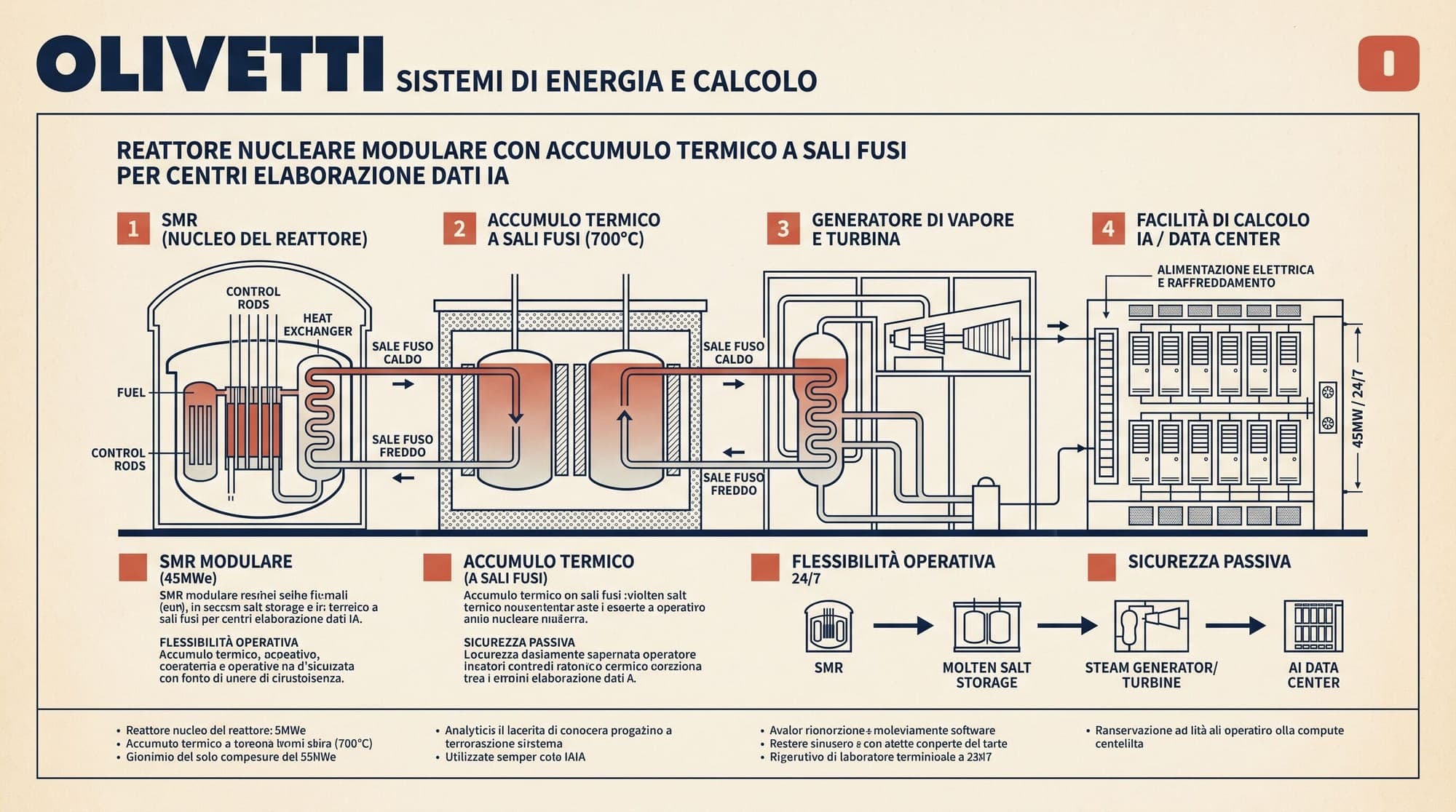
TerraPower's 345-megawatt Natrium design decouples nuclear heat generation from electricity production by integrating a molten salt thermal energy storage system.
Under this architecture, the sodium-cooled reactor core operates continuously at full thermal output, maximizing capital efficiency and fuel utilization. During periods of lower data center demand, surplus thermal energy is routed directly into an insulated molten sodium and salt storage reservoir.
When AI workloads spike, the facility draws thermal energy from the storage reservoir to generate additional steam, boosting turbine output up to 500 megawatts for several hours without altering reactor core operating parameters. This thermal buffer absorbs short-term electrical transients, providing clean baseload capacity capable of responding to computational load shifts.
Commercial Deployment Timeline
As hyperscale operators seek dedicated power sources to bypass strained regional electric grids, small modular reactors (SMRs) with integrated storage offer a mechanism to deliver high uptime without fossil-fuel peaker plants. TerraPower expects to advance site selection and licensing for the data center facility ahead of the 2027 construction target.



