
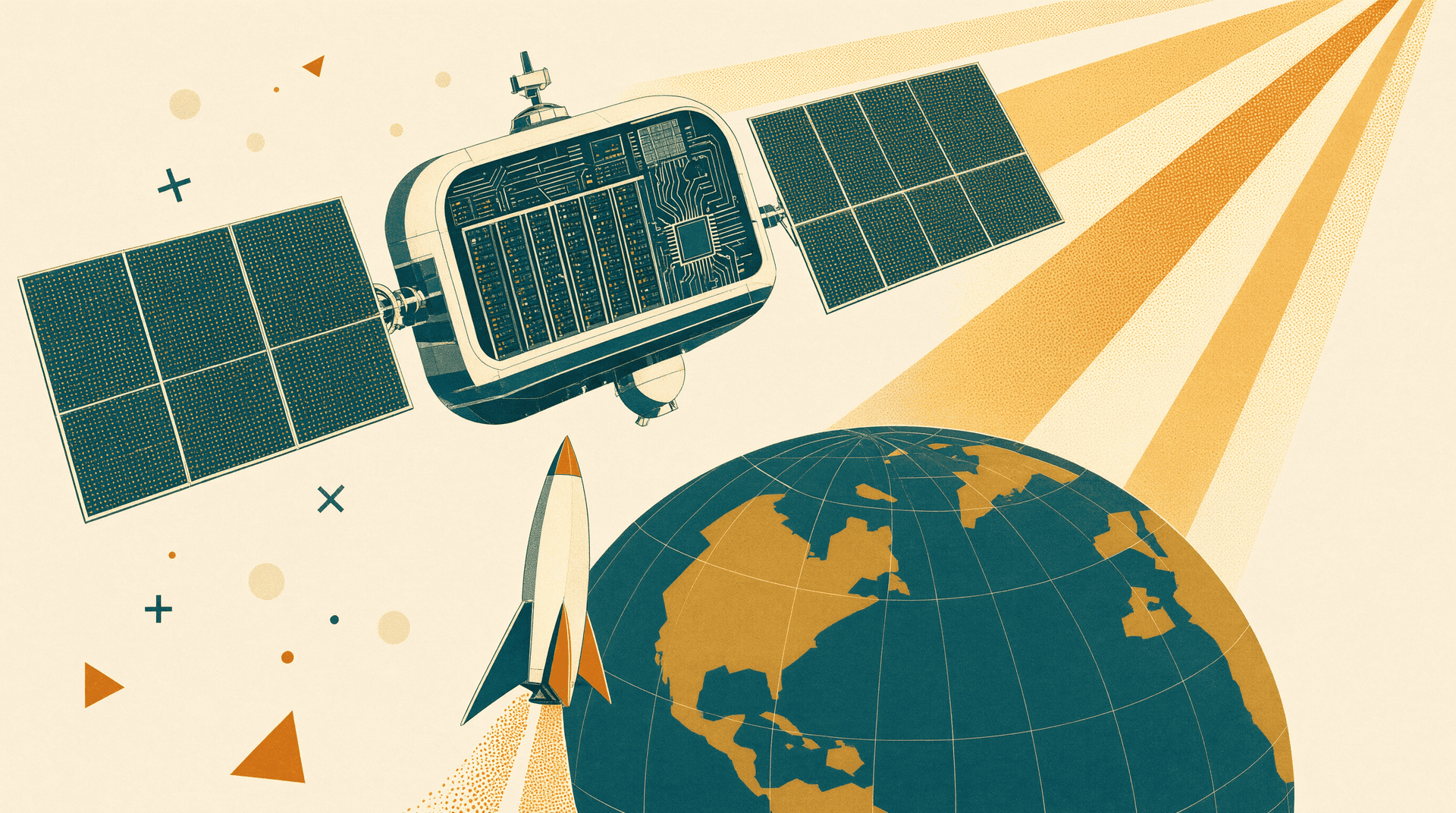
Blue Origin will fly Google's orbital AI servers. The two companies announced on November 19, 2026 that a New Glenn rocket will launch satellites carrying Google Tensor Processing Units into sun-synchronous orbit in the first quarter of 2029, in what they describe as the first dedicated heavy-lift launch for Project Suncatcher.
The satellites are sized to deliver computing capacity at roughly the scale of a single data center rack. Financial terms were not disclosed.
From rideshare to dedicated lift
Google's first orbital TPU did not ride a rocket of its own. In October 2026 a prototype spacecraft called MVP, about the size of a refrigerator and built by Planet Labs, flew to orbit on a SpaceX Falcon 9 as part of the Transporter-18 rideshare. It carried four TPUs and roughly one kilowatt of solar power. Once in orbit Google booted the chips, ran inference through an on-board Gemma 4 model, and received the first AI-generated answer transmitted back from space. A haiku, in case the tone of this story was unclear.
The Blue Origin contract is the step from science-fair payload to committed infrastructure. A dedicated heavy-lift launch means Google is buying capacity for a cluster rather than a single test article, and sun-synchronous orbit is the choice that keeps solar panels in near-continuous light. Google has said a panel in the right orbit can produce up to eight times the energy of the same panel on the ground, which is the entire economic premise of the program.
What still has to be proven
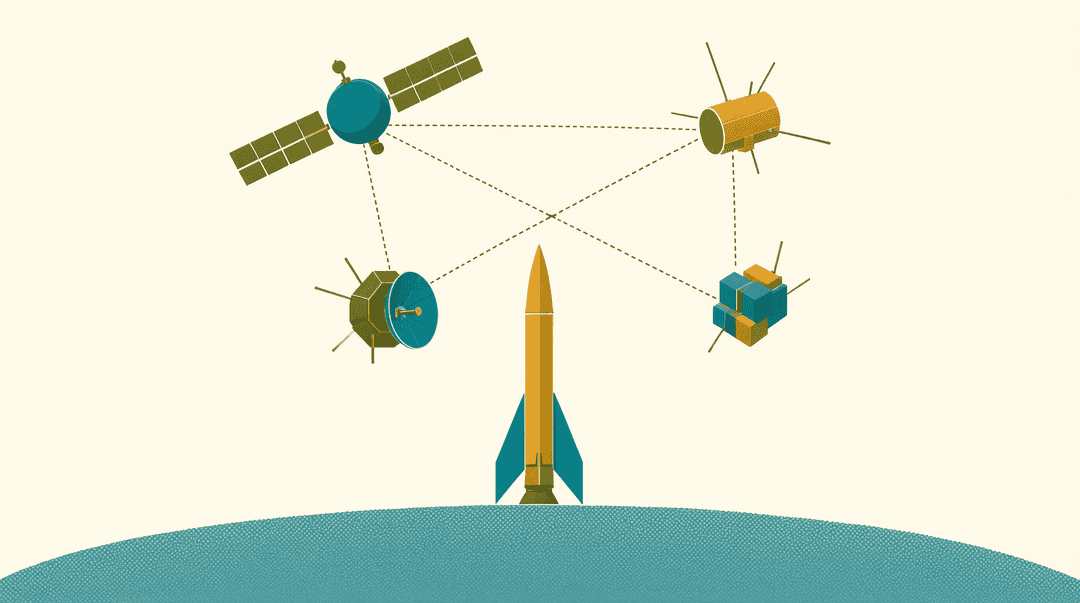
The technical list is long and mostly unglued. Google's own published plan puts the next milestone at 2027, when it intends to fly two interconnected satellites and test high-bandwidth laser links between them. That is the load-bearing test: without reliable optical inter-satellite links, Suncatcher is a handful of expensive computers that cannot work as one machine. Google has described the pointing problem as hitting a coin-sized target from miles away while both objects are in motion.
Thermal behavior is the second constraint. On the MVP prototype the TPUs run compute in short windows of around fifteen minutes before shutting down to cool, against a one-year design life and a planned deorbit in about six years. Radiation tolerance, and launch vibration loads that individual chips can experience at 50 to 100 g, are the other two items Google lists among its engineering hurdles.
The scaling arithmetic is where skepticism belongs. Google's long-range concept is clusters of satellites each carrying dozens of TPU chips, with designs under study above 80 spacecraft. Orbital compute at that point has to beat terrestrial data centers on cost per token, not just on novelty, and launch economics remain the binding term of the whole exercise.
Travis Beals, Google's senior director for Project Suncatcher, called the program a long-term moonshot to scale AI infrastructure in space by tapping abundant orbital solar power. Constellation plans of this kind also carry the standing objections around orbital debris and night-sky preservation, which the project has had to address as it moves from paper to payload.
The competitive shape
Google is currently the only operator in the field that controls the accelerator, the frontier model, the cloud demand and a flight-proven path to orbit, and it just diversified its launch dependency away from a single provider. Starcloud has flown Nvidia H100 hardware in space, and SpaceX has filed for a constellation of up to one million satellites delivering compute in orbit. The fight over whether the next generation of AI capacity gets built on the ground or above it is now a procurement story rather than a thought experiment.
Sources
- The Verge: Blue Origin will launch Google's AI server satellites in 2029
- Techmeme: Google partners with Blue Origin for Project Suncatcher
- Google: Learn about Project Suncatcher
- Google Research: Exploring a space-based, scalable AI infrastructure system design
- The Verge: Google's satellite AI server transmits its first response to Earth
- Futurum: Project Suncatcher prepares to launch TPUs
