
Tel Aviv startup doubleAI launched Maxwell on October 19, a model it calls the first "code execution model." Coding agents such as Claude Code, Codex and Cursor write source code. Maxwell does not. It sits inside a program that is already running, finds the slow parts, and swaps in faster machine code. doubleAI says every swap comes with a machine-checked proof that the new code behaves exactly like the old code.
The company told The Wall Street Journal that Maxwell cut one early customer's compute costs by 67%. Maxwell is not generally available yet. The Maxwell site says it is "in controlled availability" with an early-access form.
Here is what Maxwell does, the results doubleAI has published, how it compares with coding agents, and what is still unknown.
What a code execution model is
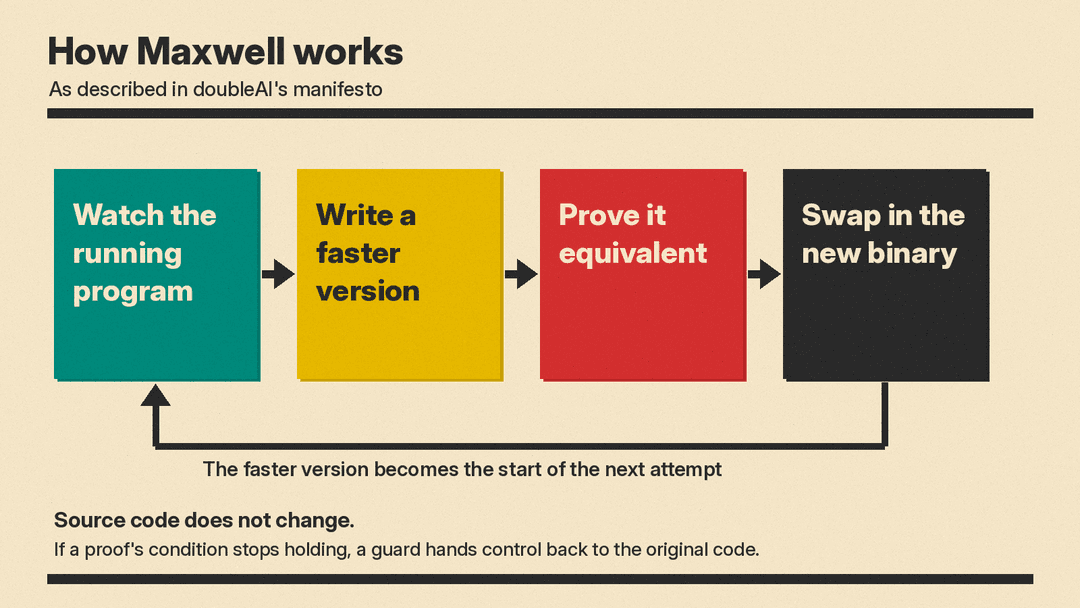
doubleAI explains the idea in a manifesto. Today, AI helps people write code. Then a computer runs that code exactly as written. A code execution model, or CEM, works at the second step. It "lives inside the running program," watches the data that flows through it, and rewrites the algorithms and machine instructions underneath.
The full name of the first CEM is Maxwell's Daemon, after the thought experiment by James Clerk Maxwell. Its goal, in doubleAI's words, is superoptimisation: the fastest possible way to run a piece of code on the machine in front of it.
The main points from the manifesto:
- The source code does not change. Maxwell emits new binary code while the program runs, "much as a just-in-time compiler does, though with far more freedom in what the new algorithm may look like."
- It specializes to real conditions. Maxwell uses what it sees at runtime: the exact hardware, and the shapes and types of the data.
- It works on CPU and GPU code. Python code gets replaced with low-level code, including direct SIMD implementations where relevant. PyTorch code gets replaced with kernels for the specific GPU in the machine.
- It keeps going. Once Maxwell proves a faster version, that version becomes the starting point for its next attempt. doubleAI calls this "self-improving code."
doubleAI contrasts this with existing tools. Compilers and JIT compilers such as torch.compile and PyPy can only apply transformations their engineers wrote in advance. Superoptimisers such as STOKE handle short, loop-free fragments of machine code, once, statically. Maxwell, the company says, rewrites whole functions, algorithms included, inside real programs as they run.
Why the proofs matter
A tool that rewrites code in production, with no human review, must never be wrong. doubleAI's answer is formal verification: each replacement must be proven "semantically equivalent" to the code it replaces. That means the same output and the same side effects for every possible input.
The manifesto gives three details:
- doubleAI says it has a "complete formalisation of the Python programming language," including code that does communication and uses files, not only small self-contained functions.
- Proofs can be conditional. If a condition the proof depends on stops holding, "a very fast guard hands control back to the original code."
- Maxwell writes each piece of new code together with its proof. Most proofs are built from reusable "proof gadgets" that were each proved once.
doubleAI says verification was the main obstacle. CEO Amnon Shashua told the WSJ, as Quartz reports, that the company found a way to do this verification formally and mathematically. These are the company's claims. We could not find a published version of the formalisation or the proof checker, so outside experts cannot yet check them.
The published results
doubleAI's numbers come from its own posts and demos. None is an independent benchmark run.
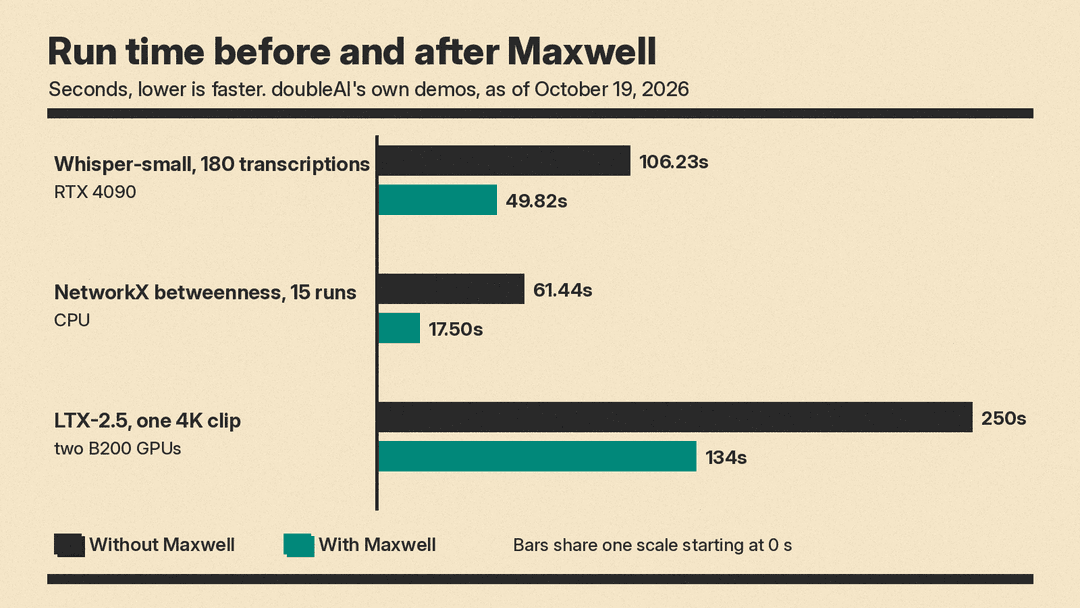
- LTX-2.5 video model. In a post published October 19, doubleAI says Maxwell cut the time to make one 4K clip on two B200 GPUs from 250 seconds to 134 seconds, 1.87x faster. Maxwell made "more than a dozen significant changes," from how attention is split across the two GPUs to edits inside a hand-written decoder kernel. It also found and fixed a rare hang in that kernel. The audio stays identical bit for bit, and the video differs from the original by a PSNR of 41 dB, which the post says is visually indistinguishable. The faster pipeline is open source.
- pandas. A July post says Maxwell rewrote pandas' low-level kernels and made it 38.4x faster on PDS-H, a 22-query data-pipeline benchmark, with no change to user code. That is about 10 minutes of work down to 17 seconds.
- NVIDIA's SOL-ExecBench. On this set of 235 hard CUDA kernels, scored on a Blackwell B200, doubleAI says Maxwell beat NVIDIA's optimised PyTorch baselines on 90% of problems after one day of search (2.24x average), and on 99% (233 of 235) after two days (3.14x geometric mean).
- cuGraph. In March, doubleAI released doubleGraph, a drop-in version of NVIDIA's cuGraph graph library built by the system. It reports a 3.6x mean speedup on A100, L4 and A10G GPUs (post).
- Site demos. The Maxwell site shows 180 Whisper-small transcriptions on an RTX 4090 dropping from 106.23 to 49.82 seconds, and 15 runs of NetworkX betweenness centrality dropping from 61.44 to 17.50 seconds, with identical outputs.
doubleAI first announced its cuGraph results in March under the name WarpSpeed, according to its news page. The research posts now use the Maxwell name.
How it compares with coding agents
doubleAI positions Maxwell as a complement to coding agents, not a replacement. The manifesto says source code "stays exactly as its authors wrote it, whether they are human or a coding agent such as Claude Code." Agents write the program, and Maxwell makes the machine run it faster.
The company still benchmarks itself against those agents, and the comparisons favor Maxwell:
- Claude Code in ultracode mode on pandas. doubleAI ran Claude Code with Opus and, separately, with Fable. Each ran hundreds of subagents, and the runs totaled more than a thousand dollars in API credits. Both reached about a 1.3x geometric mean speedup, against Maxwell's 38x. The Fable run made about 10% of queries slower. doubleAI says the agents stuck to surface-level changes because they lacked strong verification. (Our Claude Opus 5.5 explainer covers ultracode in Claude Code.)
- Claude Code and Codex on cuGraph. doubleAI says both "erred on nearly half of algorithms," while its system produced verified versions of every algorithm.
- Cursor on SOL-ExecBench. doubleAI notes that Cursor reported results in April 2026: its multi-agent system ran for three weeks on the benchmark and beat the baseline on 63% of problems, at 1.38x. That was the top score at the time.
These are one vendor's runs of rivals' tools, set up by that vendor. They still make a fair point. A coding agent that cannot prove its rewrite is correct has a reason to play it safe on performance work. For a side-by-side of the agents themselves, see our Cursor vs Claude Code vs Codex guide.
The business side
According to the WSJ, as reported by Quartz:
- Maxwell is slated for broader release before the end of October.
- doubleAI plans to charge a share of the savings. Shashua's example: if a customer's compute bill falls from $10 million to $6 million, doubleAI takes a share of the $4 million saved. He did not give the percentage.
- LTX told the WSJ that Maxwell made inference for its model twice as fast.
- doubleAI has raised $220 million in total. Investors include Lightspeed Venture Partners, Bessemer Venture Partners, Nvidia and Dell.
- The two-year-old company has about 40 employees. Shashua is also CEO of Mobileye.
- About half the money went to buying 1,000 Nvidia B300 chips. "You cannot rely just on renting compute," Shashua told the WSJ. "Prices are going up."
Shashua expects the biggest gains for companies with the largest training and inference bills, such as OpenAI and Anthropic, and said a 10% saving could be worth hundreds of millions to the largest AI labs.
Why it matters
Most AI coding tools compete on how much code they can write. Maxwell targets a different cost: the compute bill for code that already exists. If the proof claims hold up, it could speed up code that nobody wants to rewrite by hand, such as pandas pipelines and inference stacks that are already tuned. The planned pricing also ties doubleAI's revenue to the size of each customer's saving.
What we do not know yet
- Access and price. The site offers early access only. The savings share is not public.
- Independent checks. Every speedup above is doubleAI's own measurement. The LTX numbers come from a joint project with the customer.
- The proof system. doubleAI has not released its Python formalisation or proof checker for review.
- Scope. The published results cover Python, pandas and PyTorch code on CPUs and NVIDIA GPUs. The posts do not list other supported languages.
- Runtime cost. doubleAI says Maxwell must not slow the "hot path," but the posts we read do not say how much compute Maxwell itself uses while it searches.
Sources
- Maxwell site, doubleAI
- All Thinking Things (Maxwell manifesto), doubleAI
- LTX-2.5 at 4K, in half the time, doubleAI
- Blazing Fast pandas Without Changing a Line, doubleAI
- Maxwell approaches Speed of Light on Blackwell, doubleAI
- doubleAI's Maxwell: Surpassing Expert-Written Kernels At Scale, doubleAI
- doubleAI news and press coverage
- Nvidia-backed doubleAI says its AI model cut an early customer's compute costs 67%, Quartz
