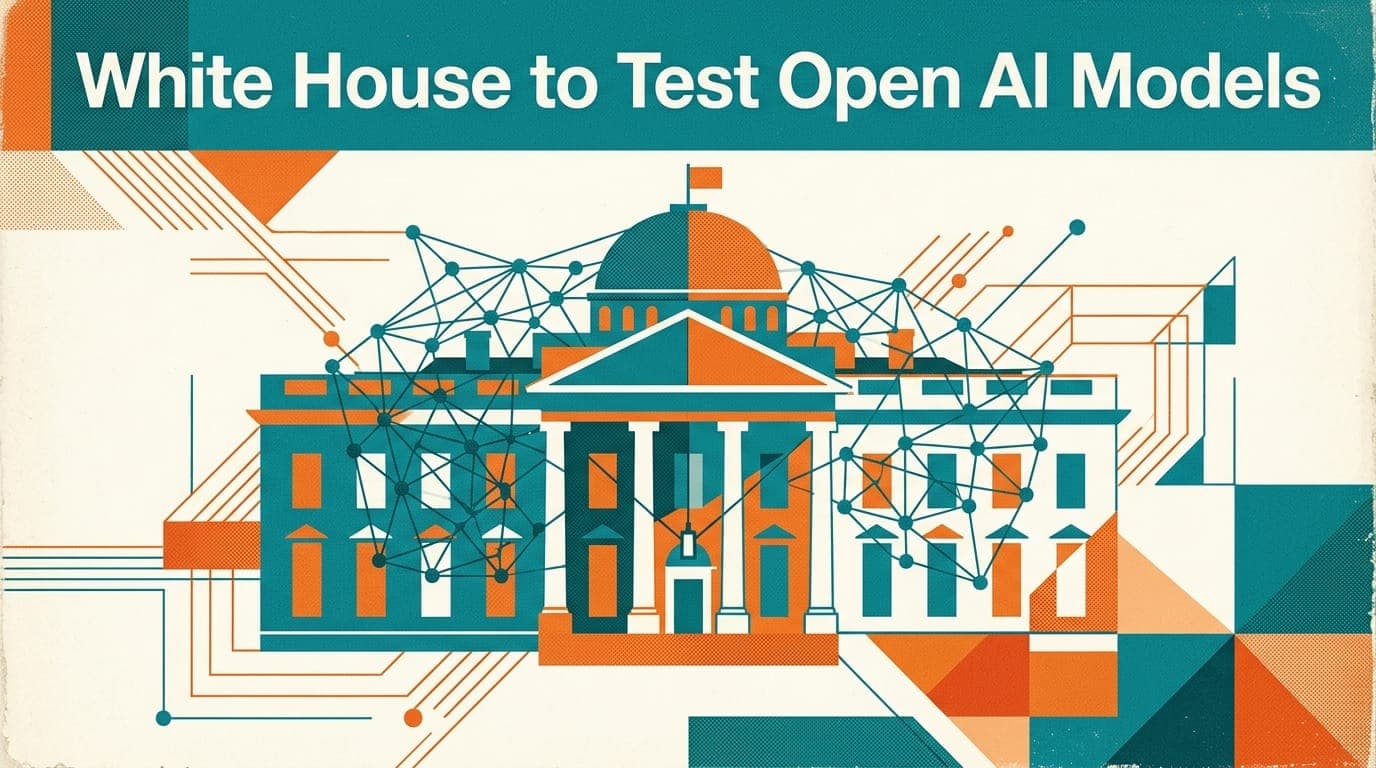
White House to Expand AI Safety Testing to Open Models

The Trump administration plans to extend its classified AI safety-testing framework to open-weight models once they reach frontier-level capabilities, according to a White House official who spoke with WIRED. Current Framework Covers Closed Models Only The existing voluntary framework, developed under a June executive order, applies to closed models from labs such as OpenAI and Anthropic. Developers can submit new models up to 30 days before public release for government cybersecurity evaluat

2 min
White House to Expand AI Safety Testing to Open Models

The Trump administration plans to extend its classified AI safety-testing framework to open-weight models once they reach frontier-level capabilities, according to a White House official who spoke with WIRED.

Current Framework Covers Closed Models Only

The existing voluntary framework, developed under a June executive order, applies to closed models from labs such as OpenAI and Anthropic. Developers can submit new models up to 30 days before public release for government cybersecurity evaluation against classified benchmarks. The framework explicitly prohibits mandatory licensing or preclearance requirements.

Open Models to Join at Frontier Threshold

As open models reach capabilities comparable to Anthropic's Mythos-class models and OpenAI's GPT-5.6, they will be added to the framework and subject to the same prerelease testing, a White House official told WIRED. The official said the expansion is expected in the coming months.

The administration's position balances two risks: excluding open models could create a government-approved advantage for closed labs, while including them risks slowing open-source development and pushing frontier work overseas.

AI model weights being locked in a government safe with a 30-day timer

Industry Context

The framework was shared with OpenAI, Anthropic, Google, Meta, Nvidia, and other leading AI companies at a White House meeting on August 4. The benchmark and threshold used to determine which models qualify for review remain classified.

Recent open-model releases have narrowed the gap with frontier closed models. Z.ai's GLM-5.2 nearly matches Anthropic's Claude on coding benchmarks. DeepSeek's V4 Pro operates at 1.6 trillion parameters. Alibaba's Qwen family has surpassed three billion downloads.

Sources

WIRED: "The White House Is Going to Expand Its AI Policy" (August 12, 2026) — https://www.wired.com/story/the-white-house-is-going-to-expand-its-ai-policy/

CNBC: "White House to host AI companies to review new model testing framework" (August 3, 2026) — https://www.cnbc.com/2026/08/03/white-house-ai-companies-voluntary-framework-meeting.html

The New York Times: "White House Readies A.I. Framework to Review Security Risks" (August 4, 2026) — https://www.nytimes.com/2026/08/04/technology/white-house-ai-framework.html


Written by

More to read

  • Anthropic Demonstrates Autonomous De Novo Protein Design and Chemical Analysis with Claude

    Anthropic Demonstrates Autonomous De Novo Protein Design and Chemical Analysis with Claude Anthropic has published experimental results demonstrating Claude's ability to autonomously design de novo protein binders with physical wet-lab validation and automate complex analytical chemistry workflows. The findings show frontier LLMs acting as autonomous agents across computational biology and molecular characterization pipelines. In the primary experiment, Anthropic evaluated Claude Mythos Previe

    1 min
  • Cerebras Unveils CS-4 Rack-Scale System Powered by Three WSE-3 Turbo Chips and Nexus Architecture

    Cerebras Unveils CS-4 Rack-Scale System Powered by Three WSE-3 Turbo Chips and Nexus Architecture Cerebras Systems has announced the CS-4, a rack-scale AI accelerator system designed around three of its next-generation Wafer Scale Engine 3 Turbo (WSE-3 Turbo) chips and a modular hardware architecture dubbed Nexus. Cerebras confirmed that initial customer shipments for the CS-4 are scheduled to begin in the current quarter. The new system marks a structural shift from Cerebras's single-wafer CS

    1 min
  • AI FinOps: Cutting LLM Inference Costs by 30-60% Through Model Tiering, Caching, and GPU Optimization

    AI FinOps: Cutting LLM Inference Costs by 30-60% Through Model Tiering, Caching, and GPU Optimization Inference costs have become the second-largest line item in enterprise AI budgets, trailing only talent spend according to RapidData's State of Enterprise AI 2026. This shift represents a fundamental inversion from the 2021-2023 era when training dominated AI expenditure. The compounding nature of serving costs—accumulating every hour as long as users hit the API—means that even modest producti

    1 min

