
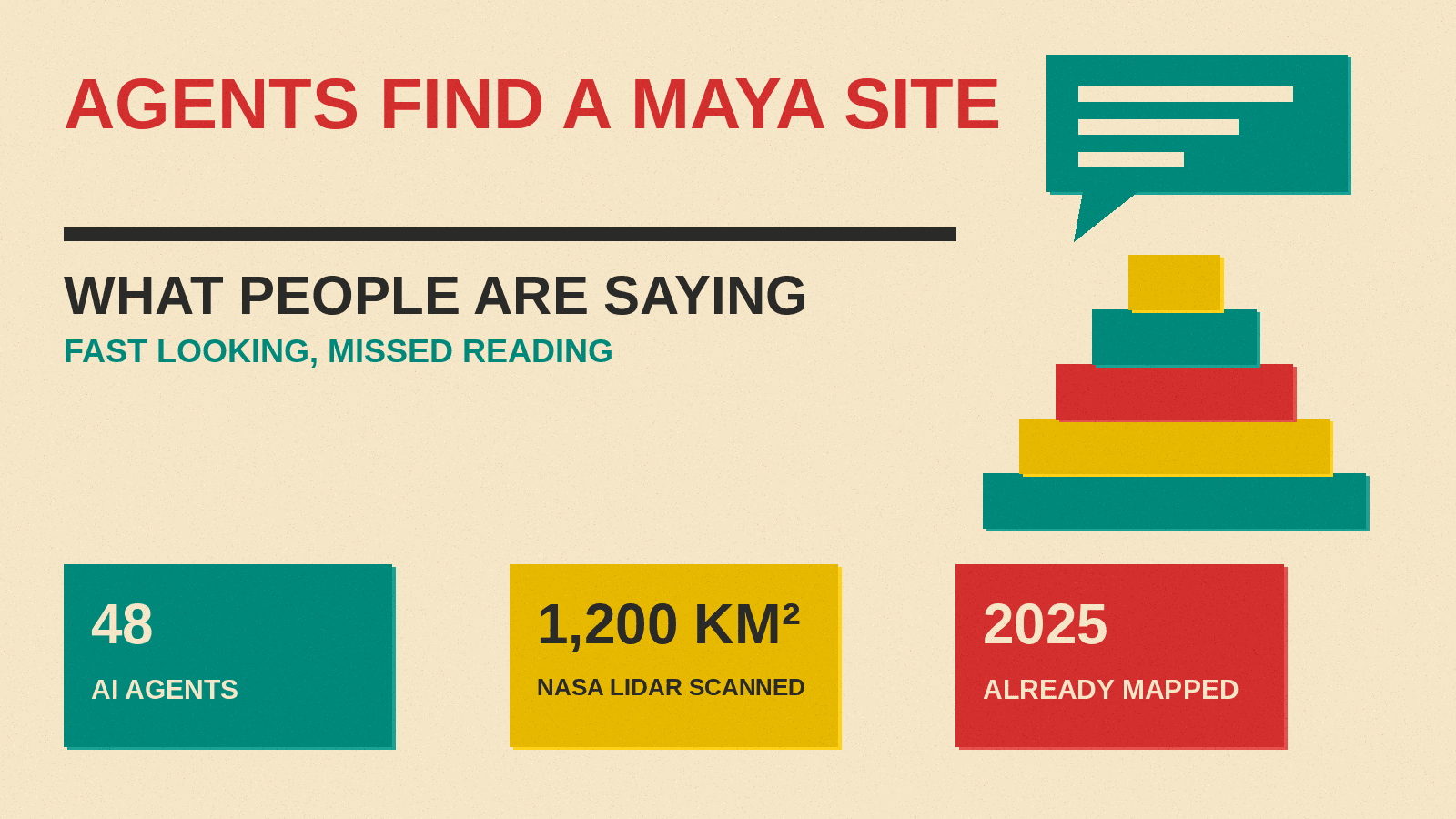
A software researcher pointed 48 AI agents at old NASA lidar scans of the Mexican jungle, and they flagged what looked like an unrecorded Maya civic centre. The story went viral on X and reached 900 points on Hacker News. Then came the twist: archaeologists had already mapped the site in 2025. Here is what Pietro Miotti says happened, and what people on X and Hacker News are saying about it. Counts are as of 3:20 PM PT on Nov 11.
What Pietro Miotti says his agents did
Miotti tells the story as a diary in a blog post now titled "My AI Agents (Re)discovered a Maya Site in 72 Hours". His X bio lists "Research @Google Paradigm of Intelligence", and posts on Hacker News and X described him as a Google SWE. He says plainly that he is not an archaeologist.
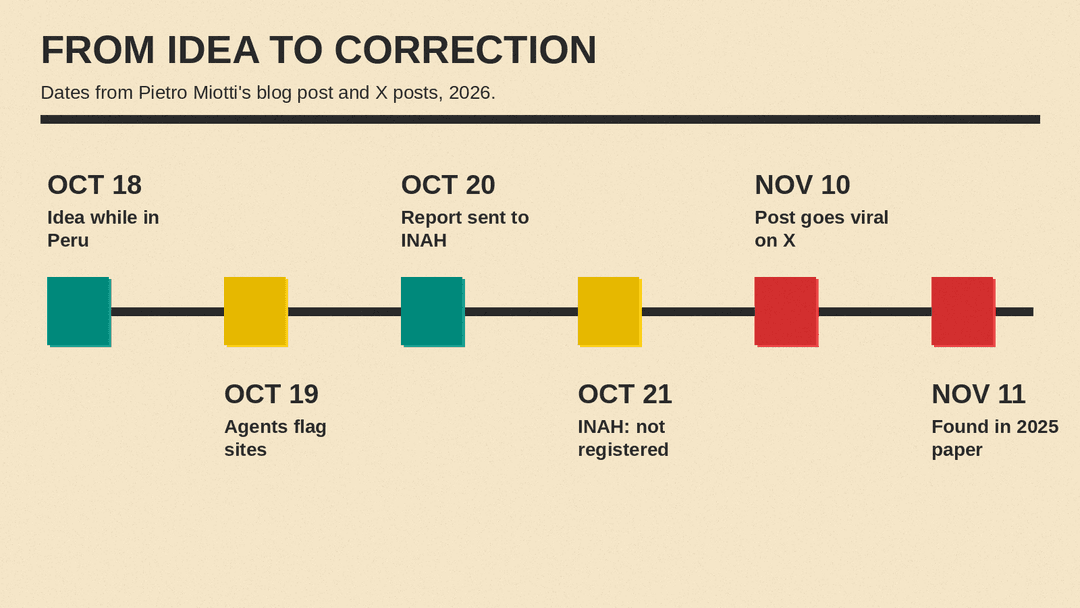
On Oct 18, while traveling in Peru, he asked Gemini, ChatGPT, Claude and Grok how the explorer Hiram Bingham might hunt for ruins with today's tools. All four said lidar, a laser scan that maps the ground under the tree canopy. Peru had little public lidar, so he switched to the Maya region.
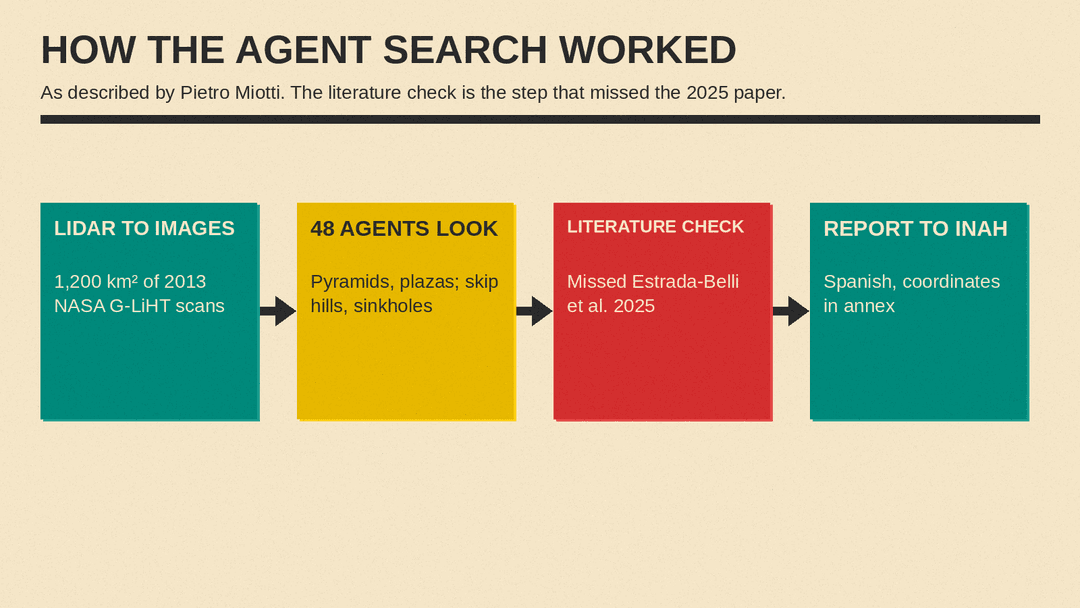
The data came from a NASA lidar dataset. The post labels the bare-ground scan 2013 and points readers to NASA's G-LiHT instrument. The agents turned about 1,200 km² of scans into images, and 48 agents went through them one by one with a written guide. They looked for pyramids, platforms and plazas and filtered out hills, sinkholes and roads. In Miotti's words, "There was no special model or classifier involved: the agents literally looked at the pictures, following a precise guide."
By the next morning the agents had flagged many structures. One hilltop site did not seem to be registered: a levelled plaza, an oval pyramid at least 8 to 12 m tall, a raised courtyard and a possible water reservoir. The agents checked the raw point cloud to make sure the shapes were on the ground and not in the trees. They also drafted a report for INAH, Mexico's National Institute of Anthropology and History, translated into Spanish, a language Miotti does not speak. On Oct 21, INAH replied that no registered archaeological site was identified at that location.
The 72 hours in the title cover the whole trip from idea to INAH reply, not 72 hours of agent compute.
The twist: the site was already mapped
On Nov 11, Miotti updated the post. The site appears in a 2025 paper by Estrada-Belli, Canuto, Šprajc and Fernandez-Diaz. "The agents missed it while going through the literature, so they rediscovered it rather than discovered it", he wrote. It was simply not yet in the INAH register.
He posted the same correction on X: "Update: the site had already been discovered. It appears in a 2025 paper by Estrada-Belli, Canuto, Šprajc & Fernandez-Diaz (page 14)." That update has about 70 likes. His original post, "My AI agents found an unmapped Maya site in Mexico, using LiDAR data from a NASA dataset.", has about 20,400 likes, 2,200 reposts and 1.28 million views.
Archaeologists spotted the problem early. @Marco_Langbroek shared a note he attributed to archaeologist Sarah Parcak: "The site was already published by Dr. Francisco Estrada-Belli of Tulane University ages ago. Mexican gov didn't have it in their database, but that doesn't mean it is unknown/unmapped". On Hacker News, strix_varius linked the earlier paper and said the title "seems incorrect".
Praise: citizen science with agents
Many readers liked the idea more than the find. Miotti's follow-up post, with about 2,800 likes, reads: "I think we're on the brink of a revolution across every science, not just coding, physics and math." @RichardSocher replied: "That is the exact thesis I describe in my book the Eureka Machine."
On Hacker News, pu_pe wrote: "I think we are about to see a whole new age of "citizen scientists", enabled by AI." The same comment adds: "The bottleneck will be data." hanoz, who built the UK lidar viewer lidarmap.uk, said dozens of previously unknown sites have been found with it, and that "Britain really is littered with this stuff."
Some people started their own runs. @georgepickett wrote: "Throwing some tokens at Scotland, looking for prehistoric roundhouses."
Pushback: hype, verification and who does the real work
The correction became the main point for many critics. @Shashankdev03 put it shortly: "agents can look. "is it new?" needs an expert." @MGCAPITAL99 wrote: "so the AI found the pyramid and skipped the reading".
On Hacker News, octocop wrote: "This post turned out to be a perfect example of the blind faith in LLM agents. Their outputs are not to be trusted and must be rigorously checked." chirau had asked for caution before the update: "I don't want to sound like a hater or anything, but I will personally wait for an expert archaeologist's verification on this." m0llusk said lidar finds by amateurs are common already: "This is not a big advance."
Others worried about the people at the other end. joshdata compared outsider reports to "the new drive-by pull requests I'm getting in my open source repositories." TSiege raised looting: "The best way to protect a site is to leave it alone." Miotti says he kept the exact coordinates in a confidential annex. pelzatessa hoped he had not sent an AI-written report straight to INAH without writing a personal note.
The Google angle drew its own complaints. glimshe asked: "Why is "Google SWE" relevant here? Shouldn't the evidence speak for itself?"
Cost: who can run 48 agents?
Cost was the most common practical question. windowshopping asked: "Who can afford 48 agents working overnight? I pay $100 a month to Claude to have one agent..." StilesCrisis argued that it means either $50,000 of personal money or an employer with unlimited tokens. agnosticmantis pushed back on that math: "The actual agents-on-the-job time and compute seems much less than 48 agents * 72hours from the report." sailfast took the wider view: "The have / have-not of tokens will be interesting to see over time."
Miotti's post does not give a cost figure, so nobody outside knows the real number.
The harness question
Developers also wanted the setup. zingerlio asked what harness lets you "fire off a prompt, go to sleep" and wake up to 48 orchestrated agents. The blog post does not name one. y04nn asked if it would be better to have a single model build a normal pipeline with an image classifier, instead of agents looking at each picture. @PerfumeKage joked: "i can't get ONE agent to finish a refactor without deleting my tests".
Why it matters
This is a clean test of agents outside coding, after experiments such as YC Labs' agent swarms in Minecraft. The agents did the slow visual search fast, and they found a real structure that experts had also found. But they missed the one step that decides whether a find is new: reading the existing research. Miotti calls that "Still work to do". For anyone using agents for research, the lesson is the same as for code: the output still needs a human check against what is already known.
What to watch
- Whether INAH or the authors of the 2025 paper comment on the site or the report.
- More people running agents over public lidar, as already started in Scotland and the UK.
- How archaeology bodies handle more outsider reports, and how they protect site locations.
- Whether Miotti publishes his agent guide, harness or cost so others can check the method.
Sources
- Pietro Miotti: My AI Agents (Re)discovered a Maya Site in 72 Hours
- Estrada-Belli et al. 2025 (DOI 10.1016/j.jasrep.2025.105288)
- Hacker News discussion
- @PietroMiotti original post on X
- @PietroMiotti follow-up on X
- @PietroMiotti update on X
- @Marco_Langbroek on X
- @RichardSocher on X
- @georgepickett on X
- @Shashankdev03 on X
- @MGCAPITAL99 on X
- @PerfumeKage on X
