
Donald Trump has proposed barring US companies from building data centers in other countries or subjecting them to a "tremendous tax" if they do, citing fears that China would capture these facilities. The announcement lacks specific legislative mechanisms, effective dates, or company lists, and faces constitutional questions regarding Congress's authority to levy such taxes. This move aligns with existing export controls on advanced chips but conflicts with industry needs to mitigate US grid interconnection backlogs by expanding globally.
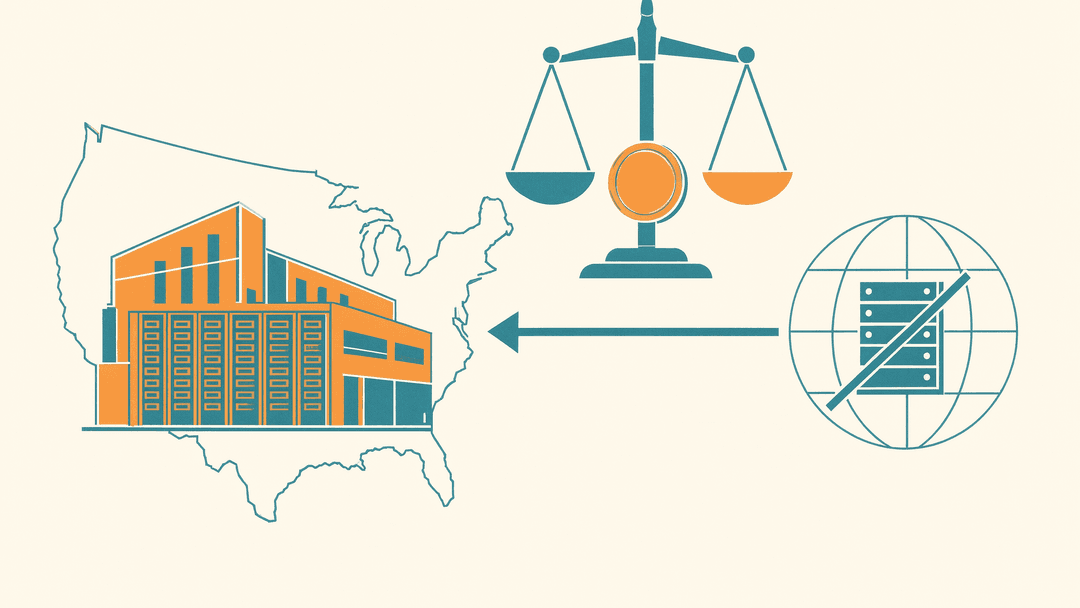
Trump on Friday said he would bar US companies from building data centers in other countries, or tax them until they stop.
The president made the announcement at a White House press conference on November 20, framing it as the next step in a policy that so far had run in the opposite direction.
"We are not going to allow companies to build data centers in other countries," Trump said. "If they do that, they can, but we are going to put a tremendous tax on them."
He added: "We're not allowing data centers to go into other countries because China will take all of them and we're not allowing that to happen, and we are going to put tremendous penalties on companies that try and do it."
No mechanism, no list, no date
The proposal arrived without the parts that usually make a tax policy implementable. Trump did not describe how the tax would be assessed, which companies it would cover, or when it would take effect, as Newsweek reported. He named one project he said his administration would block, a planned data center in Finland, and otherwise left the target list blank.
There is also a constitutional problem with the instrument he chose. Axios noted that the authority to levy federal taxes sits with Congress, not the White House. A levy on overseas capital expenditure by US firms would need legislation, or some stretch of an existing tool such as the tax code's outbound rules. Neither was specified.
Trump did not pretend the plan was ready. He said he had not run it past his own officials. "I don't know if that's a breaking story," he said, per CNBC. "I haven't even said that to my people. But I'm telling them now they're here."
The political clock behind the announcement
The timing is not accidental. Data center construction turned into a midterm-election issue in the past several weeks, as voters weighed the grid load, water use and land conversion that come with a facility of the scale frontier labs now order. Axios pointed to that backlash as the context for the announcement, and to Trump's parallel claim that keeping the buildout domestic would push American energy costs and taxes down.
The pressure is visible in the numbers. The International Energy Agency's 2026 World Energy Outlook projected that global data center power use would roughly double by 2030, with associated emissions up around 70 percent and investment heading toward $4 trillion. That demand has been exported, in part. Hyperscalers and their GPU suppliers have signed capacity in Nordics, Malaysia, Brazil and the Gulf, because US grid interconnection queues stretch past the point where a training cluster can wait.
A ban or penalty on that behavior cuts against the industry's own constraint. If the queues in Virginia, Texas and Ohio cannot deliver megawatts inside a two-year window, an overseas prohibition does not move those megawatts onshore. It moves them into storage, or into a lawsuit.
Where it fits with the export rules
The one consistent thread is that the administration keeps tightening how foreign actors touch American computing. The Washington Times noted the proposal follows a run of restrictions on foreign access to advanced US chips, aimed squarely at China's ability to train frontier models.
That earlier framework regulated who could buy or rent the hardware. This proposal regulates where a US company is allowed to pour concrete. The two pull in opposite economic directions. Export controls pushed suppliers to serve foreign demand from foreign soil, since a US data center hosting Chinese workloads was never on the table. A build-at-home rule removes the workaround that made those customers reachable at all.
For allies, the announcement is a demand to choose a supplier under a second set of rules. For the companies funding the buildout, it is an unhedged regulatory risk attached to assets with fifteen-year depreciation schedules.
Nothing here is law yet. The realistic near-term outcome is a legislative proposal, an executive order reaching for something adjacent, or a quiet disappearance. Until one of those appears, the concrete effect is that any hyperscaler with an overseas site in planning now has to price in the possibility that its capital plan becomes a political statement.
Sources
- Axios: Trump threatens tax on US companies building data centers overseas
- CNBC: Trump vows to stop U.S. companies from building data centers abroad
- Newsweek: Trump threatens massive tax on US data centers built overseas
- The Washington Times: Trump to ban U.S. companies from building data centers overseas
- The Guardian: IEA sees data centre power use doubling and emissions rising 70% by 2030
Frequently asked questions
What is Trump's proposal regarding offshore data centers?
Trump announced he will not allow US companies to build data centers in other countries and threatens to put a 'tremendous tax' on them if they proceed with such projects.
Why does Trump want to stop offshore data center construction?
The President stated he is preventing offshore data centers because 'China will take all of them' and the administration aims to stop this outcome through taxes and penalties.
Has a legal mechanism been defined for this tax?
No; the proposal lacks details on how the tax would be assessed, which companies it covers, or when it takes effect, and experts note that Congress holds the authority to levy federal taxes.
How does this relate to US export controls on AI chips?
While previous restrictions limited foreign actors' access to advanced US chips, this new rule targets where US companies are allowed to build infrastructure, effectively removing a workaround that previously allowed suppliers to serve foreign demand from abroad.
What is the impact of US grid interconnection queues on this policy?
US grid interconnection queues often stretch beyond the timeframe required for training clusters, prompting hyperscalers to seek capacity in regions like the Nordics and Malaysia; a ban may not solve domestic megawatt shortages but creates regulatory risk for planned overseas sites.
