
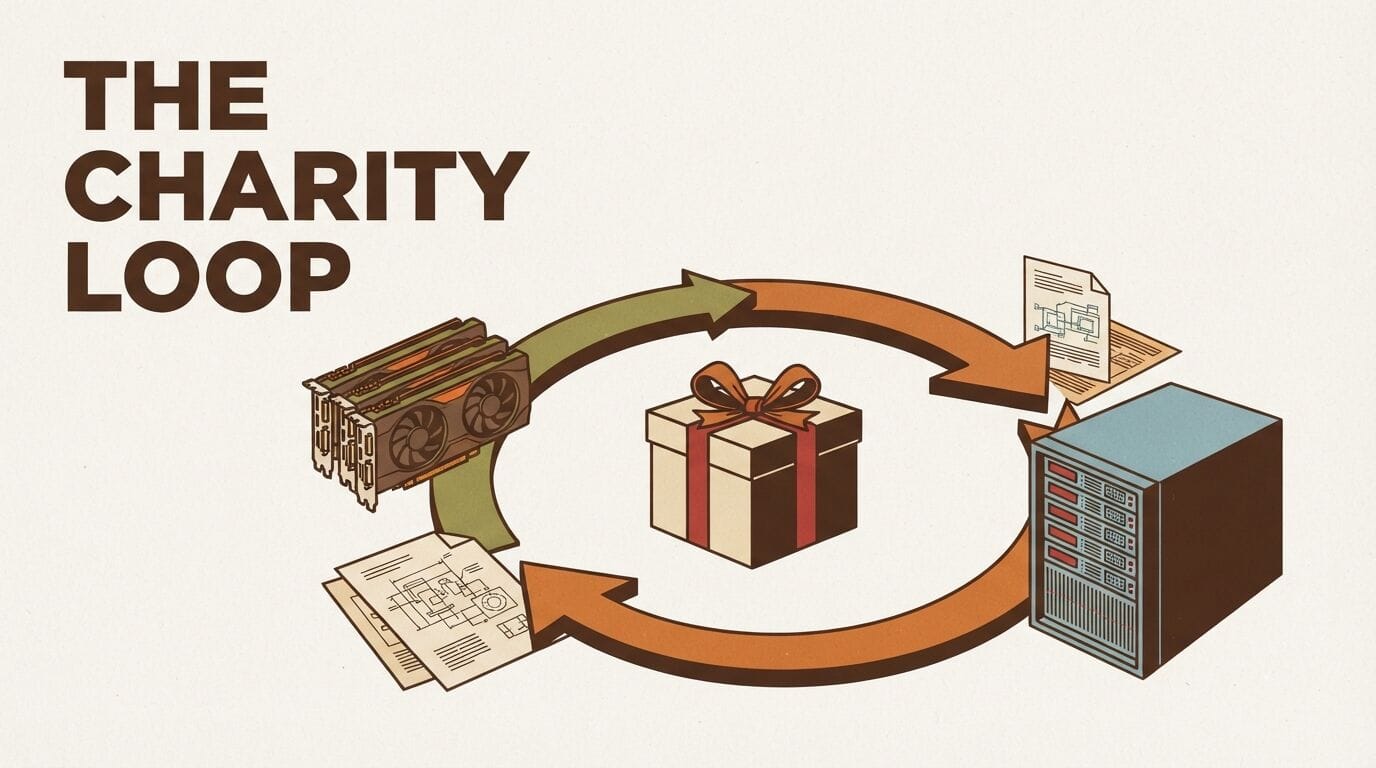
The Jen-Hsun & Lori Huang Foundation plans to spend $350 million renting GPU time from CoreWeave, Bloomberg reported, citing the foundation's most recent tax filing. A separate Nvidia filing from June showed the money flows to CoreWeave and that $108.3 million has already been spent.
The gift funds the Computing Initiative for Open Science, which the filing describes as an effort to break down "one of the most significant barriers to modern scientific discovery: access to large-scale GPU computing power." Recipient institutions, not the foundation, consume the compute, a CoreWeave spokesperson said. A spokesperson for Jensen Huang declined to comment.
Two details make the filing more interesting than a routine act of philanthropy.
First, the scale inside the foundation's own books. The CoreWeave commitment is by far the largest gift the foundation made last year. The foundation donated roughly $373 million in total, about three times its 2024 giving, and its assets ended 2025 at $12.7 billion, up from $9.2 billion the prior year. Nvidia stock accounts for nearly 90% of those assets.
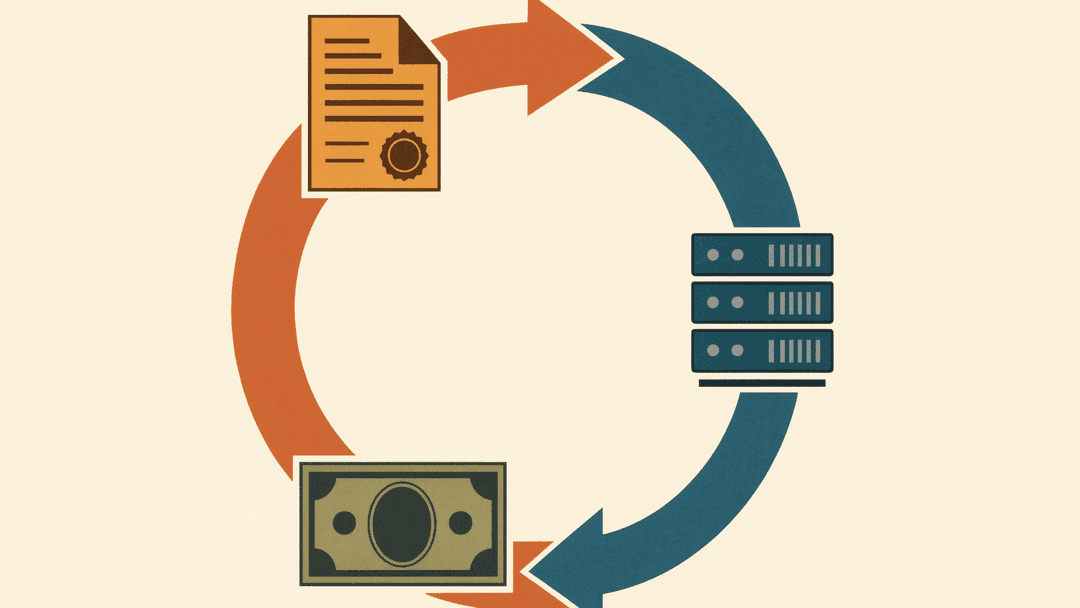
That is the loop, stated plainly. The foundation is capitalized with Nvidia equity. It gives the equity away, then directs the proceeds to a cloud company that sells capacity built from Nvidia chips, in which Nvidia holds a large equity stake and a backstop commitment. Nvidia invested $2 billion in CoreWeave, becoming its second-largest shareholder at the time, and agreed last year to buy up to $6.3 billion of cloud capacity CoreWeave cannot sell to anyone else. Huang resigned as Nvidia chief executive this month and publicly defended CoreWeave earlier this year when its shares slumped on concerns that its debt load would stall hardware spending.
None of this is illegal, and none of it is new. Regulators and investors have spent the past year examining whether chip suppliers inflate their own demand by investing in their customers, an inquiry that now covers more than $750 billion of Nvidia-linked deals, including reported talks to guarantee OpenAI's Ohio data center buildout. What the tax filing adds is a new vector: personal philanthropy is now inside the structure.
Second, the form of the gift matters more than the size. A cash donation lets a university buy whichever tools its researchers prefer. A compute donation decides the stack for them: CoreWeave cloud, running Nvidia hardware, with Nvidia also planning to provide free engineering support to selected grant recipients, Reuters reported. Researchers get capacity they could never afford. The ecosystem gets a cohort of labs trained on one vendor's toolchain.
One early recipient shows what the money buys. In June the UW Medicine Institute for Protein Design, led by 2024 Nobel laureate David Baker, began accessing Nvidia GPUs through CoreWeave under a foundation grant of nearly 7 million GPU hours, enough to support the institute for about a year, GeekWire reported. Baker said his team historically rationed experiments around a limited in-house cluster, batching model changes to save cycles, and called the new capacity "transformational." Huang said in a statement that the compute lets researchers train models "on tens of millions of molecular structures" to find "novel protein designs that have eluded nature."
The scientific gains are real and should not be dismissed as a financing trick. Open-science compute grants address a genuine scarcity, and smaller labs get resources that accrue to the public because the resulting tools, like the institute's open-source protein models, stay public.
The editorial question is narrower. Charitable foundations have become a demand line in the AI buildout, and the Huang foundation's own balance sheet makes the dependency visible: nearly 90% Nvidia stock paying for Nvidia-shaped compute. Philanthropy that recycles a company's equity into its customers' revenue is a new kind of circular financing, one that no investor protection rule was written to cover.
Sources
- Bloomberg: Jensen Huang's Charity Committed $350 Million to CoreWeave
- Techmeme: Filings on the Huang foundation's CoreWeave pledge
- Reuters via Pulse2: foundation's $108.3 million in donated CoreWeave compute, Nvidia engineering support, $6.3 billion backstop deal
- GeekWire: UW protein institute grant of nearly 7 million GPU hours
- GuruFocus via TradingView: foundation asset figures and Nvidia stock concentration
- Startup Fortune: analysis of the Nvidia deal web around the grant
