
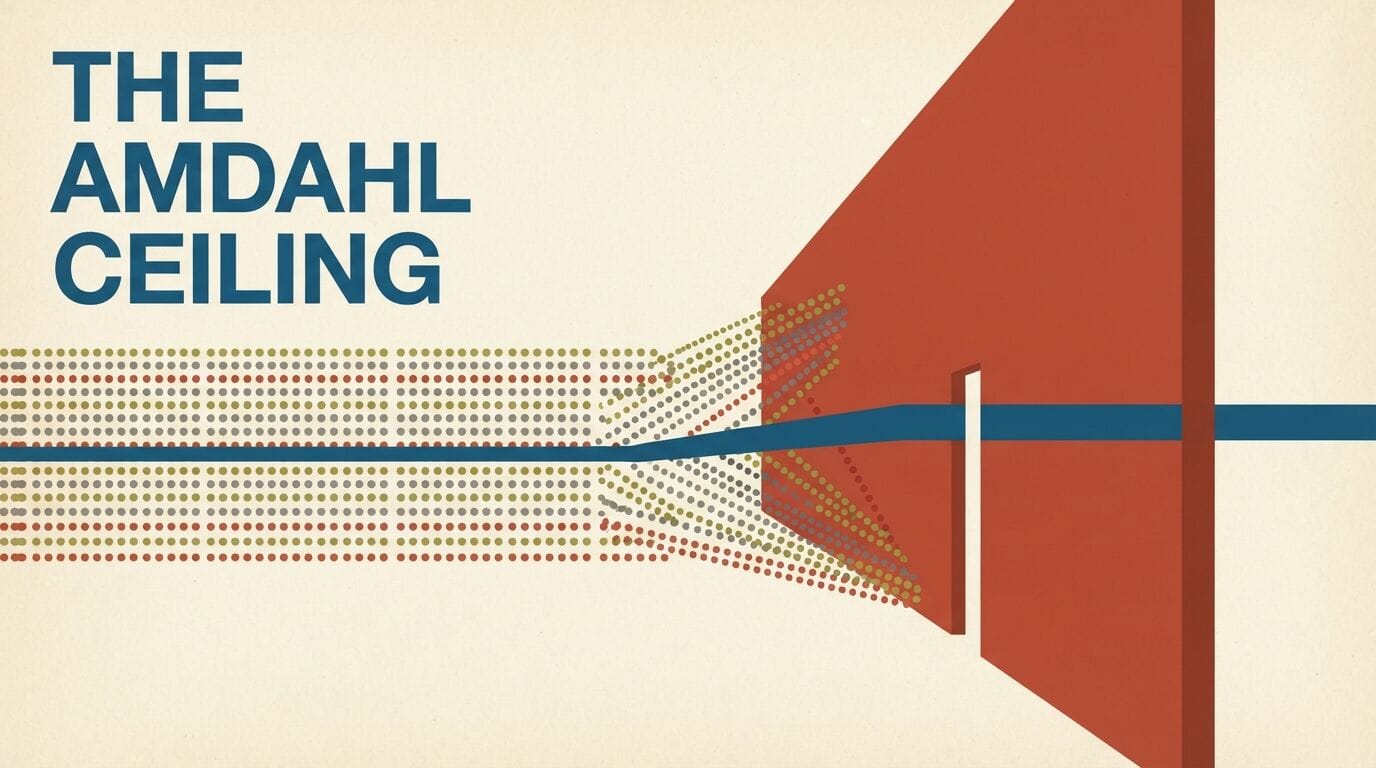
A lab doubles its GPU cluster and expects training to take half as long. It usually does not. The shortfall has a name that predates every modern accelerator by more than half a century: Amdahl's law, a one-line argument from 1967 about why parallel speedup has a hard ceiling, and why the ceiling is set by the part of the job that cannot be parallelized at all.
The 1967 argument
Gene Amdahl was an IBM engineer designing the System/360. In April 1967 he presented a short paper, Validity of the single processor approach to achieving large scale computing capabilities, at the Spring Joint Computer Conference. His point was arithmetic, not opinion. Split a job into a fraction that must run sequentially and a fraction that can run in parallel. If the sequential share is s and you throw N processors at the rest, the speedup is:
Speedup = 1 / (s + (1 - s) / N)
The consequence is the part that made the paper famous. Let N go to infinity and the parallel term vanishes, leaving a maximum speedup of 1/s. A job that is 95% parallelizable cannot be sped up more than 20x, no matter how many processors it gets. A job that is 75% parallelizable caps out at 4x. In the reprinted version of his own paper, Amdahl estimated that realistic programs of the day had at least a quarter of their execution in sequential code, and further noted (invoking what was then called Grosch's law) that doubling the hardware inside a single machine tended to quadruple its performance. Both arguments cut the same way: one big processor was often a better buy than many small ones.
Worked numbers, for intuition:
- Serial share 25%: 3.8x on 64 machines, 4x on a million.
- Serial share 5%: 15.4x on 64 machines, 19.6x on 1,000.
- Serial share 1%: 39.3x on 64 machines, 91x on 1,000.
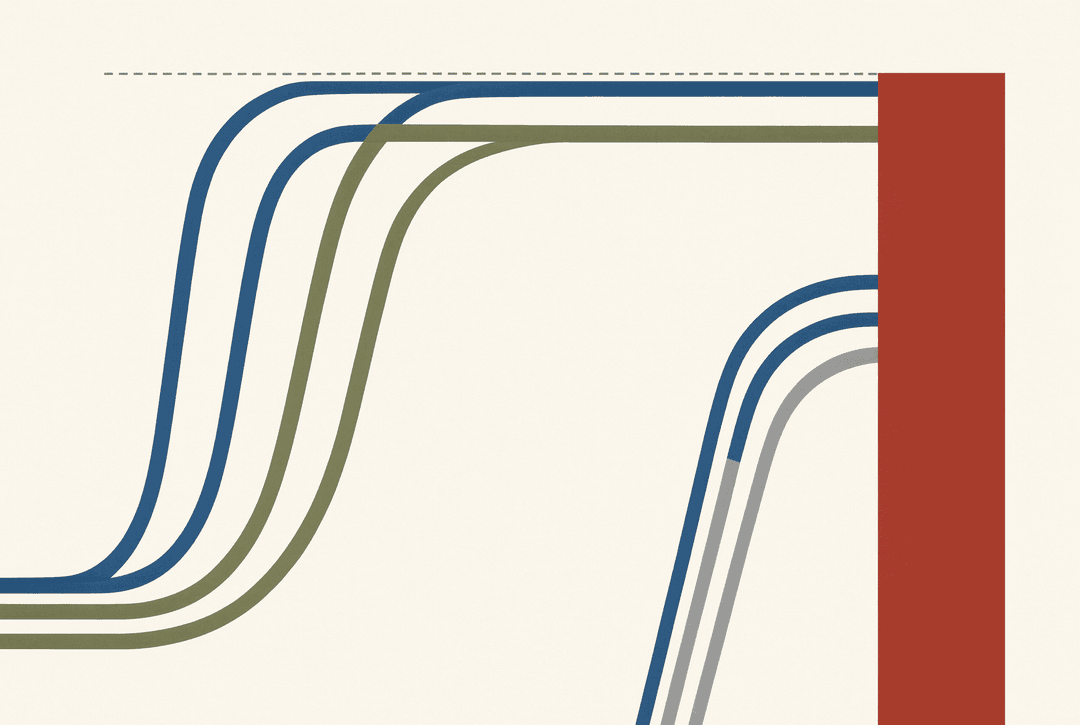
The law says the last few percent of sequential work matters more than the first few thousand processors.
Where it shows up in LLM training
Modern training farms are the largest test of Amdahl's argument ever run, and they mostly confirm it. The Megatron-LM paper reported 76% scaling efficiency running an 8.3-billion-parameter model across 512 GPUs, measured against a single-GPU baseline that itself sustained only 30% of peak FLOPs. NVIDIA's follow-up on scaling training to a trillion parameters reported 52% of peak A100 throughput (163 teraFLOPs per GPU, 502 petaFLOPs aggregate) on 3,072 GPUs. The gap between "spec FLOPs" and "useful FLOPs" is the serial share showing up as communication and synchronization cost, which researchers have formalized as an extension of Amdahl's law for multicore systems.
Failure behaves the same way. Meta's Llama 3 report counted 466 job interruptions during a 54-day snapshot of pre-training on up to 16,000 H100s, 419 of them unexpected, and noted that synchronous training makes the whole job restart when one GPU fails. Meta kept effective training time above 90% anyway, which is the practical lesson: the ceiling is not a wall, it is a budget. Every engineering trick in distributed training, from overlapping communication with computation to checkpoint recovery, is a way to shrink the sequential fraction or amortize its cost. An independent SC23 infrastructure poster pushed the logic to its end: on current-style systems, strong scaling of a one-trillion-parameter model stalls around 12,288 GPUs, where per-GPU work becomes too small to overlap with the communication it triggers.
Gustafson's reply: grow the problem, not the speedup
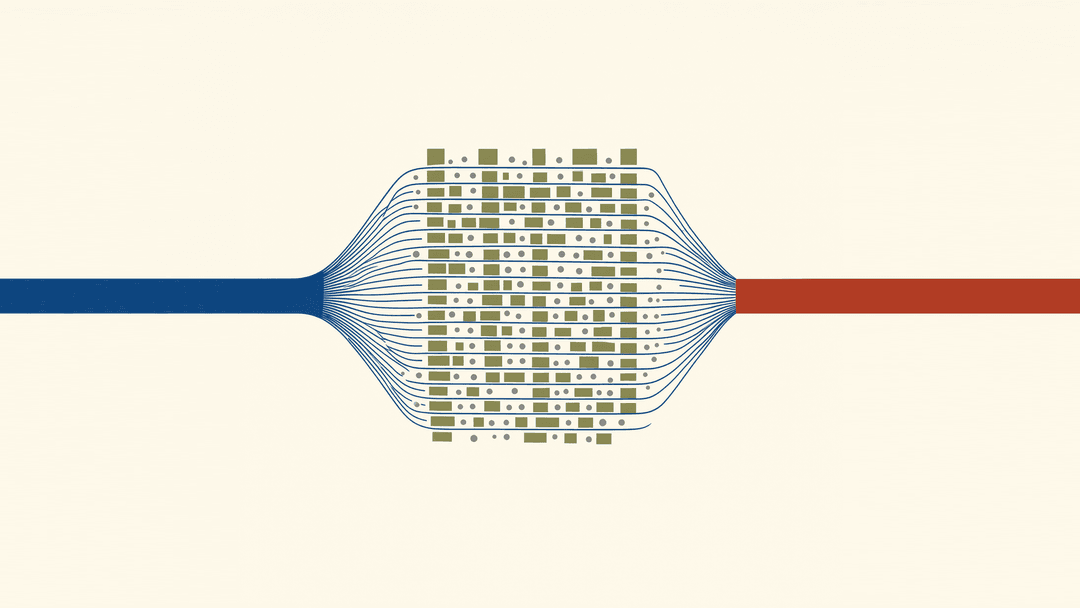
In 1988, Sandia physicist John Gustafson published Reevaluating Amdahl's law in Communications of the ACM (DOI: 10.1145/42411.42415). His objection was to the fixed problem size the law assumes. In practice, he argued, when a machine gets bigger the problem grows to fill it, and the serial share falls as the work scales. Sandia's 1,024-processor hypercube ran three production applications with serial fractions of 0.4% to 0.8% at speedups of 1,016x to 1,021x, close to linear, which Amdahl's formula would have called impossible at fixed size.
That debate is the reason frontier labs do not use bigger clusters to train the same model faster. They use bigger clusters to train bigger models in the same wall-clock time. Amdahl governs what you can accelerate; Gustafson describes what labs actually do, which is scale the job so the hardware pays for itself.
The serial tax in inference
The law also sits on top of everything you notice as a user. Autoregressive decoding is the most literal sequential fraction in AI: as the speculative decoding paper puts it, generating K tokens takes K serial runs of the model, because each token depends on the one before. You cannot buy lower per-token latency by adding accelerators to one request. The known workarounds each attack the serial step directly. vLLM batches many requests together and reports 2-4x throughput over prior serving systems, which scales throughput, not the latency of any single answer. Speculative decoding drafts several tokens with a small model and verifies them in one parallel pass through the big model, reporting 2-3x wall-clock acceleration on T5-XXL with identical outputs.
Agents inherit the same math
The compounding logic travels from FLOPs to steps. METR's measurement of AI task length defines a 50% time horizon: the human-benchmark duration of tasks an agent completes half the time, about 50 minutes for Claude 3.7 Sonnet as of early 2025, doubling roughly every seven months since 2019. A long agent run is a chain of dependent steps, and a chain is sequential by construction: reliability multiplies down it the way wall-clock time divides up a parallel job. The horizon doubling is the field's slow march against that tax, driven, in METR's analysis, mostly by per-step reliability and error recovery rather than raw capability.
What to actually do with a ceiling
Amdahl's law is most useful as a measuring instrument. Before scaling anything, estimate the sequential share of the job, because it is the only number that bounds the return on the last 99% of the hardware. Consequences worth internalizing:
- Speedup saturates early. Going from 64 to 1,000 processors buys 27% more speed at a 5% serial share, and roughly nothing at 25%.
- Halving the serial fraction beats doubling the processors. Overlap, asynchrony, and smarter parallel layouts move the ceiling itself; more hardware only walks toward it.
- When the problem can grow, grow it. That is Gustafson's escape hatch, and it is why cluster size and model size rise together.
- For interactive latency, attack the serial step itself. Batching buys throughput per dollar; speculation and parallel verification are the only ways to buy time back per token.
A 1967 slide-rule estimate is still the cheapest predictor of what your next GPU purchase will return. The clusters have changed; the division has not.
Sources
- Gene M. Amdahl, Validity of the Single Processor Approach to Achieving Large Scale Computing Capabilities, AFIPS Spring Joint Computer Conference, 1967 (reprinted PDF)
- John L. Gustafson, Reevaluating Amdahl's Law, Communications of the ACM 31(5), 1988 (DOI)
- Mohammad Shoeybi et al., Megatron-LM: Training Multi-Billion Parameter Language Models Using Model Parallelism, 2019
- Deepak Narayanan et al., Scaling Language Model Training to a Trillion Parameters Using Megatron, NVIDIA Technical Blog, 2021
- Tripathi et al., Scaling Infrastructure to Support Multi-Trillion Parameter LLM Training, SC23 poster
- Lior Yavits, The Effect of Communication and Synchronization on Amdahl Law in Multicore Systems, 2013
- Meta, The Llama 3 Herd of Models, 2024
- Yaniv Leviathan et al., Fast Inference from Transformers via Speculative Decoding, 2022
- Woosuk Kwon et al., Efficient Memory Management for Large Language Model Serving with PagedAttention, 2023
- Thomas Kwa et al., Measuring AI Ability to Complete Long Tasks, 2025
