
Every transformer in production today contains millions of perceptrons. That is not a metaphor. The feed-forward block in each attention layer is a stack of linear layers with nonlinear activations, and a linear layer with a threshold is exactly what Frank Rosenblatt described in 1958. The machine that started the field was built out of photocells, patch cables, and motor-driven potentiometers, and it lived in a lab in Buffalo, New York.
This post explains what a perceptron is, what was new about it, why it collapsed, and which parts of it survived into every modern model.
The idea that was missing in 1958
Neuron-like computing elements existed before Rosenblatt. In 1943 Warren McCulloch and Walter Pitts proposed a mathematical model of a nerve cell behaving like a tiny logic gate, and their design influenced every later network. What it did not have was learning. In a McCulloch-Pitts network a human picked the weights by hand. The machine did what you wired it to do, and nothing more.
The perceptron supplied the missing piece: a rule by which a machine changes its own numbers after being shown it is wrong. Rosenblatt, a psychologist by training, was trying to answer a question about brains. He wrote in 1958 that machines of this sort were expected to become "ultimately capable of concept formation, language translation, collation of military intelligence, and the solution of problems through inductive logic." He put the full model in the November 1958 issue of Psychological Review, in the paper "The Perceptron: A Probabilistic Model for Information Storage and Organization in the Brain."
How a perceptron works
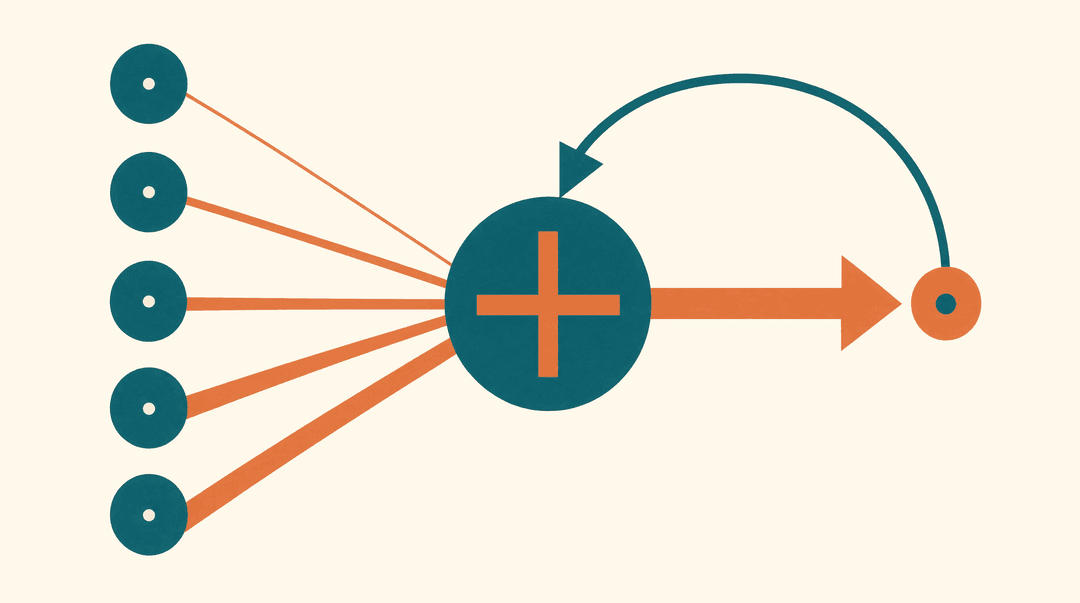
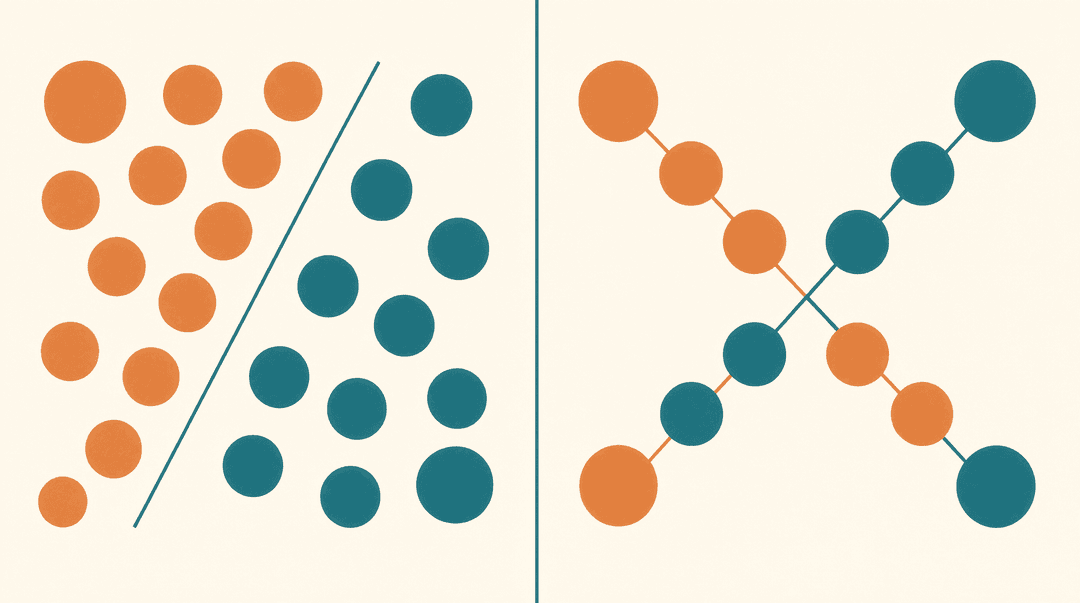
Mechanically, a perceptron is small. It takes inputs as a vector of numbers. Each input gets a weight. The weighted inputs are summed, a bias term is added, and the total is passed through a step function: above threshold, output 1; below it, output 0. That is a linear classifier. It draws a flat decision boundary through the input space and answers which side of the line an example falls on.
The learning rule is the part that mattered. Present an example, make a prediction, and if the prediction is wrong, nudge the weights toward the input that exposed the mistake. Repeat. A 1962 analysis by Novikoff, in the literature Rosenblatt's own 1962 book Principles of Neurodynamics helped codify, gave the rule a guarantee: if the two classes can be separated by a hyperplane at all, the perceptron will find one after a finite number of mistakes. A simple machine with a proof attached. This is the direct ancestor of the update loops in every training run today, where the nudge is computed from gradients instead of a single misclassification, and the guarantee disappears along with the step function's clean geometry.
The machine, and the hype
In July 1958 the U.S. Office of Naval Research, which funded the work, announced the perceptron at a press briefing. The demonstration ran on an IBM 704, a five-ton computer: fed a series of punch cards, it taught itself after 50 trials to tell cards marked on the left from cards marked on the right. Rosenblatt called it "the first machine which is capable of having an original idea." The New York Times headline read "NEW NAVY DEVICE LEARNS BY DOING: Psychologist Shows Embryo of Computer Designed to Read and Grow Wiser." The New Yorker called it "the first serious rival to the human brain ever devised."
The hype outran the artifact, and the artifact was still remarkable. Between 1959 and 1960, Rosenblatt's team at the Cornell Aeronautical Laboratory in Buffalo built the Mark I Perceptron as physical hardware. Its "retina" was a 20 by 20 grid of 400 cadmium sulfide photocells looking at projected slides. The next layer was 512 association units wired to the retina at random, through a patch panel, according to a table of random numbers. Rosenblatt insisted on the random wiring because he believed the retina was randomly connected to the visual cortex and wanted the machine to resemble what he thought he knew about brains. The output layer had eight response units, and the adjustable weights between layers lived in potentiometers that electric motors turned whenever the machine learned. Watching it train meant watching small motors rotate. The Mark I taught itself to sort block letters shown in random positions, and the full alphabet when positions were fixed. The machine now sits in the Smithsonian's National Museum of American History, transferred from Cornell via the Navy in 1967.
The collapse
The perceptron has one fatal geometric limit. A single unit draws one straight line. Some problems have no straight line that solves them. The standard example is XOR: output 1 when exactly one of two inputs is on. The four possible inputs form a square, and no single line separates the two 1s from the two 0s. Stacking perceptrons into layers solves XOR easily, and in fact Rosenblatt's own Mark I was a three-layer machine whose first layer was random rather than learned. But in 1969 Marvin Minsky and Seymour Papert, MIT researchers who had been skeptical of Rosenblatt since their Bronx High School of Science days, published Perceptrons: An Introduction to Computational Geometry (MIT Press), a rigorous analysis of what these networks could and could not compute. It proved single-layer limitations in general, including that parity-like functions were out of reach for shallow machines.
The book is often blamed for the first AI winter, and historians of the field, including in later reappraisals, point out the story is rougher than the legend. Minsky and Papert did not claim multilayer networks were hopeless; they knew layers could compute XOR. What they doubted was that anyone could train deep networks, and at the time, nobody could. Backpropagation arrived as the standard method only in the mid-1980s, and neural networks revived then, a decade after Perceptrons. Funding had already been moving toward symbolic AI before the book landed. But the timing did the damage regardless: Rosenblatt watched federal support for his project collapse through the 1960s, kept building anyway (his last machine, Tobermory, wired 12,000 weights in magnetic cores between 1961 and 1967 to recognize speech, and was obsolete on arrival because software simulation had become faster), and did not live to see the thaw. He drowned in Chesapeake Bay in 1971, on his 43rd birthday.
What survived
Strip the history and the perceptron's skeleton is still the load-bearing structure of deep learning.
A modern "neuron" is a perceptron with the step function replaced by a smooth nonlinearity such as ReLU, so that mistakes produce a graded signal (a gradient) instead of a binary one. Everything else carries over: weighted sums, bias terms, learning by error correction.
A transformer's feed-forward block is a multilayer perceptron applied independently at each token position. The 2017 "Attention Is All You Need" design interleaves attention with exactly this two-layer MLP. When people argue that knowledge lives in transformer MLP blocks, they are arguing about perceptron descendants.
The linear separability limit is the reason depth exists at all. One flat cut is weak; learned layers exist to bend the space until a flat cut becomes possible. The embedding-space pictures on this site assume the same geometry: a classifier on top of a model is a perceptron, and it only works because the layers underneath moved the data around.
The convergence theorem is the one part most models have quietly abandoned. Deep networks are not linearly separable problems, they are not guaranteed to converge, and they make mistakes after training anyway. What survived is the loop: predict, be wrong, adjust, repeat. A Cornell machine learning professor, Thorsten Joachims, put the lineage plainly in the university's retrospect: "The perceptron was the first neural network... in hindsight, his algorithm is still fundamental to how we're training deep networks today."
Rosenblatt's own verdict on his hardware was that motor-driven potentiometers were "intolerable solutions for very large systems." He was right, and wrong about the only thing that mattered. The loop, not the knobs, was the invention.
Sources
- Rosenblatt, F. (1958). The Perceptron: A Probabilistic Model for Information Storage and Organization in the Brain. Psychological Review 65(6), 386-408. https://doi.org/10.1037/h0042519 (https://pubmed.ncbi.nlm.nih.gov/13602029/)
- Cornell Chronicle, "Professor's perceptron paved the way for AI - 60 years too soon" (Sept. 2019). https://news.cornell.edu/stories/2019/09/professors-perceptron-paved-way-ai-60-years-too-soon
- Wikipedia, Perceptron. https://en.wikipedia.org/wiki/Perceptron
- Wikipedia, Mark I Perceptron. https://en.wikipedia.org/wiki/Mark_I_Perceptron
- Smithsonian National Museum of American History, "Electronic Neural Network, Mark I Perceptron" (object record). https://americanhistory.si.edu/collections/object/nmah_334414
- MIT Press, Minsky & Papert, Perceptrons: An Introduction to Computational Geometry (1969; expanded edition 1988). https://mitpress.mit.edu/9780262534772/perceptrons
- Yuxi Li, "The Perceptron Controversy." https://yuxi.ml/essays/posts/perceptron-controversy
- Jerry Cards, "Rosenblatt, 1958: The Machine That Learned From Its Mistakes" (Mark I specification and quotes from Principles of Neurodynamics). https://www.jerrycards.com/news/rosenblatt-1958-perceptron-birth-of-machine-learning
- Vaswani et al. (2017). Attention Is All You Need. arXiv:1706.03762. https://arxiv.org/abs/1706.03762
