
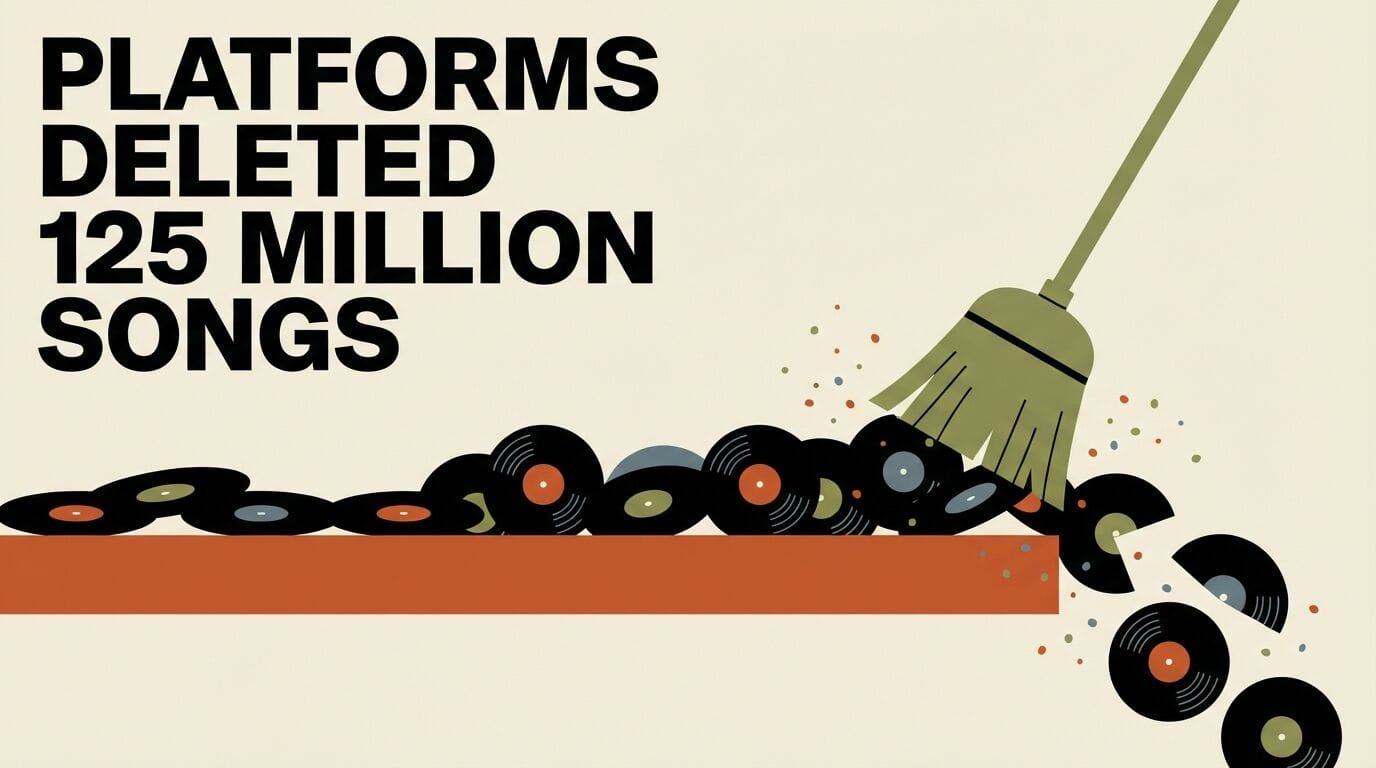
The takedown numbers now dwarf the upload numbers, and that is the wrong comparison. Spotify spent a year deleting AI "slop" at industrial scale. The economics explain why the purge changes nothing for the people it targets.
On October 20, Spotify published a one-year progress report on its fight against spam, impersonation and deception. The headline figures: more than 50 million tracks kept out of recommendations this year as "AI slop and spam," on top of more than 75 million tracks deleted from the platform outright for serious or repeated rule violations. The 50 million are not gone. They stay searchable. They simply never surface algorithmically or in editorial playlists.
Those 125 million numbers arrive against a supply curve that has been steeper than anyone predicted.
The supply side is a subscription fee
Deezer has kept the category's only public census, because it is the only streamer that runs its own classifier on every delivery. In January 2025, roughly 10,000 fully AI-generated tracks arrived per day, about 10% of uploads. By April 2026 the figure was nearly 75,000 per day, 44% of deliveries, more than 2 million tracks a month. By July, Deezer reported nearly 90,000 per day, with the AI share passing 50% of daily uploads at its June peak. In 2025 alone the platform detected and tagged more than 13.4 million fully AI recordings.
The tooling economics make this inevitable. Suno, the generator responsible for a large share of that supply, said in February 2026 that it had passed 2 million paid subscribers and roughly $300 million in annual recurring revenue, with more than 100 million people having used the product. A subscription costs about $10 a month and yields, per company statements and platform counts, millions of finished songs generated per day. Even at Deezer's more conservative intake, marginal production cost per track is measured in cents.
No moderation regime survives when one side's unit cost is a prorated subscription and the other side's is a human review queue. Both Spotify and Deezer said as much in practice: their enforcement is automated first, and it works by demotion and demonetization rather than deletion.
The flood is spam, not an audience
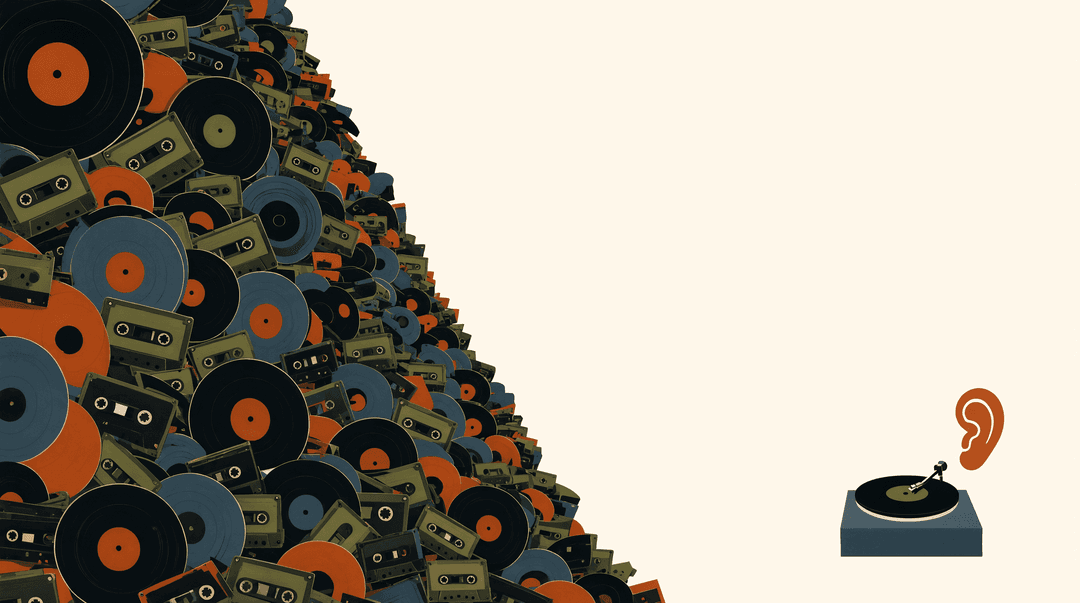
The demand data is what turns the "AI is taking over the charts" story inside out. Deezer says fully AI tracks draw between 1% and 3% of streams on its platform, and that 85% of the streams they do get are detected as fraudulent and demonetized. The uploads are not being listened to. They are being farmed.
The business model is royalty arbitrage against a pro-rata payout pool. Streaming royalties are estimated at roughly $3 to $5 per 1,000 streams, and since April 2024 a track on Spotify must clear 1,000 streams in 12 months just to earn anything; sub-threshold money is redistributed to eligible tracks, part of a change Spotify sized at about $1 billion a year moving toward professional artists. Mass uploaders bet that tens of thousands of near-zero tracks will catch enough bot streams, playlist spam or search traffic to clear the floor. Artificial streaming triggers direct charges against the uploader's distributor account.
Spotify's own October numbers confirm the bet usually loses: tracks it identifies as AI-generated are ten times more likely than average to miss the 1,000-stream threshold. The purge is therefore not primarily about taste. It is about policing the royalty pool, and Spotify framed the report in exactly those terms, noting that the removals protect "royalties that should go to professional artists and songwriters."
How the detectors actually work, and where they fail
Neither platform claims to hear the difference. A Deezer-commissioned Ipsos survey of 9,000 people across eight countries found 97% could not tell fully AI-generated music from human-made music in a blind test with three tracks; 52% said the result made them uncomfortable, and 45% would like an AI filter on their platform.
So the detection is structural, not acoustic. Spotify says it combines listener behavior (skips, ignores, explicit "don't play this" feedback), metadata and upload patterns (mass uploads, duplicates, spammy playlist networks, suspiciously short tracks) with third-party AI detection tools. Its recommendation demotion was built by studying what listeners reject and discovering that slop and skipped tracks overlap almost perfectly.
The seams are visible. Deezer's classifier flags only 100% AI recordings from known models such as Suno and Udio; partially AI-produced songs are neither tagged nor penalized, and hybrid tracks are the fastest-growing gray zone now that Suno v5.5 and similar tools produce broadcast-usable stems. Generalization beyond trained-on models is a stated work in progress, not a shipped capability. And neither Spotify nor Deezer has published an appeals path, a false-positive rate, or a breakdown of how many of the 50 million demoted tracks were miscategorized. Legitimate AI-assisted artists report silent recommendation loss with no recourse; Spotify's October post acknowledges detection is imperfect and points artists toward its new Artist Profile Protection beta, where participating artists preview uploads using their name before they appear publicly.
The chart lane splits the same fight three ways
The industry has no agreed rulebook, and 2026 produced three incompatible answers.
In late July, Universal, Warner, Sony, HYBE, Believe and other rights holders proposed chart principles: only substantially human-made tracks using authorized AI, properly labeled and free of stream manipulation, should be chart-eligible. IFPI and its national groups adopted the exclusion approach; Australia's ARIA stopped counting wholly AI recordings from August 31. Billboard went the other way: identify AI songs in charts and coverage, do not ban them, with data provider Luminate attaching "AI Generated" and "AI Assisted" labels. Meanwhile YouTube treats slop as a monetization question rather than an authorship one: its July clarification of the "inauthentic content" policy demonetizes template-identical mass-produced uploads, content engineered to be disturbing, and AI personas posing as experts on health, finance, legal or political topics, regardless of whether AI made them.
Three platforms, three definitions of the same object. For anyone shipping AI-generated media, the practical conclusion is that compliance now means satisfying the strictest meter in every lane you enter.
What the purge proves

The numbers say the supply problem is unsolvable at the ingestion layer and tractable at the distribution layer. Platforms cannot stop 90,000 tracks a day from being made, and the 2026 takedown totals prove they can stop most of them from ever being heard: demotion is free at scale, deletion is not.
What the purge has not touched is the incentive. AI tracks still earn 1 to 3% of streams somewhere, impersonation uploads still reach profiles until the artist vetoes them, and the detection arms race runs against a generator that costs $10 a month. The 125 million deleted tracks are less a verdict on AI music than the first honest price list for attention: creation is nearly free now, and distribution, finally, is the whole product.
Sources
- Spotify Newsroom: One Year In: Putting Human Artistry First on Spotify (October 20, 2026) - https://newsroom.spotify.com/2026-10-20/prioritizing-human-artistry
- NBC News: Spotify says it removed 50 million 'slop' and spam AI tracks this year - https://www.nbcnews.com/business/media/spotify-slop-spam-ai-tracks-rcna604571
- Variety: Spotify Removes 50 Million AI Slop Tracks from Recommendations - https://variety.com/2026/music/news/spotify-removes-50-million-ai-slop-tracks-recommendations-1236917108
- RouteNote: Spotify removes over 50 million AI spam tracks from recommendations - https://routenote.com/blog/spotify-removes-50-million-ai-spam-tracks
- Deezer Newsroom: AI-generated tracks reach 44% of uploads (April 20, 2026, updated July 2026) - https://newsroom-deezer.com/2026/04/ai-generated-tracks-represent-44-of-new-uploaded-music
- Billboard: Deezer Says Over 50% of Daily Song Uploads Are Now Fully AI-Generated - https://www.billboard.com/pro/deezer-50-percent-daily-song-uploads-fully-ai-generated
- Deezer Newsroom / Ipsos: 97% of listeners can't tell AI from human music - https://newsroom-deezer.com/2025/11/deezer-ipsos-survey-ai-music
- Spotify for Artists: Modernizing Our Royalty System to Drive an Additional $1 Billion toward Emerging and Professional Artists - https://artists.spotify.com/en/blog/modernizing-our-royalty-system
- Unite.AI: Suno Reaches 2 Million Paid Subscribers and $300M ARR (Feb 2026, per TechCrunch and WSJ reporting) - https://www.unite.ai/suno-reaches-2-million-paid-subscribers-and-300m-arr-in-two-years
- Billboard: UMG, WMG, Sony & More Propose Principles for AI Song Chart Eligibility - https://www.billboard.com/pro/umg-wmg-sony-propose-principles-ai-song-chart-eligibility
- TechCrunch: YouTube clarifies policies around AI slop and upsetting videos (July 20, 2026) - https://techcrunch.com/2026-07-20/youtube-clarifies-policies-around-ai-slop-and-upsetting-videos
- Tubefilter: YouTube's three inauthentic-content monetization categories - https://www.tubefilter.com/2026-07-13/youtube-inauthentic-content-monetization-policy-update
