
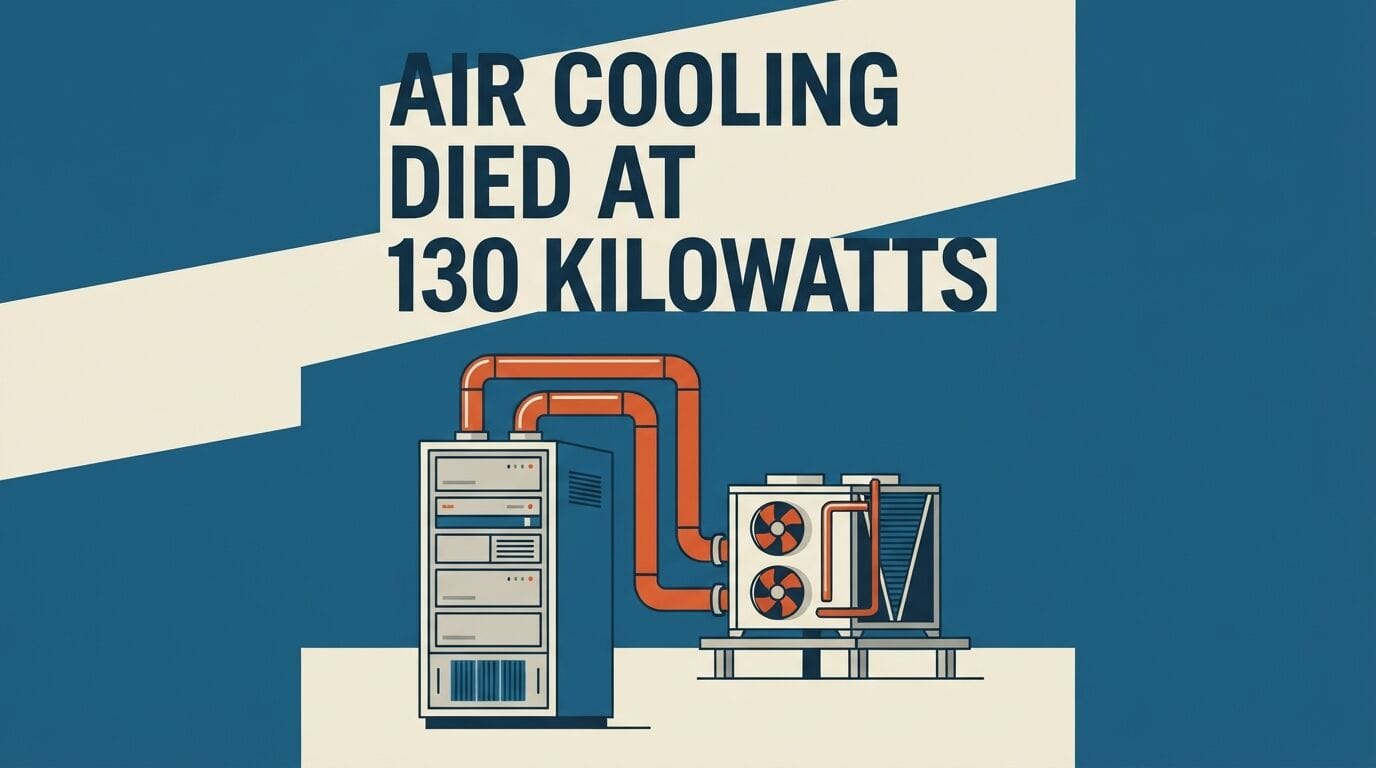
For thirty years, cooling a data center meant moving cold air across hot metal. That model is now dead in the segment that matters, and 2026 was the year the industry stopped pretending otherwise. NVIDIA's Vera Rubin generation, in full production with customer availability from the second half of 2026, is the first AI infrastructure platform where every chip and every networking component is cooled entirely by liquid. There are no fans in the system (NVIDIA, June 2026). The rack your AI cluster sits in is a plumbing project, the vendors that supply it are mostly owned by chemical and electrical giants now, and the fluid that made the most advanced approach work no longer exists.
The density ladder left air behind
A traditional enterprise rack draws 5 to 10 kilowatts. NVIDIA's GB200 and GB300 NVL72 racks draw around 120 to 130 kilowatts, more than ten times the old norm, and the published roadmap goes further: the Vera Rubin NVL144 holds near 120 to 130 kW in the second half of 2026, while the Rubin Ultra "Kyber" NVL576 targets roughly 600 kW per rack in the second half of 2027, with 1 MW racks openly discussed beyond that (Data Center Playbook). Power delivery infrastructure is being redesigned around the same curve; Schneider Electric told Techzine in 2026 that its planned 600V DC systems had to be rethought because they could not support the 400 kW per rack requirements of upcoming Vera Rubin Ultra deployments.
The practical rule of thumb, as Network World laid out from vendor specifications: up to roughly 20 kW per rack, air is adequate; to about 100 kW, rear-door heat exchangers extend viability; direct-to-chip cold plates fill the band between 100 and 175 kW; above 175 kW, immersion is required. Modern AI racks are at the top of that ladder, and the next generation is above the whole ladder.
What 45-degree water changed
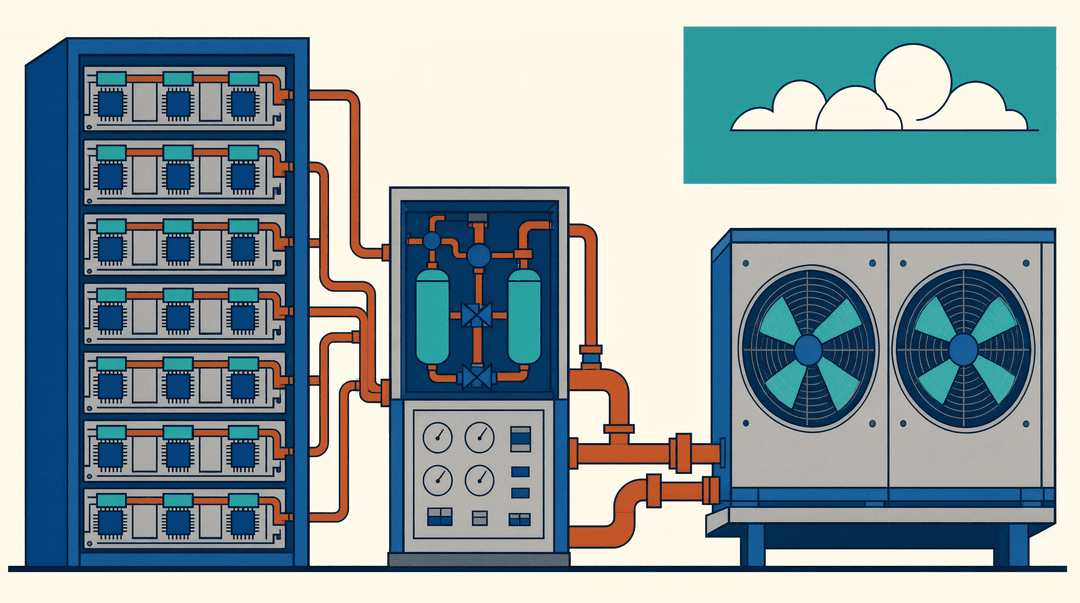
The interesting number in the Rubin design is not the flow, it is the temperature. The platform runs warm-water, single-phase direct liquid cooling at a 45 degrees Celsius supply, hot enough that a data center can dump the heat through outdoor dry coolers on ambient air instead of running mechanical chillers (Network World; NVIDIA). NVIDIA claims the resulting closed-loop, chiller-less design brings facility water consumption from roughly 2.6 million gallons per megawatt per year in cooling-tower systems to near zero, and says a 50-megawatt facility can save more than $4 million a year in cooling-related energy and water costs. Industry estimates the company cites put cooling at up to 40 percent of a data center's electricity, and each degree of chiller-plant temperature increase cuts cooling energy cost by about 4 percent.
One caveat, straight from the operator surveys: recovered heat is not what buyers are optimizing for. The IEA's 4E programme DC6 report on liquid cooling, published February 2026, found ease of retrofit (46 percent) and operating costs (39 percent) dominate adoption decisions, while heat recovery potential is a priority for only 16 percent of respondents. The 45-degree water makes the economics of cooling work; nobody is selling the hot water back yet.
Adoption is past the inflection, on borrowed hardware
Numbers from three independent counts point the same direction. The Uptime Institute's 2025 survey, cited in the IEA 4E report, found about 22 percent of data centers running some form of direct liquid cooling, concentrated in large facilities: 20 percent adoption at sites of 20 MW or more, 13 percent below 5 MW. AFCOM's State of the Data Center Report 2026 (summarized by Upsite) has 36 percent of operators deploying liquid cooling and another 28 percent planning to within 12 to 24 months, with more than one in four racks now liquid-cooled. Future Market Insights, as reported by Network World, puts direct-to-chip at roughly 47 percent of the AI data center liquid cooling segment, the clear near-term winner over immersion.
Dell'Oro Group's January 2026 report sized the worldwide data center liquid cooling market to approach $7 billion in manufacturer revenue by 2029, with Vertiv leading and CoolIT, nVent and Boyd holding strong share. That is still small money compared with the compute it protects, which is precisely why the strategic buyers moved.
The vendor map was redrawn by chequebook
Two years ago liquid cooling was a market of specialists. In 2026 it belongs mostly to industrial conglomerates:
- Ecolab bought CoolIT Systems from KKR for about $4.75 billion in cash, announced March 20, 2026 and closed July 2, 2026, around 29x CoolIT's next-twelve-months adjusted EBITDA on roughly $550 million of sales (Futurum; Bluefield Research; Smart Water Magazine). KKR had bought in around 2023 for an estimated $270 million, a reported 15x return. CoolIT's year-to-date sales grew more than 100 percent before the close.
- Eaton agreed in November 2025 to pay $9.5 billion for Boyd Thermal from Goldman Sachs Asset Management, 22.5x projected 2026 EBITDA. Boyd Thermal expected 2026 sales of $1.7 billion, $1.5 billion of it from liquid cooling (Eaton press release). The logic, in CEO Paulo Ruiz's words, is selling power and cooling together "from the chip to the grid."
- Trane Technologies completed its acquisition of LiquidStack in March 2026, and Schneider Electric has owned Motivair since early 2025 (We The Flywheel roundup).
The independents that survived are being funded by the companies that build AI servers. LITEON took a 25 percent stake in DCX for $176 million in September 2026, ZutaCore raised $100 million in June, Iceotope $26 million in May, and in January 2026 Microsoft signed a multi-billion-dollar annual supply agreement with LG Electronics for cold plates, CDUs and chillers, per the same roundup and ENKI's deal log.
The queues and the fluid cliff
Demand outran the factories. Vertiv reported Q1 2026 organic sales growth of 23 percent, a backlog near $15 billion up 109 percent year-over-year, and a book-to-bill ratio of 2.9 (MarketWise, citing the April 22 earnings report). CDU lead times stretched from a historical 12 to 16 weeks to 20 to 26 weeks by early 2026, and a late-2025 industry survey found 83 percent of experts calling cooling delivery capacity a major impediment to growth (ENKI). A project that wins its GPUs can still lose six months on its coolant manifolds.
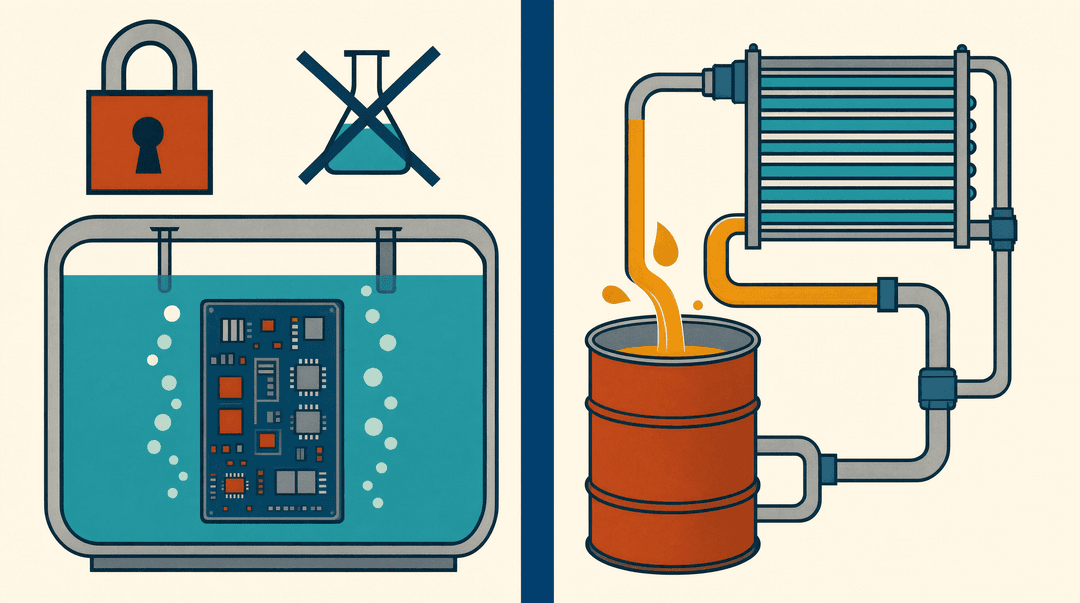
Then there is the chemistry problem. The fluids that made two-phase immersion cooling viable were 3M's: Novec 7100, Novec 649, Fluorinert FC-72. 3M announced in December 2022 it would exit PFAS manufacturing entirely by the end of 2025, stopped taking orders on March 31, 2025, and completed the exit in December 2025 (Precision Lubrication; Schneider Electric blog). Replacement two-phase fluorochemicals exist, Chemours' Opteon 2P50 among them, but they cost $200 to $300 per liter, which makes a single 800-liter tank fill $160,000 to $240,000, and they remain classified as PFAS under regulatory pressure including EPA scrutiny of trifluoroacetic acid byproducts (Energy Solutions Intelligence). Single-phase hydrocarbon fluids at $8 to $15 per liter took an estimated 55 percent of 2026 immersion volume. There is no PFAS immersion ban yet; states from New Jersey to Washington have reporting rules, and operators are qualifying esters and hydrocarbons ahead of a federal restriction whose date nobody is certain of (Schneider Electric blog).
What an operator actually pays
Installed economics, per Energy Solutions Intelligence's 2026 comparison: single-phase immersion runs $4,500 to $6,800 per kilowatt of IT load; direct-to-chip $6,000 to $9,500 per kilowatt; advanced air (rear-door or in-row) $5,500 to $8,500. Varidata prices a per-rack direct-to-chip retrofit package at $8,000 to $12,000 of upfront cost against lower operational cost per kilowatt. ENKI puts the breakeven against air around 50 to 60 kW per rack, where payback lands under three years, and the IEA notes a 130 kW GB300 rack leaves no decision to make: air simply will not work.
Brownfield is where the money goes to die. The IEA 4E report describes complete overhauls of existing buildings as often impractical and very expensive; even a simplified retrofit, one high-density rack plus a liquid-to-air CDU in a row of air-cooled racks, can require floor load spreaders because the new hardware is far heavier than what it replaces. Nautilus Data Technologies' 2026 liquid cooling report found retrofit projects running 30 percent longer than planned on average, and advises designing new capacity for a minimum of 60 to 80 kW per rack with headroom past 100 kW, because buildings rated for 30 kW will be obsolete before construction ends.
The scoreboard
The story of AI infrastructure in late 2026 is usually told in chips and megawatts. The binding constraint that gets less press is heat removal. The compute roadmap is a thermal roadmap: 120 kW racks today, 600 kW in 2027, all of it liquid, all of it needing CDUs on 20-week queues, coolant chemistry that has to be re-qualified because a Minnesota company exited an entire product family, and vendors that now answer to Ecolab, Eaton, Trane and Schneider. Buyers who locked their AI build-out around GPU price and delivery alone underpriced the easiest part of the bill to quote and the hardest part to get on site.
Sources
- NVIDIA, "Hotter Than a Hot Tub: The 45°C Breakthrough to Cool AI's Biggest Machines," June 2026 - https://blogs.nvidia.com/blog/liquid-cooling-ai-factories
- Network World, "Why AI rack densities make liquid cooling nonnegotiable" - https://www.networkworld.com/article/4149069/why-ai-rack-densities-make-liquid-cooling-nonnegotiable.html
- Data Center Playbook, "Data Center Trends: AI Density, Liquid Cooling & Nuclear" - https://datacenterplaybook.com/trends.html
- Techzine, "The data center of the future: high voltage, liquid cooled, up to 4 MW per rack" - https://www.techzine.eu/blogs/infrastructure/137071/the-data-center-of-the-future-high-voltage-liquid-cooled-up-to-4-mw-per-rack
- Dell'Oro Group, "Data Center Liquid Cooling Market to Approach $7 Billion by 2029," January 8, 2026 - https://www.delloro.com/newsroom/data-center-liquid-cooling-market-to-approach-7-billion-by-2029-as-ai-deployments-accelerate
- Upsite, "The State of Data Center Cooling in 2026" (AFCOM State of the Data Center Report 2026 summary) - https://www.upsite.com/blog/the-state-of-data-center-cooling-in-2026
- IEA 4E DC6, "Liquid cooling in Data Centres, Final report," February 2026 - https://www.iea-4e.org/wp-content/uploads/2026/02/EDNA-2026-LIQUID-COOLING-IN-DATA-CENTRES3.pdf
- Futurum, "Ecolab's $4.75B CoolIT Systems bet" - https://futurumgroup.com/insights/will-ecolabs-4-75b-coolit-systems-bet-define-the-future-of-gpu-liquid-cooling
- Smart Water Magazine, "Ecolab closes $4.75 billion CoolIT Systems acquisition" - https://smartwatermagazine.com/news/smart-water-magazine/ecolab-closes-475-billion-coolit-systems-acquisition
- Eaton press release, "Eaton signs agreement to acquire Boyd Thermal," November 3, 2025 - https://www.eaton.com/us/en-us/company/news-insights/news-releases/2025/eaton-signs-agreement-to-acquire-boyd-thermal--expanding-solutio.html
- We The Flywheel, "Data Center Cooling Companies: The Liquid Cooling Vendors After the Buyouts" - https://wetheflywheel.com/en/guides/data-center-cooling-companies
- MarketWise, "11 AI Data Center Cooling Stocks to Own After the Ecolab-CoolIT Deal" - https://marketwise.com/investing/ai-data-center-cooling-stocks-ecolab-coolit
- ENKI, "Vertiv Liquid Cooling 2026" (CDU lead times, industry survey) - https://enkiai.com/data-center/vertiv-liquid-cooling-microsoft
- Energy Solutions Intelligence, "Immersion Cooling Fluids: Availability, Material Compatibility" - https://energy-solutions.co/supply-chain/ai-data-centers/data-center-immersion-cooling-fluids-supply-compatibility
- Energy Solutions Intelligence, "Liquid vs Air Cooling for Data Centers 2026" - https://energy-solutions.co/articles/sub/data-center-cooling-liquid-immersion-vs-air
- Precision Lubrication, "Data Centers Are Redefining What a Lubricant Is" - https://precisionlubrication.com/articles/data-center-lubricants
- Schneider Electric blog, "PFAS phase-out & data center liquid cooling: US 2026 guide" - https://blog.se.com/datacenter/2026/05/22/pfas-phase-out-liquid-cooling-us-data-center-operators-must-do
- Varidata, "What are the Liquid Cooling Solutions for NVIDIA Rubin?" - https://www.varidata.com/knowledge-en/what-are-the-liquid-cooling-solutions-for-nvidia-rubin
- Nautilus Data Technologies, "Five Things the 2026 Liquid Cooling Report Tells Us" - https://nautilusdt.com/five-things-the-2026-liquid-cooling-report-tells-us-about-where-the-market-is-going
