
OpenAI Publishes A Deployment Playbook For Exploit-Capable Cyber Agents
OpenAI on November 19 published a reference architecture for running Daybreak Red, the access tier that hands verified security teams its purpose-trained cyber models, including GPT-5.6-Cyber. The 10-page PDF, "Supervised Investigations with Daybreak Red: A Reference Architecture," is less a product announcement than an operations manual: it tells approved customers exactly how to cage an agent that has been trained to stop refusing exploit requests.
The document is the operational counterpart to August's Daybreak expansion, which introduced the Blue/Red tiers and GPT-5.6-Cyber. OpenAI's own numbers show why the cage matters: on an internal evaluation of advanced cyber requests (exploit-chain development, authentication bypass, privilege escalation), GPT-5.6-Cyber completes 95.0% of them, against 1.5% for GPT-5.6 Sol with standard guardrails. Under OpenAI's Preparedness Framework the model rates High for cybersecurity capability, below the Critical threshold.
The architecture: one analyst, one disposable VM, no shared credentials
The design splits the investigation across four pieces. A "coordinator" is a local Codex install on the analyst's workstation; it directs the run and presents results. Execution happens on a separate, disposable agent VM inside an isolated VPC, where Codex runs as a dedicated non-admin user. Lab network rules (iptables, a firewall, or security groups that the Codex account cannot change) limit what the VM can reach. Telemetry, Codex tool activity, target request logs and sign-in events, lands in a log store outside the agent's control. Model inference connects out to OpenAI or AWS; everything else stays inside the lab.
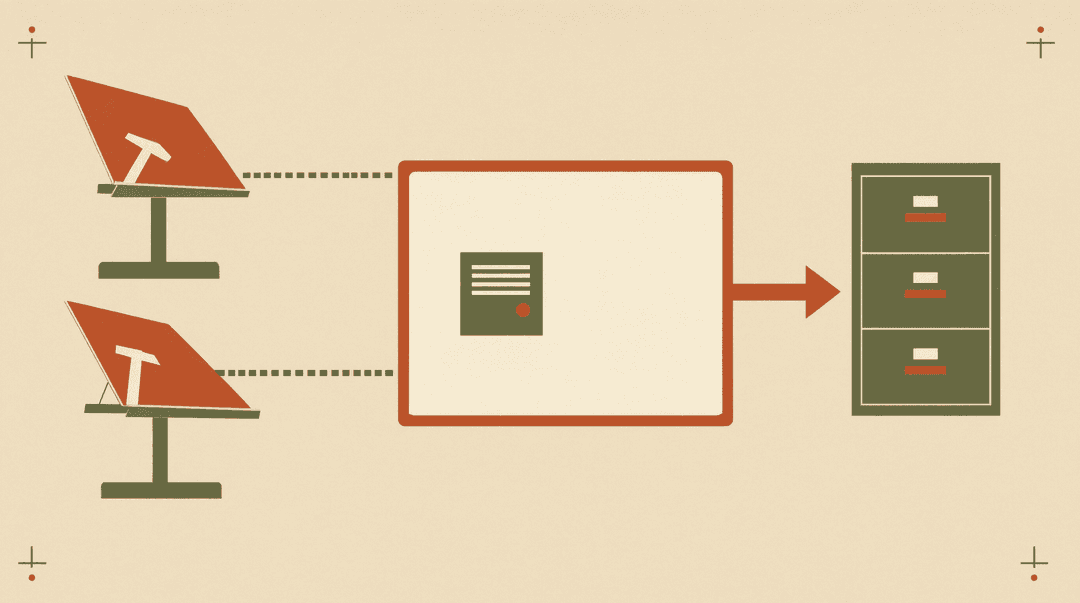
Safety controls layer on top of that topology. Before any run, the analyst fixes a scope: target, permitted actions, investigation window, stopping point, and whether the agent works anonymously or through a dedicated test account with least-privilege access and short-lived credentials. Private keys, deployment credentials and host-management sockets stay outside the VM account's reach. Codex's sandbox, built on bubblewrap, limits which files commands can read or write, and the Codex network proxy narrows destinations further: the VM might reach three staging apps while the allowlist permits only the one in scope.
For sensitive actions, the guide defaults to what OpenAI calls auto-review: a separate reviewer decides whether an action can proceed, and if the agent asks for a new target, a new account, or anything outside the agreed scope, the run pauses until the analyst confirms authorization. Mandatory settings go in a requirements file an administrator controls, so the VM account cannot override them.
Preflight checks and a kill switch you can actually verify
The playbook treats verification as a first-class step. A preflight prompt tells the agent to attempt a write inside and outside the workspace and a GET to an approved URL and a URL outside the allowlist, then confirm the blocked actions were actually blocked and logged in the independent log store. Before the first run, customers are told to verify they can stop the agent VM or cut its access to the target from outside Codex, and to use that kill switch if monitoring fails or the run cannot be confirmed stopped. Ending an investigation is its own checklist: stop prompt, verify no background jobs or lingering requests in target logs, end the session, revoke temporary credentials.
The optional walkthrough applies all of it to a disposable Gitea 28.1.0 instance reproducing CVE-2026-117649, having Daybreak Red confirm the vulnerability, save a proof-of-concept script, run it once under rate limits (one request per second, 12 attempts, five minutes per phase), and reconcile the results against the app's access logs.
Why a playbook, and why now
OpenAI is not the only lab pushing cyber-capable models at defenders, but publishing a concrete isolation-and-audit recipe is a different kind of commitment than a model release. It effectively standardizes the controls (non-admin accounts, network allowlists, out-of-band logging, human review of elevated actions, verified kill switches) that its Daybreak program expects from everyone running Red-tier workloads, and it acknowledges that reduced refusals only make sense with supervising infrastructure around them.
The timing follows a hard month for that argument. On November 12 OpenAI announced Daybreak Red Team and Defense Factory, products that chain agents through finding, validating and patching vulnerabilities. Daybreak Red reached AWS GovCloud on November 4, with a two-step gate: Trusted Access for Cyber approval from OpenAI, then account provisioning by AWS. Meanwhile an AI penetration-testing tool was implicated in the 10-day outage at the European Commission in early November, a reminder that the same class of capability is already in attacker hands. The reference architecture is OpenAI's answer to the obvious question that raises: if the model will write the exploit, who is watching the agent?
Sources
- Deploying Daybreak Red: a reference architecture for supervised security investigations (PDF), OpenAI, November 19, 2026
- Deploying Daybreak Red, OpenAI, November 19, 2026
- Expanding Daybreak as the Cyber Defense Window Narrows, OpenAI, August 10, 2026
- OpenAI Unveils Daybreak Red Team, Defense Factory Security Tools, SecurityWeek
- Daybreak Red is now available in AWS GovCloud (US-East), OpenAI
- The AI penetration tool behind the 10-day European Commission outage, Politico (via llms.blog archive)
