
Who AI Actually Cites: What the Late-2026 Citation Data Shows
An entire consulting industry now sells "answer engine optimization": the promise that if you structure your pages correctly, ChatGPT, Perplexity and Google's AI Overviews will cite you. The published citation data tells a blunter story. It says the sources AI assistants use are concentrated in a handful of platforms, that the ranking-to-citation link has broken, and that the shelf itself can be rebuilt without notice. Here is what the numbers actually support, and the short list of things that still move the odds.
The prize is smaller than the hype, and different in kind
Google says AI Overviews reach more than 2 billion monthly users across 200-plus countries (Digiday). That is the audience size. The click is a different matter. Pew Research tracked 68,879 Google searches from 900 US adults in March 2025 and found that when an AI summary appeared, users clicked a traditional result in 8% of visits versus 15% without one. Users clicked a source link inside the summary itself in just 1% of visits, and were more likely to end the browsing session entirely (26% versus 16%) (Pew Research Center).
So a citation is not a traffic channel in the old sense. It is presence in an answer: the brand named, the figure quoted, the recommendation made on someone's behalf. Whether that is worth anything depends on what you are selling. But it means the honest goal of AEO is influence without clicks, and anyone promising it as a replacement for organic traffic is selling something else.
The shelf is short, and platforms take most of it
Each answer has few slots. An analysis of 4,984 questions across five engines in September 2026 found ChatGPT cites an average of 3.7 sources per answer while Perplexity cites about 20 (Suff Digital). On ChatGPT, being one of roughly four best pages on the exact question is the bar.
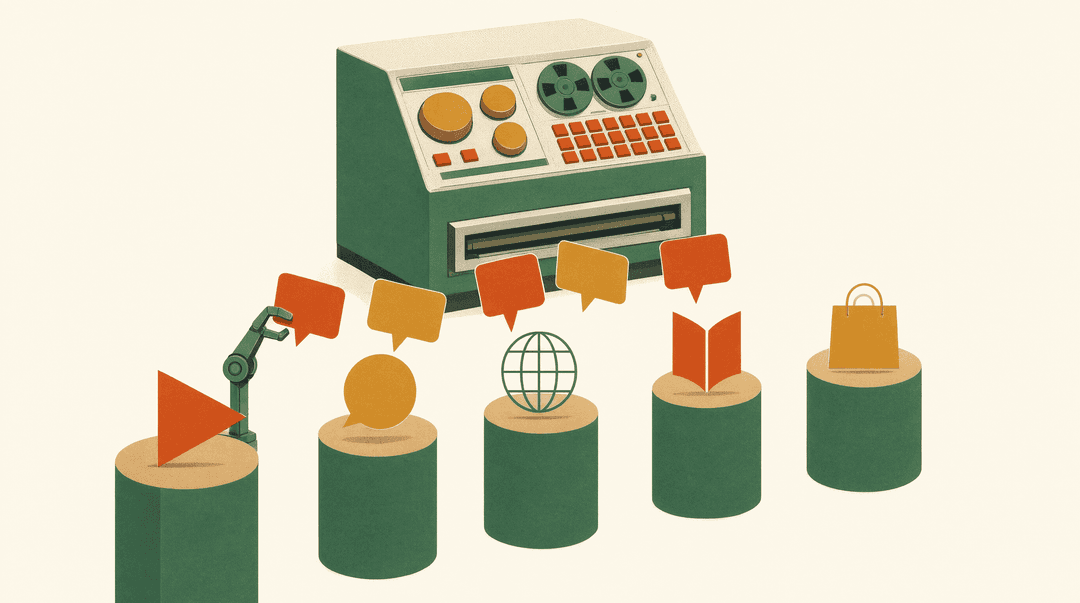
Who clears it? Ahrefs' Brand Radar tracked every domain cited across 3 million US queries. In Google AI Overviews (November 2026 snapshot), the top of the citation share went to: YouTube 24.5%, Reddit 18.1%, Facebook 12.4%, Google itself 8.6%, Instagram 5.4%, Quora 4.4%, Wikipedia 4.4% (Ahrefs). Every one of the seven most-cited properties is a platform or a search engine. The New York Times, a top-20 entry, captured 0.5%.
ChatGPT's list looks different but is no friendlier to ordinary websites: Wikipedia 10.1%, Reddit 6.2%, Consumer Reports 4.4%, Walmart 4.1%, PubMed 3.7%, the NIH's PMC archive 3.1%, the FDA 2.9% (Ahrefs). Reference infrastructure, retail catalogs and government health pages. The most-cited single site after the platforms is a 90-year-old product-testing nonprofit.
Ahrefs also classified its top 1,000 most-cited ChatGPT pages and found only 32.3% of them are the kind of page a marketer could realistically pitch or influence. The rest are Wikipedia entries, homepages, app-store listings: what Ahrefs' Ryan Law calls "dead" citations (Ahrefs). Two-thirds of the citation real estate is not on the market.
Ranking and citation have decoupled
The old assumption was that AI answers cite the top ten organic results. That link is mostly gone. Ahrefs' 2026 analysis found only 37.1% of URLs cited in AI Overviews also ranked in Google's organic top 10 for the same query, a figure CXL's 100-page study repeats, and Leapd's roundup puts as low as 17% in BrightEdge research. Surfer's study of 10,000 keywords found 67.8% of pages cited in AI Overviews did not rank in the top 10 for the query or any of its sub-queries (Surfer).
Where the cited pages do come from has two clear patterns. First, position inside the page beats position in the SERP. Kevin Indig's analysis of 18,012 verified ChatGPT citations found 44.2% of them drawn from the first 30% of a document, after which citation likelihood falls off what he calls a "ski ramp" (via CXL). Second, domain authority matters more than page authority. Of ChatGPT's top 1,000 cited pages that did rank organically, 65% sat on domains rated DR 81 or higher, with a median Domain Rating of 90, while the pages themselves had a median URL Rating of 6 (Ahrefs). And 28% of the most-cited pages had no organic search visibility at all. Freshness is prominent too: of cited pages with a detectable publish date, 60.5% were published within two years.
The shelf can be rebuilt in one release cycle
The most uncomfortable finding for anyone building a strategy is volatility. Semrush's 13-week study of more than 230,000 prompts tracked ChatGPT citing Reddit in close to 60% of responses in early August 2025, collapsing to about 10% by mid-September. Wikipedia dropped from roughly 55% to under 20% in the same window. Google AI Mode and Perplexity barely moved. The winners in ChatGPT after the shift: PR Newswire, Forbes, Medium (Semrush).
The cause was never settled. The drop coincided with Google killing the num=100 results-per-page parameter, which SEOs suspected broke ChatGPT's scraping depth, but Semrush's Sergei Rogulin notes the distribution of Reddit's rankings did not fit that theory, and favors a deliberate de-biasing change in ChatGPT's own generation to avoid over-citing particular sites. Either way: citation patterns are a vendor implementation detail. They change without changelogs.
What actually correlates: being talked about elsewhere
The strongest causal-adjacent evidence in the dataset is about brand mentions rather than on-page tricks. Ahrefs analyzed 75,000 brands for AI Overview visibility and found the top correlates were all off-site text signals: branded web mentions (Spearman 0.664), branded anchors (0.527) and branded search volume (0.392). Backlink metrics trailed far behind: Domain Rating 0.326, referring domains 0.295, raw backlinks 0.218. Paid search showed almost nothing (0.216). Brands in the top quartile of web mentions averaged 169 AI Overview mentions, more than 10 times the next quartile at 14; brands in the bottom half barely registered, and 26% of the studied brands had zero mentions (Ahrefs).
Seer Interactive's parallel work found the same weak link-metric correlations, and Kevin Indig found brand search volume to be the largest single predictor for ChatGPT visibility. Unlinked mentions, the thing that never mattered for classic SEO, matter more for this than links do, which fits how language models work: their picture of a brand is assembled from text about it across the corpus.
The defensible playbook
Strip the vendor claims down and the data supports maybe five moves:
- Put the answer in the first third of the page, in extractable sentences with numbers in them. The ski-ramp effect is consistent across engines.
- Publish facts that cannot be sourced anywhere else: original data, tests, dated claims. Reference-free "what is" text is the most substitutable content on the web.
- Keep pages demonstrably fresh. The cited-page sample skews heavily to items published and updated within two years.
- Invest in being mentioned across the web, including platforms you cannot own: Reddit threads, YouTube explainers, review sites like Consumer Reports and Trustpilot that appear in the citation tables, and unlinked text mentions that carry no SEO weight.
- Track each engine separately and expect discontinuities. A citation base can be repriced overnight by a model update nobody announced.
The thing the data does not support is the core promise of the AEO industry: that structure alone buys you a slot. The slots are mostly allocated to platforms, encyclopedias, retailers and regulators; the rest go to whichever brands the web already talks about. The answer engines have the same winner-takes-most dynamic their creators keep describing about themselves.
Sources
- The 50 Most-Cited Websites in Google AI Overviews (November 2026), Ahrefs
- The 50 Most-Cited Websites in ChatGPT (November 2026), Ahrefs
- 67% of ChatGPT's Top 1,000 Citations Are Off-Limits to Marketers, Ahrefs
- An Analysis of AI Overview Brand Visibility Factors (75K Brands Studied), Ahrefs
- The Most-Cited Domains in AI: A 3-Month Study, Semrush
- Google users are less likely to click on links when an AI summary appears, Pew Research Center
- Google's AI Overviews reach over 2 billion monthly users, Digiday
- Where Google AI Overviews Cite From: A 100-Page Study, CXL
- How to Get Cited by AI: 9 Ways to Earn LLM Citations in 2026, Surfer
- AI Sources per Answer 2026: ChatGPT Cites 3.7, Perplexity 20, Suff Digital
- How ChatGPT, Google AI Overviews, and Perplexity Source Information in 2026, Leapd
- What Drives Brand Mentions in AI Answers, Seer Interactive
