
Google DeepMind released Mass Spec Skills for Google Antigravity on November 24, a suite of agent skills that takes a raw tandem mass spectrum to a proposed molecular structure and an auditable report. The plugin is available today in the Antigravity app, and the company is offering 10,000 scientists its highest usage tier free for six months, subject to eligibility and selection.
The problem the suite targets has a name in analytical chemistry: the dark matter of mass spectrometry. A modern instrument can detect tens of thousands of molecular signals in a drop of blood, soil or plant tissue extract, but matching each spectrum against reference libraries annotates, on average, only about 5% of measured spectra, and roughly 10% for human samples, even after a decade of library expansion. Many of the unannotated molecules are already listed in public chemical databases; their spectra have simply never been recorded, so structure identification means inferring it from fragment ions, a workflow that takes a domain expert significant time per spectrum. A single study generates thousands.
The skills automate that expert workflow rather than replacing chemical judgment. Google says the suite was built with analytical chemists and wraps openly available, community-developed tools. The agent preprocesses the raw recording, searches reference libraries, deduces a molecular formula with a tool such as SIRIUS, retrieves candidate structures from public databases, and then tests every candidate against observed fragment peaks, laying out the evidence for a chemist to review. Users describe the task and instrument tolerances in plain language; the agent selects and chains the relevant skills.
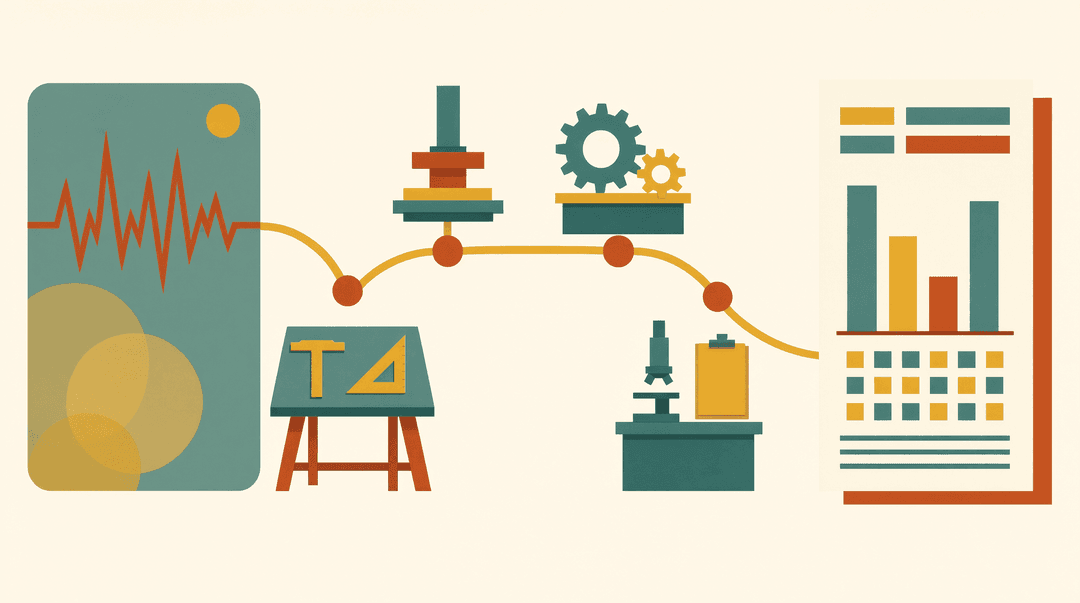
Google's worked example shows where the value sits. For a negative-mode spectrum with precursor ion at m/z 395.1387, with library lookup disabled, the agent pinned the formula C20H21ClN6O and found the molecule splits into two complementary fragments whose formulas add up to the intact precursor, plus sequential neutral losses indicating a central urea linkage. It then scored all 845 database isomers of that formula. The top-scoring candidate explained 97.7% of summed fragment intensity across 14 of 19 peaks, but it lacked a urea bond, so it had no route to one observed neutral loss; that same intensity fit was shared by the eventual answer and the leading false candidate. Distinguishing them required reasoning about fragmentation pathways, not peak scores alone, and the agent narrowed 845 isomers to five urea regioisomers, then used secondary fragments to identify the correct PubChem entry.
Two claims deserve framing. Google says the approach matches "frontier-level retrieval accuracy even with a lightweight model," which positions the skills as a cheap way to get chemistry reasoning inside an agentic harness. And in evaluations quoted from industry partners, accuracy for predicting complex molecular structures exceeded 90%; those are company-quoted partner assessments, not independent benchmarks.
The limitations are stated plainly. Mirror-image molecules and some closely related isomers break apart in nearly identical ways, so no MS/MS spectrum, interpreted by human or agent, can separate them without additional measurements like retention time, ion mobility or NMR. Genuinely new molecules, including many natural products, exist in no database, so the agent can only offer a formula, peak assignments and an annotation table as a starting point.
That caveat is the honest version of the agentic science pitch. The agent does not discover the molecule; it does the days of tool-running, database querying and evidence assembly that stand between a chemist and the decision. If it holds up outside Google's own examples, the practical effect is that the 5% annotation rate, not model capability, becomes the number worth watching.
Sources:
