
In 2016, an American software company and an American newsroom produced dueling analyses of the same algorithm and reached opposite conclusions. Both analyses were mathematically correct. That contradiction, more than any single bias scandal, is what turned algorithmic fairness into a research field: the discovery that there is no single thing for a model to be fair about.
The object of the dispute was COMPAS, a risk-scoring tool made by Northpointe and used in several US states to estimate how likely a criminal defendant is to reoffend. Judges see the score at sentencing and at parole hearings. ProPublica collected the COMPAS scores for more than 7,000 people arrested in Broward County, Florida in 2013 and 2014, and checked them against who was actually re-arrested within two years, using the same outcome definition Northpointe used. Its reporting found that the tool's errors were distributed along racial lines. Among defendants who did not reoffend, 44.9 percent of Black defendants were labeled high risk, against 23.5 percent of white defendants. Among defendants who did reoffend, 47.7 percent of white defendants were labeled low risk, against 28.0 percent of Black defendants. The methodology page publishes the full contingency tables.
Northpointe's rebuttal used the same data and a different yardstick. Among defendants the tool labeled high risk, 63 percent of Black defendants and 59 percent of white defendants went on to reoffend. Among those labeled low risk, the reoffend rates came out nearly equal the other way. On this measure, the score was doing exactly what a probability is supposed to do: a score of 7 meant the same thing for everyone.
Both sides were right. That is the whole story, and in 2016 nobody had proved it formally.
Three definitions, borrowed from three traditions
The fairness debate inherited three candidate definitions, each with its own history.
The oldest is demographic parity: a decision is fair if it comes out at similar rates across groups, regardless of predicted behavior. Parity-style thinking predates machine learning by decades. The US Equal Employment Opportunity Commission's Uniform Guidelines on Employee Selection Procedures of 1978 still govern American hiring audits with the four-fifths rule: if the selection rate of one group falls below 80 percent of the highest group's rate, enforcement agencies treat that as evidence of adverse impact.
The second is calibration within groups, Northpointe's position. If the model says 20 percent of the people in this score bucket will reoffend, then roughly 20 percent of the Black subset and 20 percent of the white subset should reoffend. Errors at the same score are, in this view, fair by construction.
The third is error-rate balance, ProPublica's position. Fairness means the mistakes themselves land evenly: the same false positive rate (innocent of future crime, flagged risky) and the same false negative rate (guilty of future crime, flagged safe) across groups. When lives turn on the flag, many people find this the only definition that matters.
The impossibility result
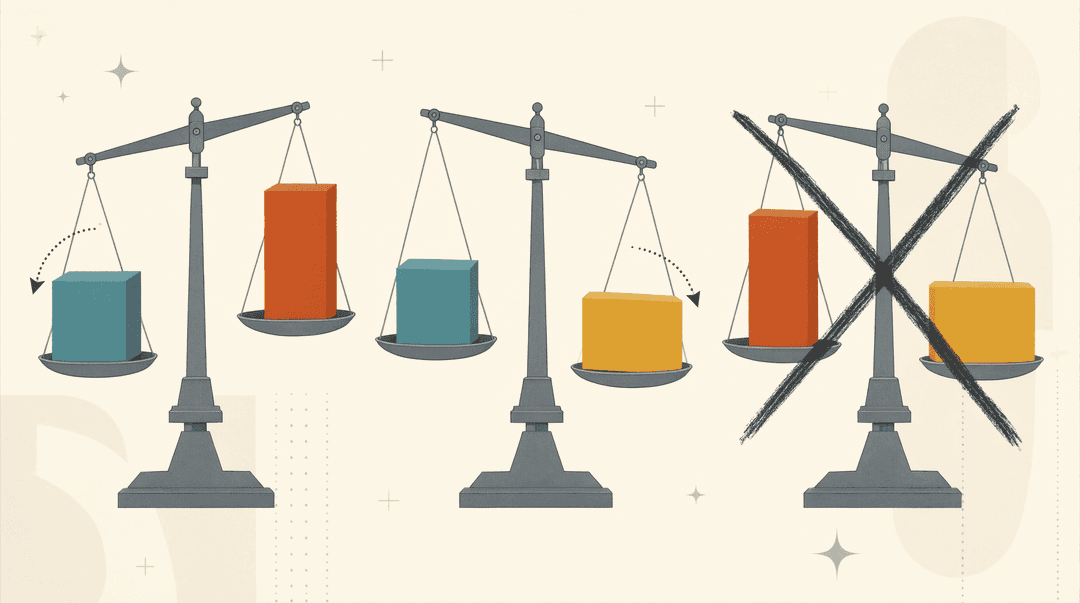
In late 2016, Jon Kleinberg, Sendhil Mullainathan and Manish Raghavan posted a short proof (published at ITCS 2017), and Alexandra Chouldechova independently produced the same result for the recidivism setting (published in Big Data in 2017). The theorem: when two groups have different base rates for the outcome being predicted, no non-trivial risk score can be simultaneously calibrated within groups and have equal false positive and false negative rates across them. You can have calibration, or you can have equal error rates, or you can have parity in outcomes. The arithmetic permits two of the three at best, and some pairs cannot coexist at all.
The intuition is a one-line calculation. Suppose a score is calibrated and the groups' base rates differ. Then the fraction of each group sitting above any given risk threshold, and the share of that fraction that is truly high-risk, are pinned by the base rates. Making false positive rates equal forces the false negative rates apart, and the gap between the two groups' error rates shrinks to zero only in degenerate cases: equal base rates, or a score that predicts the same value for everyone, which is useless.
COMPAS is not an abstraction. The tool was close to calibrated across groups, 63 versus 59 percent positive predictive value. Under the theorem, a calibrated tool in a world of unequal rearrest base rates must produce unequal error rates. ProPublica's 44.9 versus 23.5 percent false positive spread is not evidence that Northpointe coded race in; none of the instrument's inputs is race. It is what calibration costs when base rates differ.
The repair menu, and what each repair spends
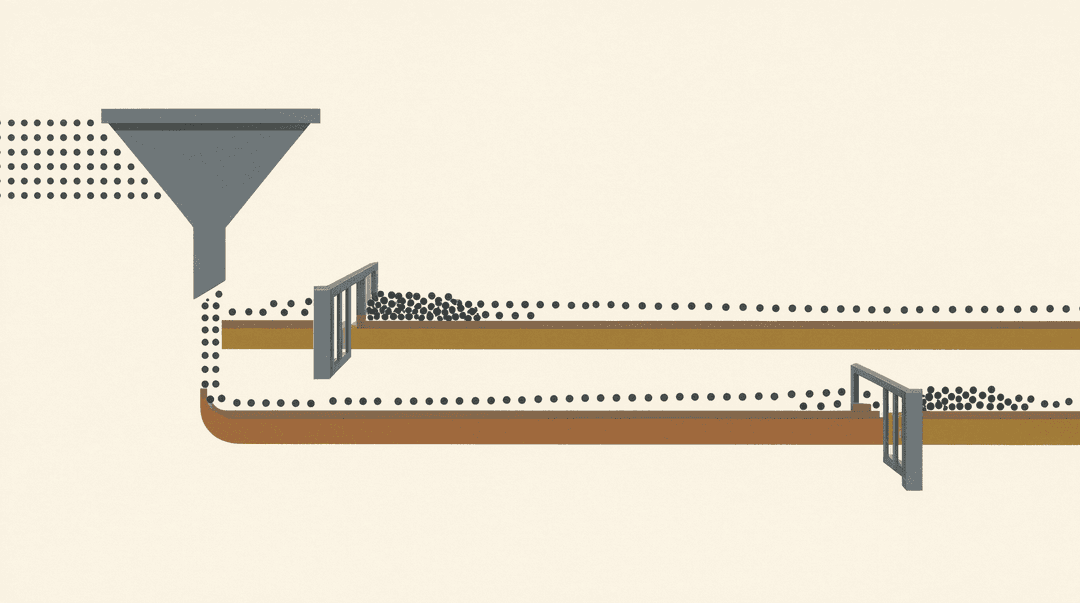
The research that followed does not fix the theorem; it spends against it. Moritz Hardt, Solon Price and Nati Srebro proposed equality of opportunity (NeurIPS 2016): choose the error type you care about, false positives or false negatives, and equalize just that one across groups, possibly by setting different decision thresholds for different groups. A model can stay calibrated and still be "fair" in exactly this narrowed sense. The cost is visible in the mechanism: the system now treats identical predicted risk scores differently depending on group membership, which is precisely what many legal frameworks forbid.
Which definition to adopt is not a modeling decision. If you believe the base-rate gap itself is an artifact of differential policing, then calibration faithfully reproduces a biased world and error-rate balance looks right. If you believe the base rates reflect behavior, calibration protects individuals from group penalties and parity-style rules force different thresholds. The theorem's real contribution was to make that choice explicit and unavoidable: every production "fairness constraint" names, in its documentation, the kind of mistake it decided to keep.
What courts and regulators did
One court touched the question the same year. On July 13, 2016 the Wisconsin Supreme Court ruled in State v. Loomis that using a COMPAS score at sentencing did not violate due process, but circumscribed its use: judges must be warned about the tool's limits, and it may not be the determinative factor in a sentence. The defendant's objection, that Northpointe's trade secret made the score unchallengeable, survived as a caution rather than a ban.
Regulators later legislated the audit without legislating the definition. The EU AI Act's Article 10 requires high-risk systems to carry data governance practices covering bias detection and mitigation in training, validation and testing data, and to make datasets "relevant, sufficiently representative, and to the best extent possible, free of errors." Note what it does not do: it mandates no particular fairness criterion, because there is no consistent triple to mandate.
Why this is a language-model problem now
Classification parity was worked out on tabular risk scores, but the geometry is decision-agnostic. Any LLM application that clears, ranks or approves things, hiring screening, credit questions, content moderation, customer support outcomes, inherits the same triangle: you can document that the model is calibrated, or equalize its error rates across user groups, or equalize outcomes, and one line of the three will be violated in your own evaluation data. This is also why a single accuracy number on a model card or a leaderboard says so little: two systems with identical headline accuracy can sit at opposite vertices of the trade-off. The field's practical legacy is procedural rather than definitional. Fairness work today looks like published confusion matrices per group, explicit threshold policies, and written justification of which mistake the team chose to keep. The theorem guarantees that the justification will always have an asterisk. The argument since 2016 is only about where to put it.
Sources
- Angwin, Larson, Mattu, Kirchner: Machine Bias, ProPublica, May 23, 2016
- ProPublica: How We Analyzed the COMPAS Recidivism Algorithm, May 23, 2016
- Kleinberg, Mullainathan, Raghavan: Inherent Trade-Offs in the Fair Determination of Risk Scores, arXiv:1609.05807, ITCS 2017
- Chouldechova: Fair Prediction with Disparate Impact: A Study of Bias in Recidivism Prediction Instruments, arXiv:1610.07524, Big Data 5(2), 2017
- Hardt, Price, Srebro: Equality of Opportunity in Supervised Learning, arXiv:1610.02413, NeurIPS 2016
- EEOC Uniform Guidelines on Employee Selection Procedures, 29 CFR 1607.4(D), the four-fifths rule
- State v. Loomis, No. 2015AP157-CR, Wisconsin Supreme Court, July 13, 2016
- EU AI Act, Article 10: Data and data governance
