

The category has a name, a price list, a venture ladder and now an acquisition. It also has, unusually for AI, a body of independent validation research that arrives before the money ran out.
On July 30, 2026, Simile, a Palo Alto startup that sells simulated human populations, closed a $200 million Series B at a $2 billion valuation, five months after a $100 million Series A that announced the company. Its founders include Joon Sung Park, the Stanford researcher behind the "Smallville" generative-agents study, and its launch customers include CVS Health, Deloitte, Wealthfront and Gallup. Two months later, on September 29, Salesforce signed a definitive agreement to acquire Listen Labs, an AI research platform founded in April 2025 that had raised a $69 million Series B in January 2026 and, according to TechCrunch, scrubbed a $1.5 billion funding round to negotiate the sale instead. Business Insider put the price at around $2 billion. In about 30 months, synthetic focus groups went from a provocative preprint to an M&A line item.
The honest question for anyone who might buy this software is not whether the demos are impressive. It is what the validation evidence says you are actually purchasing, and at what price.
The price ladder: $4 a month to quote-only
The category now has at least 29 named platforms, and their published prices span roughly three orders of magnitude, according to a comparison roundup that checked vendor sites on October 14, 2026.
At the bottom is the persona-generator lane: QoQo sells synthetic personas inside Figma for $4 a month, and Delve AI offers a persona platform at $317 a month for 100 synthetic users. These produce fluent characters. The same roundup notes that their outputs are often presented as research when they are closer to writing exercises.
The middle is the self-serve research-platform lane. Ask Rally charges $20 a month for focus-group-style reactions. SyntheticIQ is $25 at launch pricing. Articos and Deepsona are $79. SYMAR (formerly OpinioAI) is €99 ($119). Minds charges $0.12 per response or $199 per seat per month. Simsurveys packages a consumer study for $1,000. Yabble, YouGov's synthetic respondent product, is $8,900 a year. Synthetic Users, which markets itself as the research-grade option, lists at $12,500 a year plus $2 to $60 per interview.
The top lane is enterprise. Aaru, Electric Twin and Beehive AI are quote-only. Lakmoos prices a one-month neuro-symbolic pilot at €10,000. Brox, which sells digital twins that predict decisions, is reported at $100,000 a year and up. Simile does not publish prices; it has raised more than $300 million instead.

A 3,000-times spread between a Figma persona and a calibrated synthetic panel is the price of methodology, or the price of the claim of methodology. Which one, per platform, is exactly what the validation literature helps you test.
What the validation studies found
The lineage starts in 2023, when Argyle et al. showed in Political Analysis that conditioning GPT-3 on real respondents' written backstories reproduced subgroup opinion patterns, a property they called algorithmic fidelity. In 2024 came the result the industry still quotes: Park et al. interviewed 1,052 real people and built generative agents from those interviews. The agents replicated survey responses at 85 percent of the accuracy that humans achieve re-taking their own surveys two weeks later. The research index entry is careful about the number: 85 percent is relative to human self-retest consistency, not an absolute accuracy claim, and the paper is a preprint.
Other 2024 work bounded the result from the cultural side. Shrestha et al. compared synthetic and human participants across WEIRD and non-WEIRD countries on policy surveys and found the synthetic respondents systematically more progressive than the humans. The same paper cites Tjuatja et al., who found synthetic participants largely failed to reproduce the human response biases that real survey data carries, such as acquiescence and response-order effects.
Then came the synthesis. A 2026 systematic review of 182 studies by Kuric, Demcak and Krajcovic concluded that LLM-generated participants show only modest fidelity to humans, with four recurring failure modes: cognitive misalignment, distortions (reduced variability, stereotyping, flattened personality), misleading believability, and overfitting to training data. At their best, the authors write, synthetic respondents "may stochastically parrot data they were pre-trained on or fine-tuned with." Believability, the review warns, can be more detrimental than beneficial, because fluent output lends false credibility to wrong conclusions.
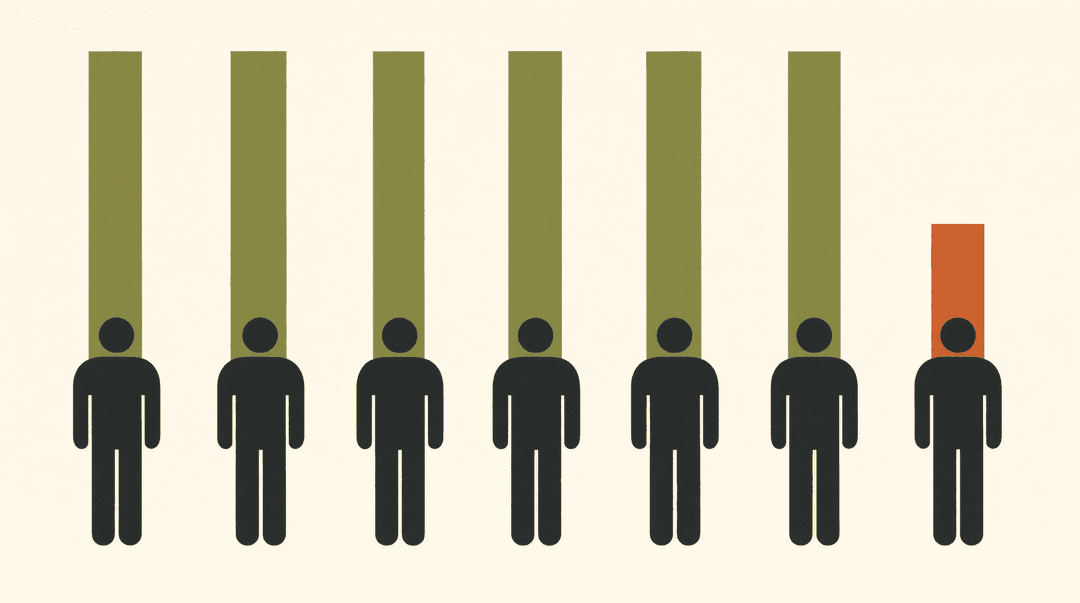
The most detailed independent test to date arrived from Pew Research Center on September 30, 2026. Pew built "digital twins" of its American Trends Panel members, gave each AI respondent the same questionnaire, the same split forms and the same response-order randomization the real person received, and compared results across three survey waves. The headline: across nearly 300 questions, the AI estimates differed from the human estimates by an average of 12 percentage points, the configuration of choice being Claude Opus 4.6. On around 28 percent of questions the error exceeded 15 points. On nearly half the questions, at least one legitimate answer option was never selected by a single synthetic respondent, the under-dispersion the 182-study review predicted. Errors ran worse for some subgroups: 16.1 points on average for Republicans, 15.1 for Black adults. On timely items the model simply missed: 25 percent of Americans said they had heard a lot about data centers, the synthetic sample said 3 percent. Pew added, for the record, that it has no current or future plans to generate survey results with AI models.
The Pew methodology page carries a second, less-noticed finding: what moved accuracy was data, not horsepower. Raising the model's reasoning level changed the person-level match rate by less than one percentage point, and the match rate itself held at roughly 55 percent across configurations. Enriching each persona with 71 additional attitude variables cut average error from 16.0 to 13.7 points; an "expert reflection" step cut it to 13.1. Switching models mattered: Opus 4.6 hit 11.4 points while GPT-5 nano landed at 17.4. The expensive part of a good synthetic panel, in other words, is the real survey data it is grounded in.
The fine print, most of it vendor-written
The skepticism is not only external. The Nielsen Norman Group's 2024 position, still the standard reference in UX ("UX without real-user research isn't UX"), recommends synthetic users for research preparation, hypothesis development, pilot interview guides and desk research, and rules them out for concept validation, niche populations and final decisions.
Vendor copy has converged on the same lane. Qualitati describes its synthetic focus groups as a planning and rehearsal artifact, not evidence about a real market. Synthetic Users publishes its parity methodology openly and posts a scorecard of its calls on the 2026 Brazil and US midterm elections. Simile states its mission as simulating "all eight billion people on earth, accurately and honestly," which TechCrunch's reviewer called preposterous in the same paragraph that called simulated user research promising. Aaru, per the platform roundup, markets a 0.90 rank correlation drawn from one replication of a single EY study. One number, one study, one marketing page: that is the quality floor of the category's published evidence.
Where the money actually went
The clearest tell is that the largest reported deal in the space did not buy a pure simulation company. The Salesforce announcement for Listen Labs (closing on November 2) describes a product anchored in recruiting from a network of more than 50 million real participants and running AI-moderated interviews in over 100 languages. Digital twins of those people are the add-on. YouGov paid £4.5 million for Yabble in August 2024 to bolt synthetic respondents onto existing panel infrastructure, and Qualtrics now ships a synthetic layer inside the most widely used survey platform in the world. Access to validated humans remains the scarce asset; the simulation is what gets bundled onto it.
For a buyer in late 2026, the arithmetic is unglamorous. A $20-to-$120-a-month synthetic panel is a fast, cheap, fluent draft of what an audience might say, and the validation literature says those drafts share two systematic defects: they under-dispense variety and they echo their training corpus. That is genuinely useful for rehearsing a discussion guide at midnight and genuinely dangerous for pricing a product or polling a news cycle. Four questions separate the platforms worth the mid-tier money:
- What is the error on your subgroups, not the aggregate correlation? Pew's Republicans were 16 points off while the total sample averaged 12.
- How many answer options did your synthetic respondents never choose? A sample that never picks an option has not simulated a population, it has simulated a mood.
- What real data grounds the personas? Pew's gains came from 71 extra human-survey variables per respondent, not from thinking harder.
- How recent is the question? On topics that broke after the model's training cutoff, the synthetic sample confidently describes a world it never saw.
The price ladder is real, the funding is real and the acquisition multiples are real. The evidence says that what all of it mostly sells, so far, is a better-shaped guess.
Sources
- TechCrunch: Simile raises $200M at $2B valuation
- Index Ventures: Simile Series B announcement
- Salesforce newsroom: Definitive agreement to acquire Listen Labs
- Research Live: Salesforce to buy Listen Labs
- TechCrunch: Listen Labs scrubbed a $1.5B funding round
- Channel Insider: Salesforce to acquire Listen Labs in reported $2B deal
- Perspective AI: Salesforce completed the Listen Labs acquisition
- Candor: 29 synthetic research platforms compared, prices checked October 14, 2026
- Pew Research Center: Can AI stand in for human survey-takers? Not really
- Pew Research Center: Silicon samples methodology
- Qualitati: 182-study systematic review of LLM synthetic participants (Kuric, Demcak, Krajcovic 2026)
- Stanford HAI: AI agents simulate 1,052 individuals' personalities
- Synthetic Research Index: summaries and caveats for Park et al. 2024 and Argyle et al. 2023
- Shrestha et al. 2024: Beyond WEIRD: can synthetic survey participants substitute for humans
- Nielsen Norman Group: Synthetic users: if, when, and how
- Synthetic Users: platform site and 2026 election call scorecard
