
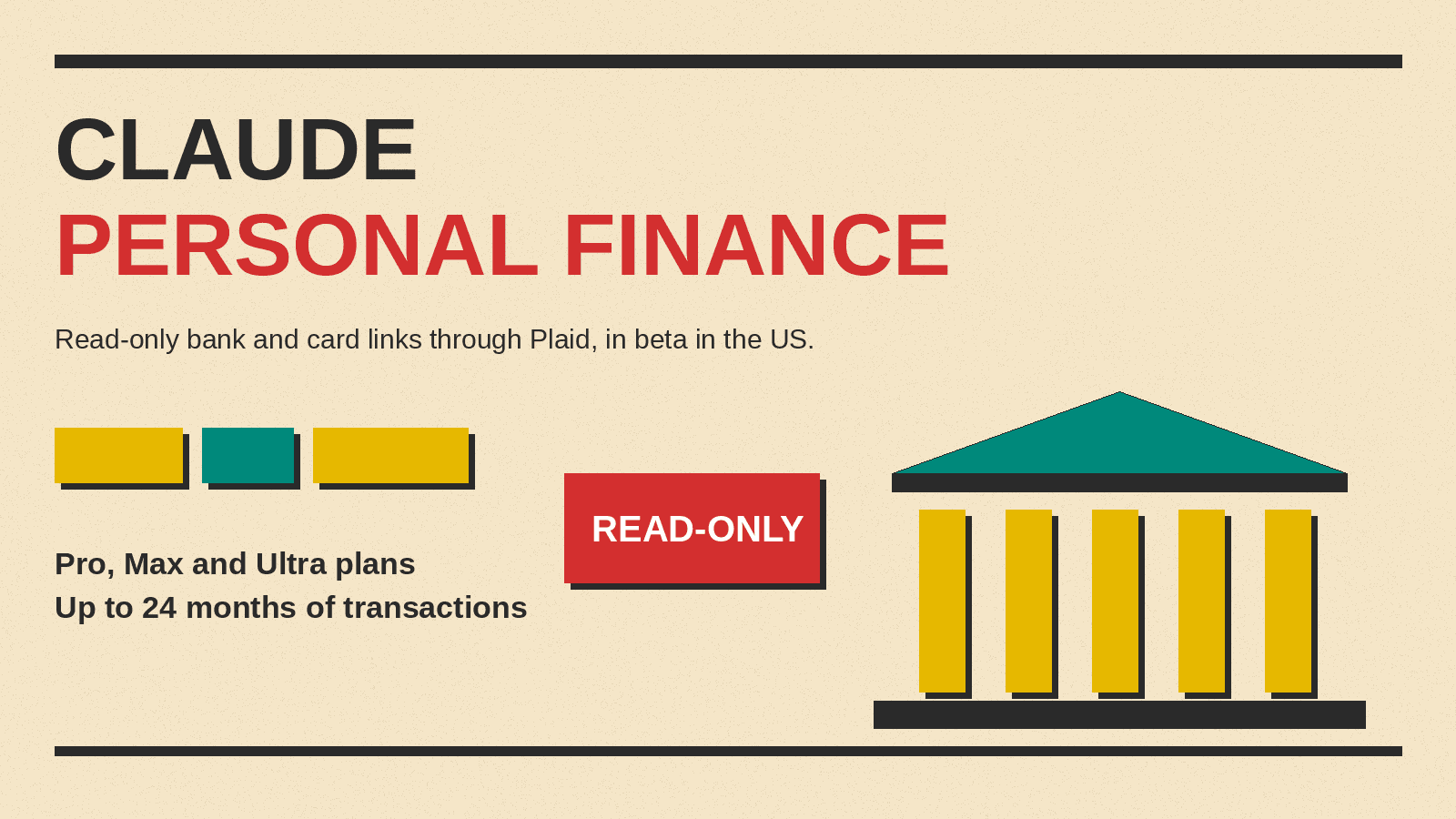
Anthropic has started rolling out Personal Finance, a beta feature that lets Claude read your bank, credit card, loan and investment accounts through Plaid and answer questions about your own money. Anthropic announced it on November 5. It is for Pro, Max and Ultra subscribers in the US, and the rollout is gradual, so some eligible users may not see it yet. The Help Center lists Claude on the web, Claude Desktop, iOS and Android.
The pitch is simple: instead of opening several banking apps and doing the math yourself, you ask Claude "Where did my money go this month?" and it adds up spending across the accounts you linked and sorts it by category. The limits are just as important as the features. Access is read-only, and Anthropic says Personal Finance "can't move, manage, or invest your money."
What Personal Finance does
Personal Finance has its own page in the Claude sidebar. According to the Claude Help Center, that page shows widgets for spending, cash flow, accounts, subscriptions, upcoming bills and short insights from Claude. You can add, edit, remove and reorder them. You can also ask questions on that page or in a regular chat.
Anthropic's announcement walks through a sample month. Claude totals spending by category, checks earlier months when asked "Is that more than usual?", points to a membership renewal, and lists four payments due before payday. Anthropic says Claude can also flag charges that hit twice, unexpected fees, or a bill that has crept up over the year. Asked "What's an APR, and what has mine cost me this year?", it explains the term and adds up the interest charged. It can build a weekly spending chart, a calendar of bills, or a custom dashboard.
TechCrunch framed the launch as Anthropic positioning Claude as a financial companion rather than a source of generic advice. Plaid's chief technology officer, Will Robinson, wrote that Claude can help with "tracking spending across accounts, spotting unexpected fees, creating a strategy to pay down debt, understanding what an APR costs and more."
What Claude can see
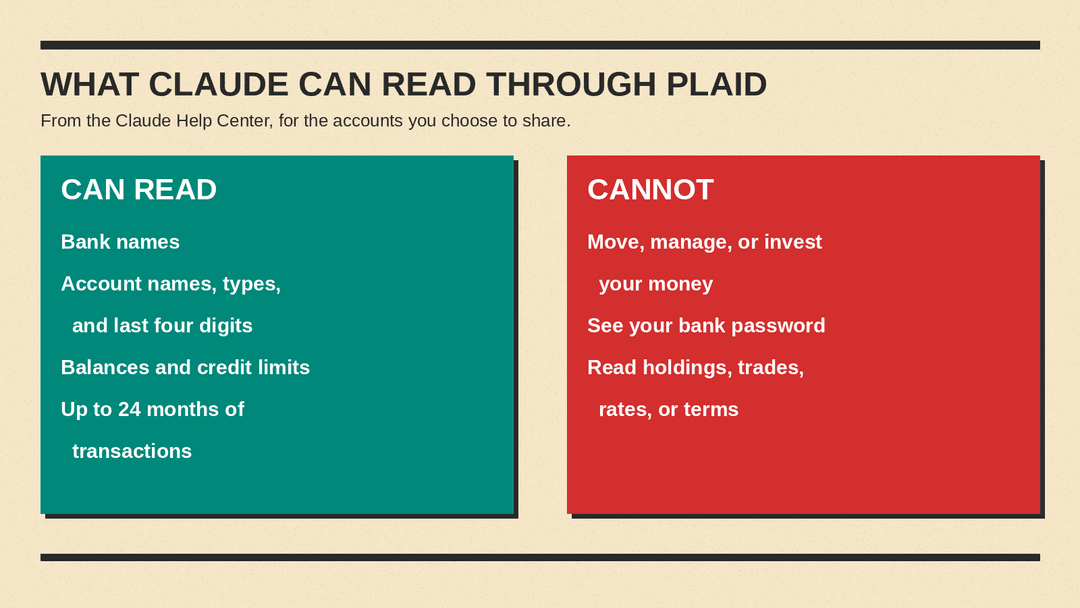
You link accounts by signing in to your bank inside Plaid, so Claude does not ask for or see your bank password. For the accounts you choose to share, the Help Center lists what Claude can read:
- Bank names
- Account names, types and last four digits
- Balances and credit limits
- Up to 24 months of transactions, with amount, date, merchant, category and the bank's description
For investments, loans and cards, Claude reads balances and credit limits, not holdings, trades, rates or terms. There is one caveat worth knowing: Plaid passes only the last few digits of an account number, but if your bank writes a full number into an account name or a transaction description, Claude may see it there.
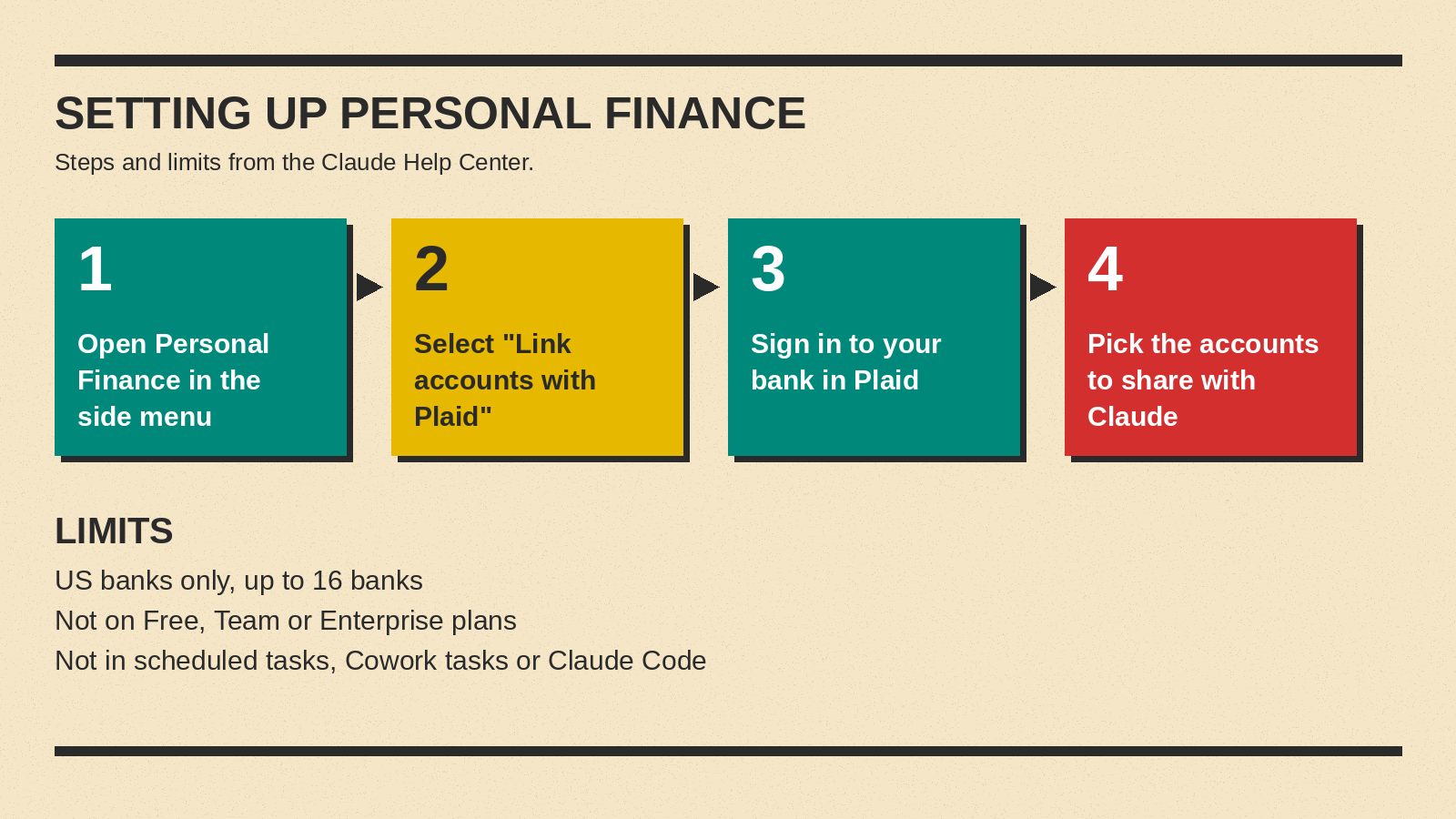
You can link up to 16 banks. Balances can be a day or two old, and an account linked through two logins may be counted twice, so the Help Center tells users to check important figures against their bank's own app or statements.
Privacy and training
Anthropic says chats inside the Personal Finance hub are not used to train its models. For anything you share outside the hub, your normal privacy settings apply. Financial data that appears in a chat stays in your chat history until you delete that chat, subject to Anthropic's retention rules, and the Help Center says the service providers that host Claude also handle bank data. Plaid handles it under its own terms and privacy policy.
A few details matter if you share your work. Once Claude has used your accounts in a chat, it is designed not to save anything from that chat to memory or search it later, and it leaves the chat out of your monthly recap. Claude asks before it publishes an artifact from such a chat. Shared chat links and published artifacts show any figures from your accounts to whoever opens them, and an artifact stays until you delete it, even if you delete the chat. An artifact can also read the linked accounts of the person who opens it, if that person has Personal Finance and allows Plaid.
By default, Claude reads your linked accounts in chats without asking each time. You can switch the Plaid connector off for chats, unlink a bank at any time, or disconnect Claude at my.plaid.com. Unlinking removes every account under that bank login. Unlinking your last bank also resets your dashboard and deletes your widgets, their settings such as budgets, and your setup answers, and that cannot be undone. What Claude already said stays in your chats, artifacts and shared links until you remove them.
Current limits
Per the Help Center, Personal Finance:
- Works with US banks only
- Is not on Free, Team or Enterprise plans; moving to a Team or Enterprise organization unlinks your banks
- Cannot use linked accounts in scheduled tasks, Cowork tasks or Claude Code, and may not work in a project
- Is not available in Claude Duet
- Does not yet include your saved dashboard in data exports
Outside the US, including on a VPN that connects from another country, the Personal Finance page does not appear until you are back. Your banks stay linked in the meantime.
Why it matters
Claude is not first here. The Verge notes that OpenAI added a similar Plaid-based feature to ChatGPT in May. We covered the latest version in ChatGPT Finances Adds Voice.
Anthropic is careful about what it promises. It says Personal Finance "isn't designed to give investment advice," that Claude can make mistakes, and that users should ask which transactions are behind a number. The company also says the feature has no ads or sponsored recommendations and that it does not offer its own credit cards, loans or savings accounts. Its closing note says Personal Finance is "a first step," and that Anthropic wants to hear from banks, wealth managers and financial services companies that want to help shape how Claude could work alongside licensed professionals and regulated firms. Anthropic already sells a separate product for advisors, Claude for Financial Advisors.
Anthropic's own getting-started advice is to connect one account and ask a single question. For more on the company's recent Claude launches, see our Anthropic coverage.
