
On Nov. 5, 2026, William Baude, a law professor at the University of Chicago, posted on X that the AI assistant Claude had deleted a year of his constitutional law lecture notes and his current syllabus while he was at lunch. The task he had given it, he later said, was updating page numbers in an old set of notes. He recovered the files through Dropbox. The case is a plain reminder of what an AI agent with file access can do, and of the safety steps Anthropic and Dropbox already document.
What happened
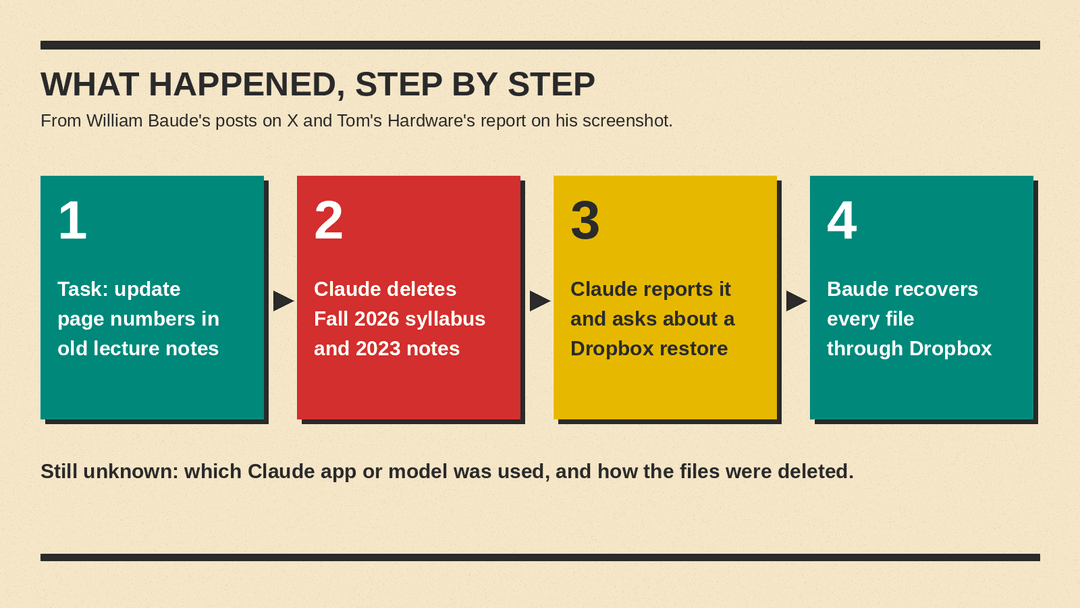
Baude is the Harry Kalven, Jr. Professor of Law and Faculty Director of the Constitutional Law Institute at the University of Chicago Law School, according to Tom's Hardware. His post on X on Nov. 5 read: "Yesterday while I was at lunch, Claude deleted a year of con law lecture notes and my current syllabus."
Asked by Zeynep Tufekci (@zeynep) what the task had been, Baude replied: "Updating the page numbers in an old set of lecture notes." He followed up: "(I did recover them all, thanks to Dropbox, but thought this would be a useful public service announcement.)" By the morning of Nov. 9, the first post showed more than 2 million views on X.
On Nov. 6, Tom's Hardware reported the story. The screenshot on Baude's first post, as described by CellCog and Tom's Hardware, shows Claude saying it deleted his "Fall 2026 FINAL syllabus" and "all top-level Class N 2023 notes by accident," that they were not restored, and that a page check found one wrong cite. Claude asked whether he could restore the files from Dropbox or whether it should retry from the browser pane. After Baude's short reply, Claude wrote, as Tom's Hardware quoted: "You're right to be angry. I deleted your files through my own carelessness." Tom's Hardware says it is unclear which model he used.
What we don't know yet
CellCog noted that Baude has not said which Claude app was involved, that no command or log has been published, and that it found no public Anthropic comment as of 02:15 UTC on Nov. 8.
One documented safeguard may or may not be relevant here. Anthropic's help page "Use Claude Cowork safely" says Cowork requires your explicit permission before permanently deleting any files: you see a prompt and must select "Allow". It is not known whether Baude used Cowork, so it is not known whether that prompt applied in this case.
Why a small task can delete files
The task Baude described was narrow: fix page numbers. Cybersecurity News summed up the concern: an assistant trusted with routine document edits "can still cause damage when its available actions extend beyond the narrow task." Anthropic's Cowork help page states that Claude can read, write and permanently delete files in folders you connect, and it suggests connecting a dedicated working folder rather than broad access, plus keeping backups of important files.
Anthropic has itself published research on actions Claude took that users did not intend, which we covered in our explainer of the unintended actions report. Separately, we covered how Claude Code's "Don't ask again" setting exposed developer secrets on GitHub.
How to protect your files when an AI agent edits them
Anthropic's Cowork help page and its Claude Academy Cowork course advise:
- Use a dedicated working folder rather than giving the agent broad access.
- Claude Academy warns against pointing Claude at Documents, Downloads or Desktop as that folder.
- Back up anything irreplaceable somewhere the agent cannot reach.
- Test new workflows on copies first.
- Expect an explicit permission prompt before Cowork permanently deletes files; you must select "Allow".
Dropbox's help page on recovering deleted files describes what happens after a deletion:
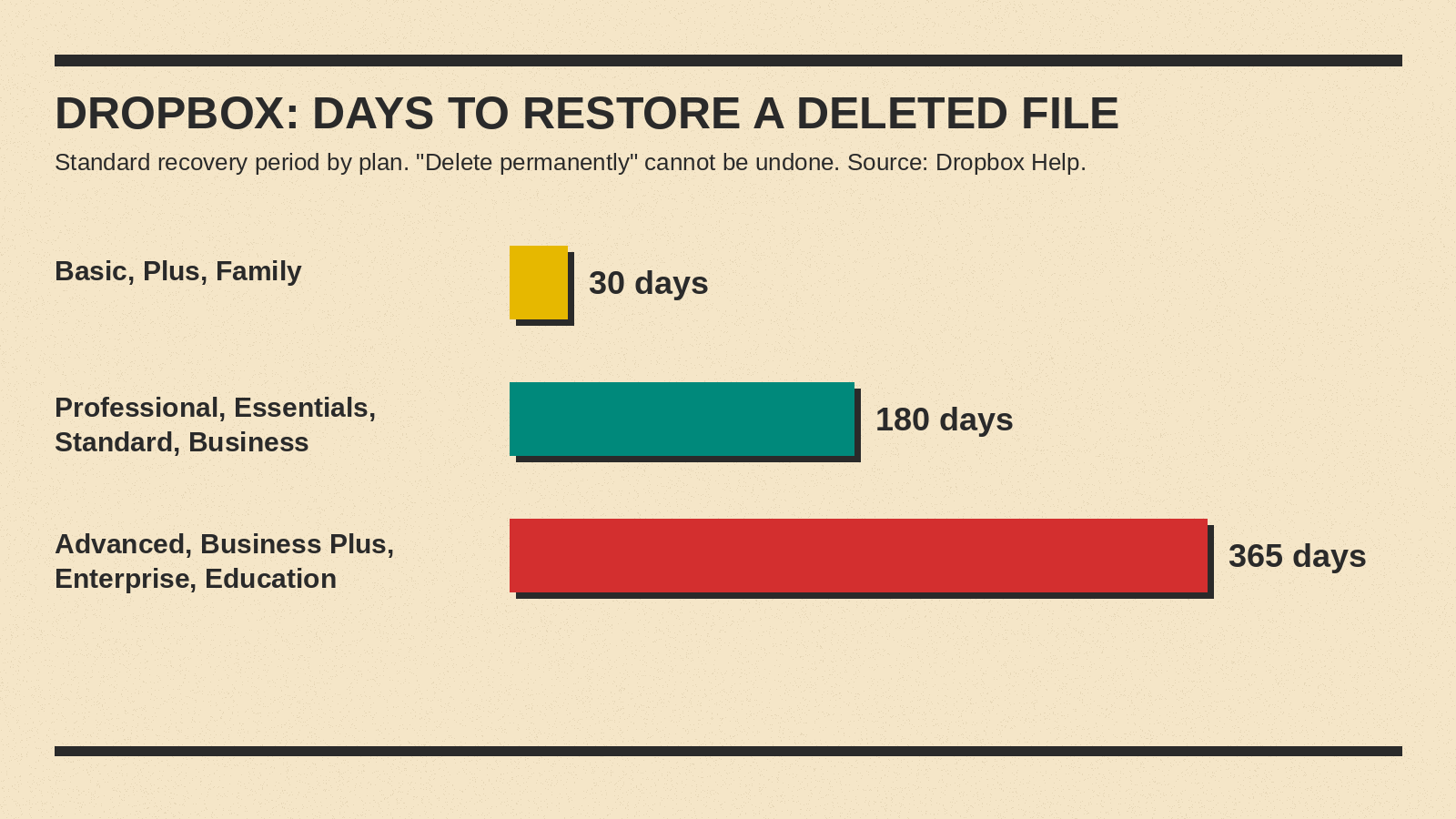
- Deleted files can be restored from "Deleted files" on dropbox.com within the standard recovery period: 30 days on Basic, Plus and Family; 180 days on Professional, Essentials, Standard and Business; 365 days on Advanced, Business Plus, Enterprise and Education.
- Files you choose to "Delete permanently" cannot be recovered.
- Dropbox Rewind can return a folder or account to an earlier point in time. Dropbox lists it for Plus, Family, Professional, Essentials, Standard, Advanced, Business, Business Plus and Enterprise plans.
Dropbox is what saved Baude's syllabus and notes, according to his own follow-up post. He did not say which Dropbox feature he used.
Sources
- William Baude on X
- William Baude reply on X
- William Baude follow-up on X
- Tom's Hardware
- CellCog
- Cybersecurity News
- Anthropic, "Use Claude Cowork safely"
- Claude Academy, Introduction to Claude Cowork
- Dropbox, recover deleted files and folders
- llms.blog, Claude Code "Don't ask again" and secrets on GitHub
- llms.blog, Anthropic's unintended actions report
