
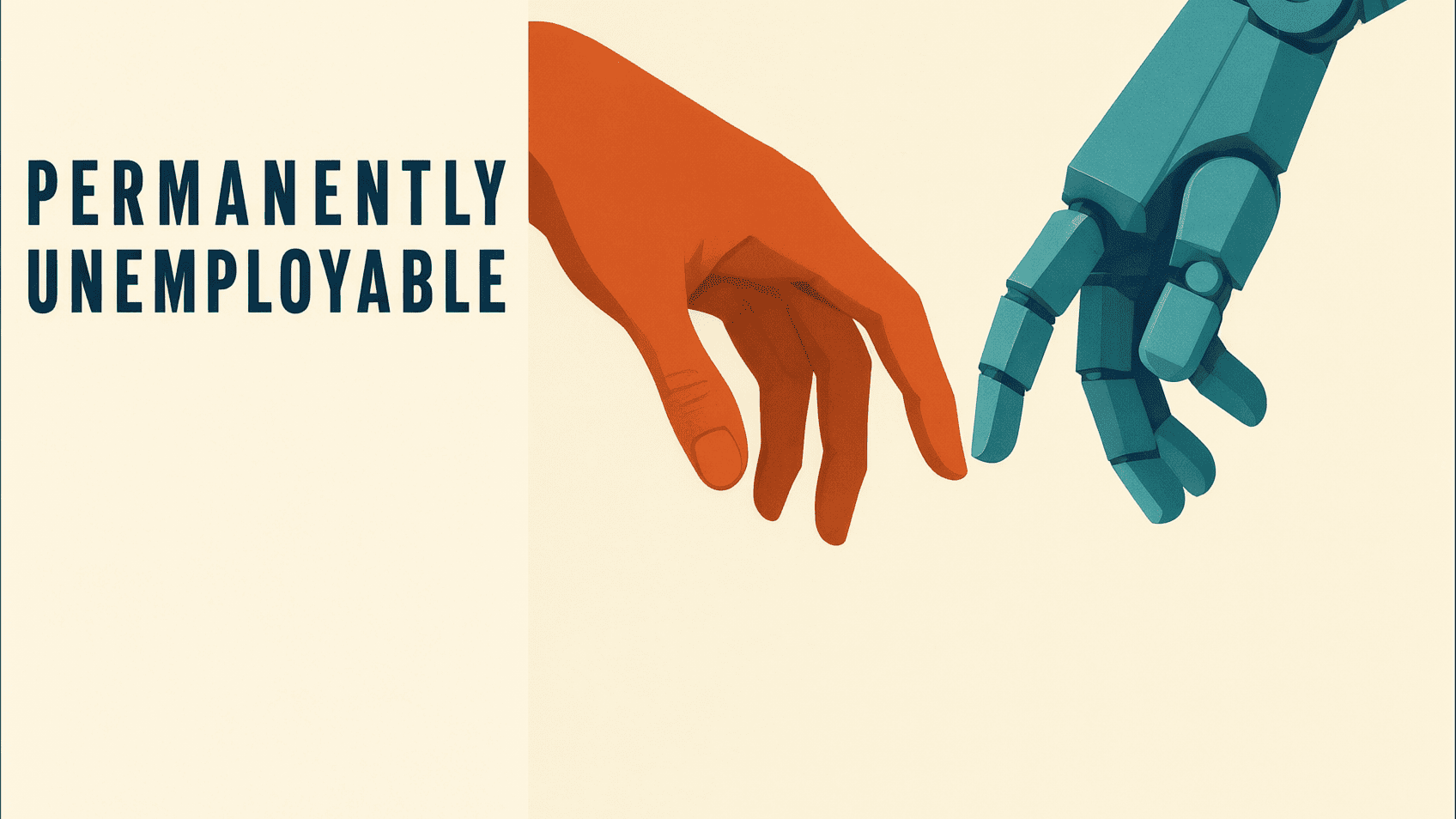
Tao Lin works on the safeguards team at Anthropic, the model developer that just completed the largest IPO on record. In an hour-long interview with AI safety nonprofit Palisade Research published days before the listing, Lin laid out his personal forecast: broadly superhuman AI within about 15 months, followed quickly by mass, permanent job loss.
"I think that it's very likely that pretty much all humans on Earth will become unemployable," Lin said. "I want to tell people that AI will be more capable than you, personally, very soon. It will be able to defeat you, personally, very soon."
Lin put the probability of a more dramatic AI takeover scenario at "less than 50 percent," and said the mundane outcome is the one he treats as near-certain. "The most predictable effect," he said, "is like, everyone losing their current jobs, everyone needing to move to a new occupation briefly, and then, sometime after that, being completely unemployable and needing to rely on the state to provide for them financially, and having no hope of ever finding employment again."

Who is making the call
The comments are Lin's own, not an Anthropic position. He has been at the company for roughly a year and a half, with earlier work on automated alignment research and AI control; his current role involves monitoring requests to Claude and blocking harmful ones, including weapons and hacking related queries. Palisade Research is an independent nonprofit that studies dangerous capabilities, cyber risks and controllability in frontier AI systems.
On timing, Lin has estimated broadly superhuman AI could arrive by around the end of 2027, with slow robot production the main thing delaying physical-world displacement. In his framing, the transition would run through welfare dependence: employment does not gradually morph, it goes away.
Why it lands, and why it is contested
An Anthropic employee predicting the end of work cuts an awkward figure this week. The company's debut minted equity-rich insiders, and doom has historically doubled as a marketing asset for frontier labs, as Bloomberg columnist Parmy Olson wrote earlier this year: "Fear, it turns out, is the ultimate sales pitch."
The empirical record so far is thinner than the rhetoric. No country's official data yet shows an AI-driven collapse in employment. The closest measured evidence points to softening at the edges rather than systemic displacement: a Bloomberg analysis of nearly 10 million Chinese job postings published Friday found AI-exposed roles declined about 10 percentage points faster than less-exposed ones from 2021 to 2025, while attributing part of that gap to the broader economic slowdown.
Lin's claim is a prediction about a specific threshold, superhuman capability across virtually all cognitive work, that current systems have not reached. What makes it newsworthy is the speaker's seat inside a frontier lab rather than the evidence behind it.
