
A spoken sentence is a pressure wave. A written sentence is a string of symbols. Speech recognition is the task of getting from the first to the second, and for seventy years the gap between them turned out to be one of the hardest problems in computing. The machines that now do it silently, in your phone and in every voice assistant, did not arrive through one clever algorithm. They arrived through three separate breakthroughs: better math, then better models, then absurd amounts of data.
This is an explainer of how the technology works and how it got here.
What the system actually has to do
Automatic speech recognition (ASR) takes an audio waveform and outputs the text that was most likely spoken. "Most likely" is doing heavy lifting. The same sentence said by two people, at two speeds, in two rooms, produces two waveforms that share almost no raw values. There is no direct comparison to run.
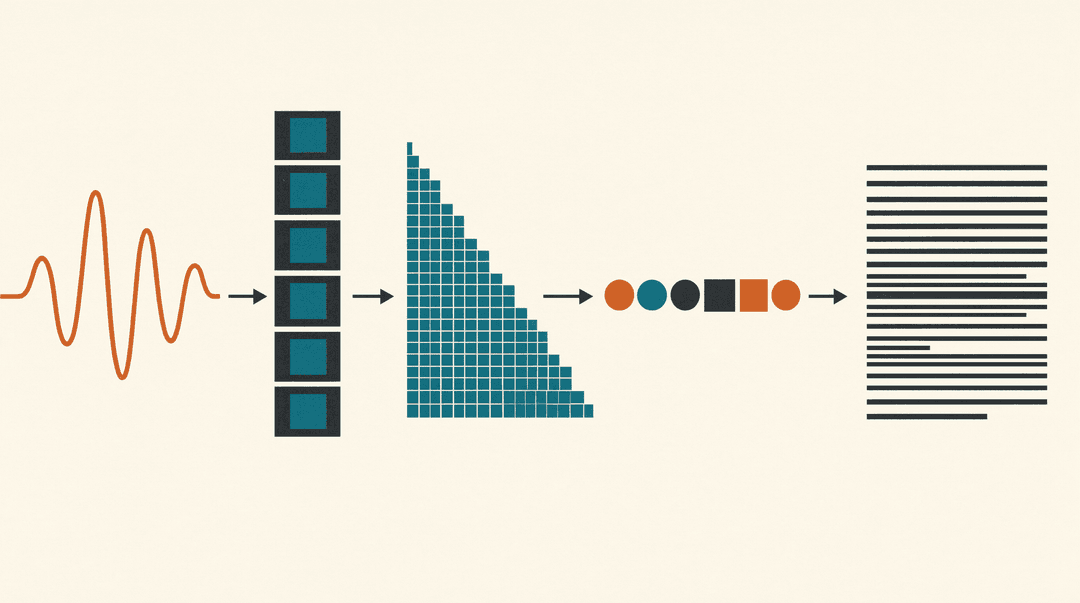
Real systems break the problem into stages:
- Sampling. Audio arrives as a stream of pressure measurements, typically 16,000 per second for speech. That is far too much detail for the model, and much of it is irrelevant to which words were said.
- Feature extraction. The waveform is chopped into short overlapping frames and converted into a time-frequency picture, usually a log-mel spectrogram. The mel scale reflects a 1937 finding about human pitch perception: listeners judge frequencies on a compressed logarithmic ladder, not a linear one. Whisper, OpenAI's open-source model, standardizes input to 16 kHz and 80 log-mel channels (Whisper paper, mel scale).
- Acoustic modeling. A neural network reads the spectrogram frames and predicts which pieces of language (characters, subwords, or phonemes) are being sounded at each moment.
- Decoding. Those moment-by-moment predictions are merged into a final word string, using prior knowledge of which word sequences are plausible. The output text is the sequence that best explains both the acoustics and the language.
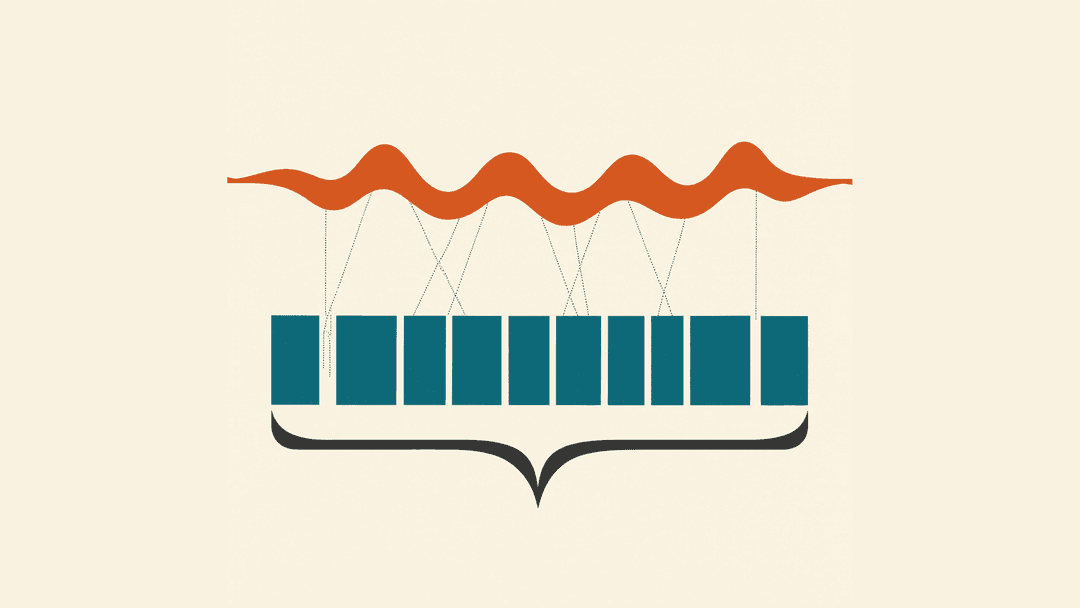
Two difficulties sit under every stage. First, sound varies uncontrollably: accent, speed, illness, microphone quality, background noise. Second, the alignment between sound and text is unknown. Nobody knows how many milliseconds a given "hello" lasts, or where one word ends and the next begins.
The alignment problem is the whole problem
The earliest recognizers dodged both difficulties by refusing to generalize. Bell Labs' 1952 machine AUDREY recognized only the ten digits, and only from a single speaker who paused between them. It scored roughly 90 percent accuracy for its inventor's voice and needed recalibration for anyone else (Computer History Museum, EBSCO overview). IBM's 1962 Shoebox managed sixteen words. These were demonstrations, not products.
The field's first real scale-up came from government money. DARPA's Speech Understanding Research program in the 1970s set a target of a 1,000-word vocabulary, and Carnegie Mellon's HARPY system reached about 1,011 words in 1976 (Soniox history, EBSCO overview). Commercial dictation software, starting with Dragon Dictate in 1990, followed in the 1990s.
The dominant method of that era was statistical: hidden Markov models (HMMs) that treated speech as a chain of hidden states emitting acoustic observations, trained on carefully hand-segmented data. Segmentation was the bottleneck. To train a model on the word "cat," you first had to mark precisely where c-a-t started and ended in the waveform, a task humans do slowly and inconsistently.
The elegant fix came in 2006, from Alex Graves, Santiago Fernandez, Faustino Gomez and Juergen Schmidhuber: Connectionist Temporal Classification (CTC). Instead of forcing a single correct alignment, CTC lets the network emit labels at every timestep, including a "blank," and sums the training loss over all alignments that collapse to the target text. The alignment stops being a labeling requirement and becomes a latent variable the model marginalizes out. First experiments were on the TIMIT phoneme corpus; the method went on to power years of end-to-end ASR (Graves et al., ICML 2006).
Neural networks moved the numbers, then data moved them more
The inflection point most researchers cite is 2011. A Microsoft Research team applied deep neural networks to the Switchboard conversational telephone speech benchmark and cut the word error rate from 27.4 percent to 18.5 percent, a 33 percent relative improvement over the best conventional system (Microsoft Research blog, Seide et al., Interspeech 2011). The standard metric, word error rate, is a simple ratio: insertions, deletions, and substitutions in the machine transcript divided by the length of the reference transcript, computed with the same 1966 edit-distance algorithm behind diff tools (word error rate).
Six years later the benchmark was effectively saturated. In 2017 Microsoft reported 5.1 percent WER on Switchboard, matching a re-measured human parity bar, after its 2016 system had met an earlier 5.9 percent estimate of professional transcriber error (Microsoft Research, TechCrunch).
Academic benchmarks saturate; kitchens do not. A model that is human-level on two telephone executives discussing a movie is still bad at your doctor's office, your car, your kitchen, your accented English. Closing that gap did not come from a new architecture. It came from the same move that reshaped language modeling: scale up weakly labeled data.
Whisper, released as open source in September 2022, was trained on roughly 680,000 hours of multilingual audio paired with transcripts scraped from the internet, supervision that is noisy by design. The architecture was an unremarkable encoder-decoder transformer. The result was a model whose claim to fame was not benchmark records but zero-shot robustness: it got good results on datasets and accents it had never been tuned for, across 96 languages, approaching human transcription quality in aggregate (Whisper paper).
How speech recognition fits into the LLM era
Voice assistants stack the pieces: ASR converts speech to text, a language model reasons over it, and a text-to-speech model speaks the answer back. What has changed in the current generation is the seams. Whisper's token-based interface already treated transcription, translation, and language identification as one sequence problem (paper), and newer multimodal models consume audio representations directly instead of round-tripping through text, which is how the pipeline ends up preserving things a transcript throws away: hesitation, emphasis, speaker identity.
The old pipeline is not dead. Transcription of meetings, podcasts, and call centers still runs on ASR models, many of them Whisper derivatives, because text is cheaper to store, search, and audit than audio.
Why it is still imperfect
Speech recognition is nominally "solved" the way translation is solved: excellent on the common case, unreliable at the edges, and quietly wrong in ways users do not notice until they do.
- WER hides errors that matter. Every word counts the same. A system can miss the word "penicillin" in a medical dictation and still post a 3 percent error rate, because the other ninety-seven words were articles, prepositions, and names of things nobody will search for.
- The long tail is the product. Proper nouns, homophones, code-switching between languages, overlapping talkers, and distant microphones remain the hard cases. Robustness to noise and accent was explicitly the design goal of web-scale training (Whisper paper), which is a polite way of saying the curated era had not solved them.
- Recognition and understanding are graded separately. A transcript with a low word error rate can still be a useless answer if the model dropped a number. Research going back two decades has noted that WER is an imperfect proxy for whether a system understood what was said (Microsoft Research, 2003).
Seventy years from AUDREY's ten digits to models transcribing ninety-six languages out of the box, the pattern of the field is the same pattern as the rest of machine learning: hand-crafted rules gave way to statistics, statistics gave way to learned features, and learned features gave way to scale. Listening was never one breakthrough. It was the same breakthrough, arriving three times.
Sources
- Computer History Museum: Audrey, Alexa, Hal, and More
- EBSCO Research Starters: Speech recognition
- Soniox: A brief history of speech recognition and Sonix: What is ASR?
- Graves et al.: Connectionist Temporal Classification (ICML 2006), via Distill.pub and Wikipedia: CTC
- Microsoft Research: Speech Recognition Leaps Forward
- Seide et al.: Conversational Speech Transcription Using Context-Dependent Deep Neural Networks (Interspeech 2011)
- Microsoft Research: New Conversational Speech Recognition Milestone (5.1 percent WER)
- TechCrunch: Microsoft's speech recognition system hits a new accuracy milestone
- Radford et al.: Robust Speech Recognition via Large-Scale Weak Supervision (Whisper), arXiv:2212.04356
- Wikipedia: Word error rate and Wikipedia: Mel scale
- Wang, Acero, Chelba: Is Word Error Rate a Good Indicator for Spoken Language Understanding Accuracy? (2003)
