Latest / page 28

The latest stories

1230 articles

Articles, page 28

541-560 of 1230
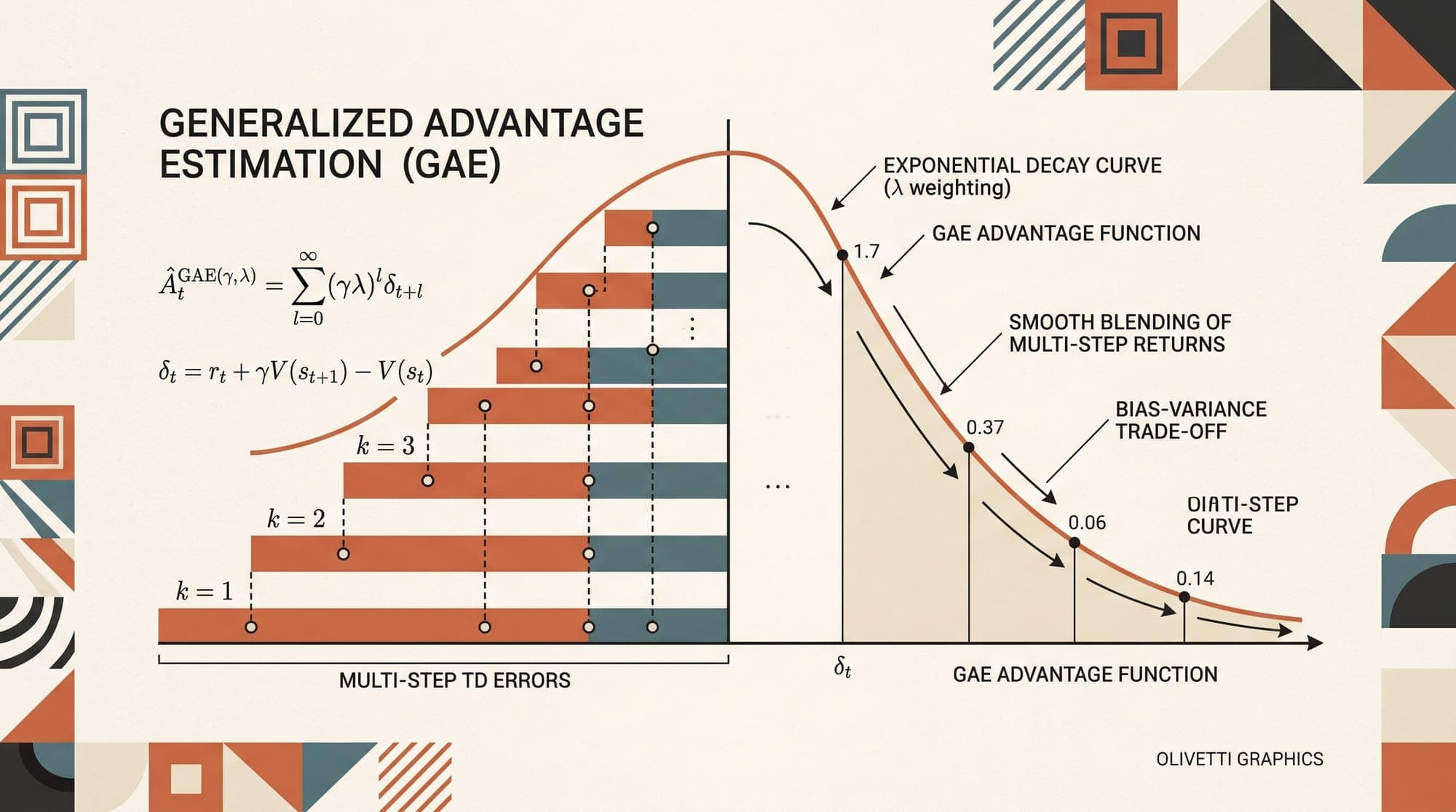
  1. Generalized Advantage Estimation: How Exponential Weighting Balances Bias and Variance in Policy Optimization

    Policy gradient algorithms form the theoretical backbone of modern policy optimization, ranging from continuous robotic control to reinforcement learning from human feedback (RLHF) in frontier large language models. A persistent challenge in policy optimization is variance: estimating the gradient of expected cumulative reward over stochastic trajectories generates high-variance Monte Carlo signals that require massive sample sizes and risk destabilizing gradient updates. Generalized Advantage

    AI
    6 min read
  2. IBM Unveils 2nm Dual-Architecture Mainframe Processor with Native Arm and On-Chip AI Acceleration

    IBM unveiled the industry's first dual-architecture mainframe processor at the annual Hot Chips conference, detailing custom silicon capable of natively executing both IBM Z (s390x) and Arm (Arm64) instruction set architectures on the exact same physical cores. Fabricated on a leading-edge 2-nanometer process node, the upcoming processor is engineered to bridge traditional enterprise transaction processing with the modern, Arm-dominated software ecosystem, particularly containerized AI framewor

    IBM
    3 min read
  3. ByteDance Consolidates TRAE and Coze into Doubao, Readies 'Doubao Work' Enterprise Brand

    ByteDance has initiated an internal organizational restructuring to consolidate its enterprise AI developer tools and agent platforms under the Doubao ecosystem. The company is merging the teams and technologies behind its AI programming suite TRAE and agent-building platform Coze into Doubao, preparing to launch a unified enterprise AI suite branded "Doubao Work." The restructuring concentrates disparate AI tools into a single corporate pillar to compete against domestic rivals, notably Tencen

    ByteDance
    2 min read
  4. Hierarchical Tree-Organized Retrieval (RAPTOR) in Production RAG: Recursive Summarization, Gaussian Mixture Clustering, and Cross-Scale Querying

    Standard retrieval-augmented generation (RAG) architectures operate on flat document chunks. Corpora are split into fixed token windows (typically 256 to 1024 tokens), mapped into vector space via dense embedding models, and queried through approximate nearest neighbor (ANN) search. While this setup efficiently resolves localized factual lookups ("What is the termination clause in contract X?"), it systematically fails on thematic synthesis, cross-document comparison, and high-level aggregation

    RAG
    7 min read
  5. Data Pruning and Core-Set Selection in Deep Learning: How EL2N, GraNd, and Memorization Dynamics Break Power-Law Scaling

    Modern foundation models are trained on tens of trillions of tokens, requiring millions of GPU hours. Yet empirical analyses consistently reveal that massive portions of web-crawled corpora and large-scale vision datasets are either highly redundant, uninformative, or dominated by unlearnable noise. Standard empirical scaling laws (such as those formulated by Kaplan et al. and Chinchilla) model generalization error as a power-law function of total training samples ($L(N) \propto N^{-\alpha}$). H

    AI
    7 min read
  6. Alibaba Launches Wan 3.0 AI Video Model with Native 30-Second Generation and Document Inputs

    Alibaba Tongyi Lab has launched a public beta of Wan 3.0, the latest iteration of its video generation model family. Available on Alibaba Cloud Model Studio and Qwen Cloud under the model identifier wan3.0-video, the model produces up to 30 seconds of continuous video in a single pass at resolutions up to 1080p. Unlike predecessor models such as Wan 2.7, which capped single-pass output at 15 seconds, Wan 3.0 consolidates video synthesis into a unified architecture and expands supported input mo

    AI
    2 min read
  7. Long-Context Evaluation in Production: Why Synthetic Needles Fail, Multi-Hop Stress Testing, and Benchmarking Effective Context Size

    Frontier model providers frequently market sequence lengths spanning 128K, 1M, or 2M tokens. However, engineering teams deploying these models in production environments for codebase refactoring, multi-turn agent execution, or complex document analysis regularly observe severe retrieval failures and reasoning breakdowns well before hitting context boundaries. The primary culprit behind this disconnect is the widespread reliance on vanilla Needle In A Haystack (NIAH) evaluations. While standard

    AI
    6 min read
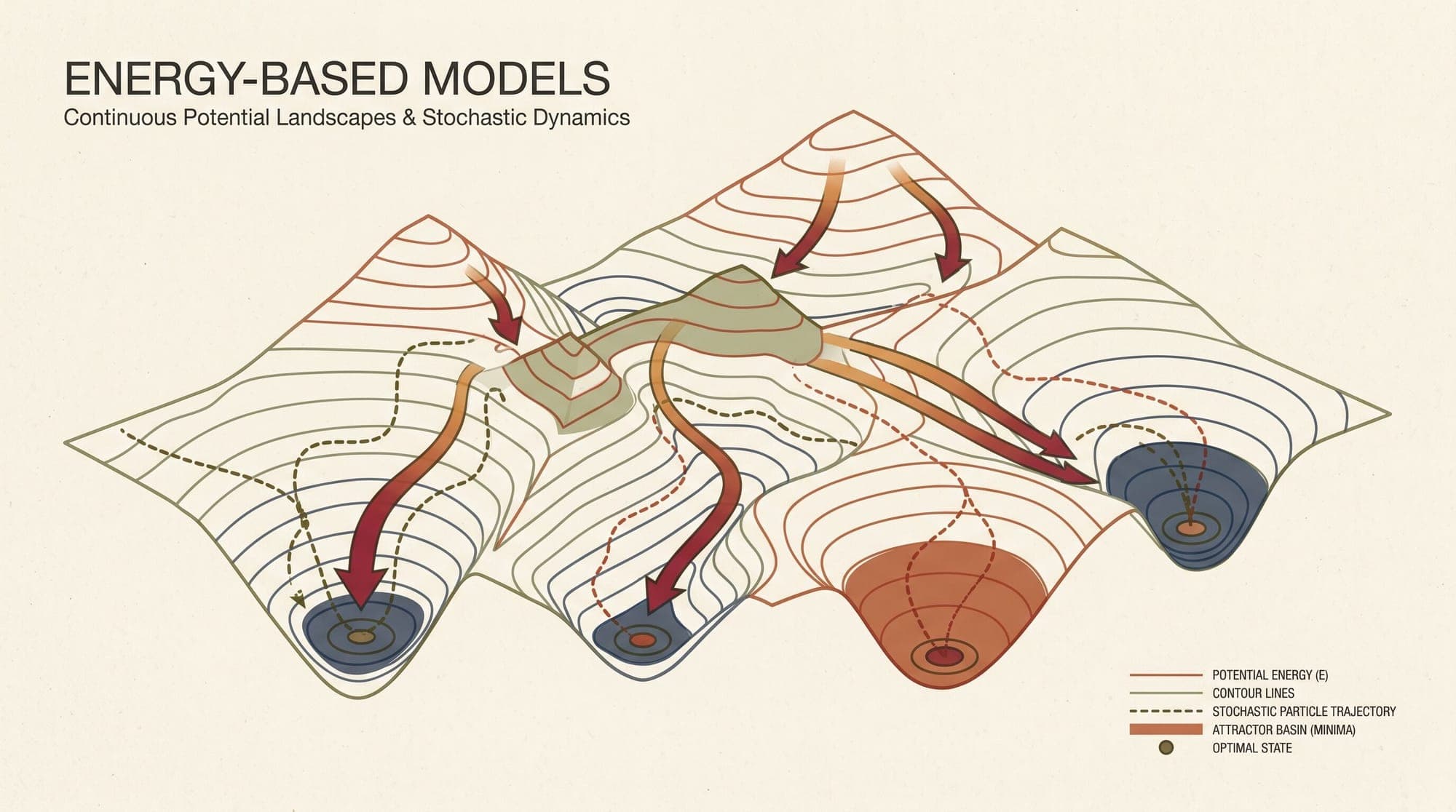
  8. Energy-Based Models: How Energy Landscapes, Contrastive Divergence, and Langevin Dynamics Unify Generative Learning

    Energy-Based Models: How Energy Landscapes, Contrastive Divergence, and Langevin Dynamics Unify Generative Learning Probabilistic modeling in machine learning fundamentally centers on estimating data distributions over high-dimensional spaces. Standard generative architectures achieve this by enforcing structural constraints: autoregressive models factorize joint distributions through causal chains, normalizing flows constrain network architectures to invertible bijections with tractable Jacobi

    AI
    9 min read
  9. Tabular RAG in Production: Table Serialization, Row-Column Chunking, NL-to-SQL Hybridization, and Dense Entity Linking

    Tabular RAG in Production: Table Serialization, Row-Column Chunking, NL-to-SQL Hybridization, and Dense Entity Linking Standard Retrieval-Augmented Generation (RAG) architectures excel when indexing unstructured prose. Dense semantic embeddings, recursive character chunking, and bi-encoder vector similarity match user queries against passages that follow linear syntactic structures. However, when these pipelines encounter tabular data (such as financial statements, medical registries, inventory

    AI
    7 min read
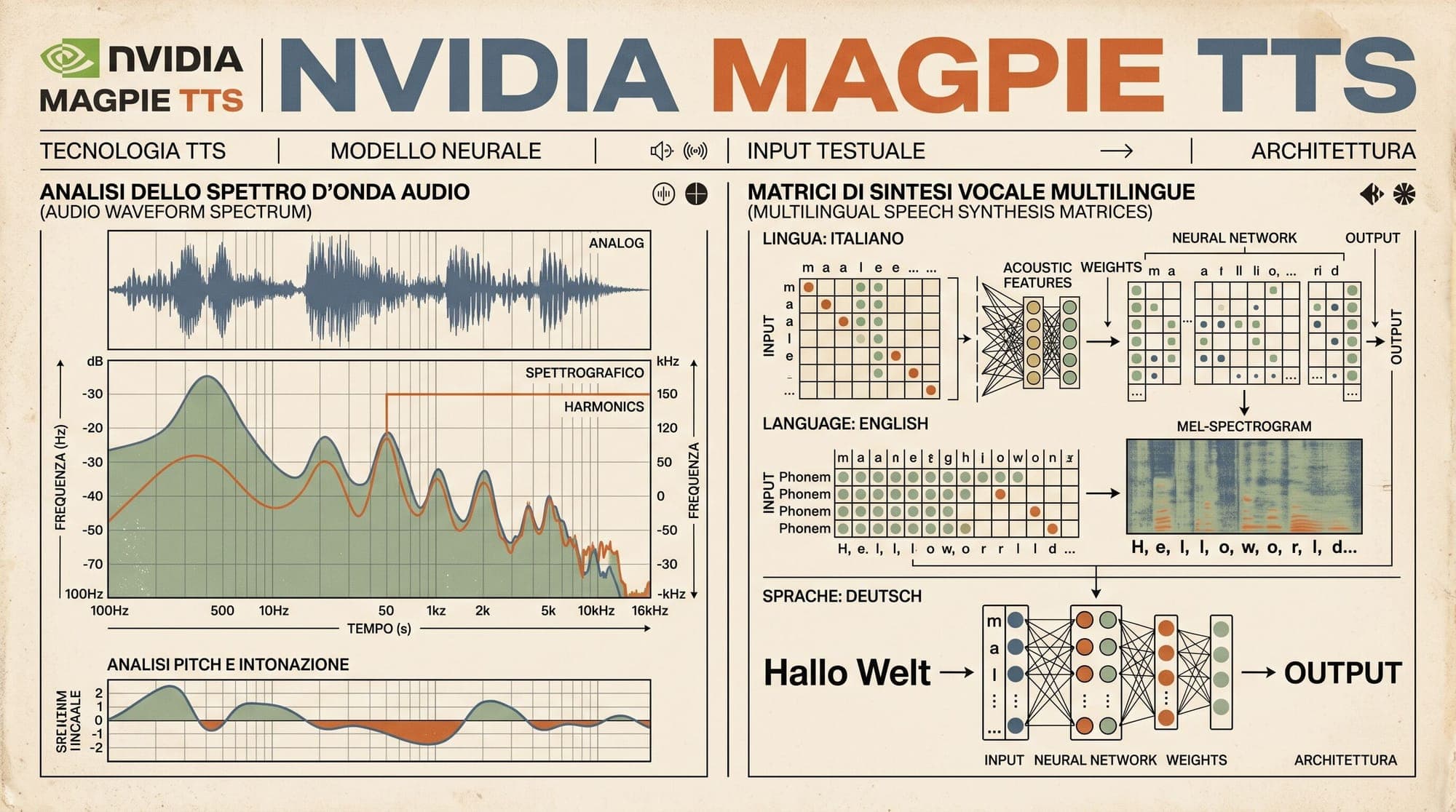
  10. NVIDIA Releases Magpie Multilingual TTS: 364M Open-Weight Model for Sub-200ms Voice Agents

    NVIDIA has released Magpie Multilingual TTS, a 364-million parameter open-weights text-to-speech model engineered for low-latency conversational AI agents. Released under the NVIDIA Open Model License, the model is available as open checkpoints on the Hugging Face Hub and as an optimized microservice container within NVIDIA NIM. The release expands language support to 12 languages: English, Spanish, French, German, Italian, Vietnamese, Mandarin, Hindi, Japanese, Modern Standard Arabic, Korean,

    AI
    2 min read
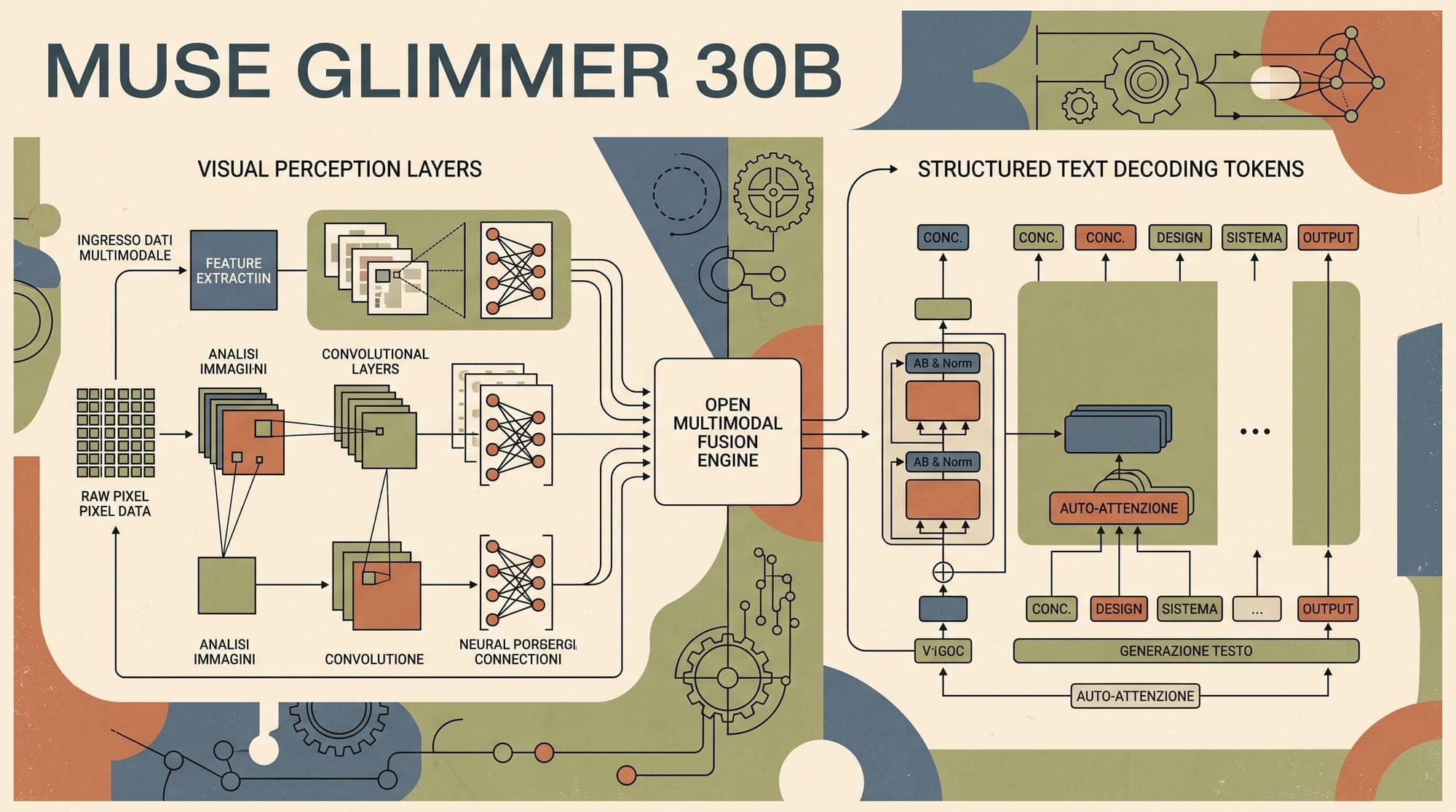
  11. Meta Releases Muse Glimmer 30B: Apache 2.0 Multimodal Model for Local AI Agents

    Meta has released Muse Glimmer, a 30-billion parameter multimodal model distributed under the permissive Apache 2.0 license. Distilled from Meta's larger Muse Spark foundation model, Muse Glimmer is engineered specifically for local execution and privacy-sensitive agentic workflows, spanning software engineering, document processing, and desktop automation. The model release includes immediate day-zero runtime support across Hugging Face Transformers, vLLM, llama.cpp, and native hardware accele

    AI
    2 min read
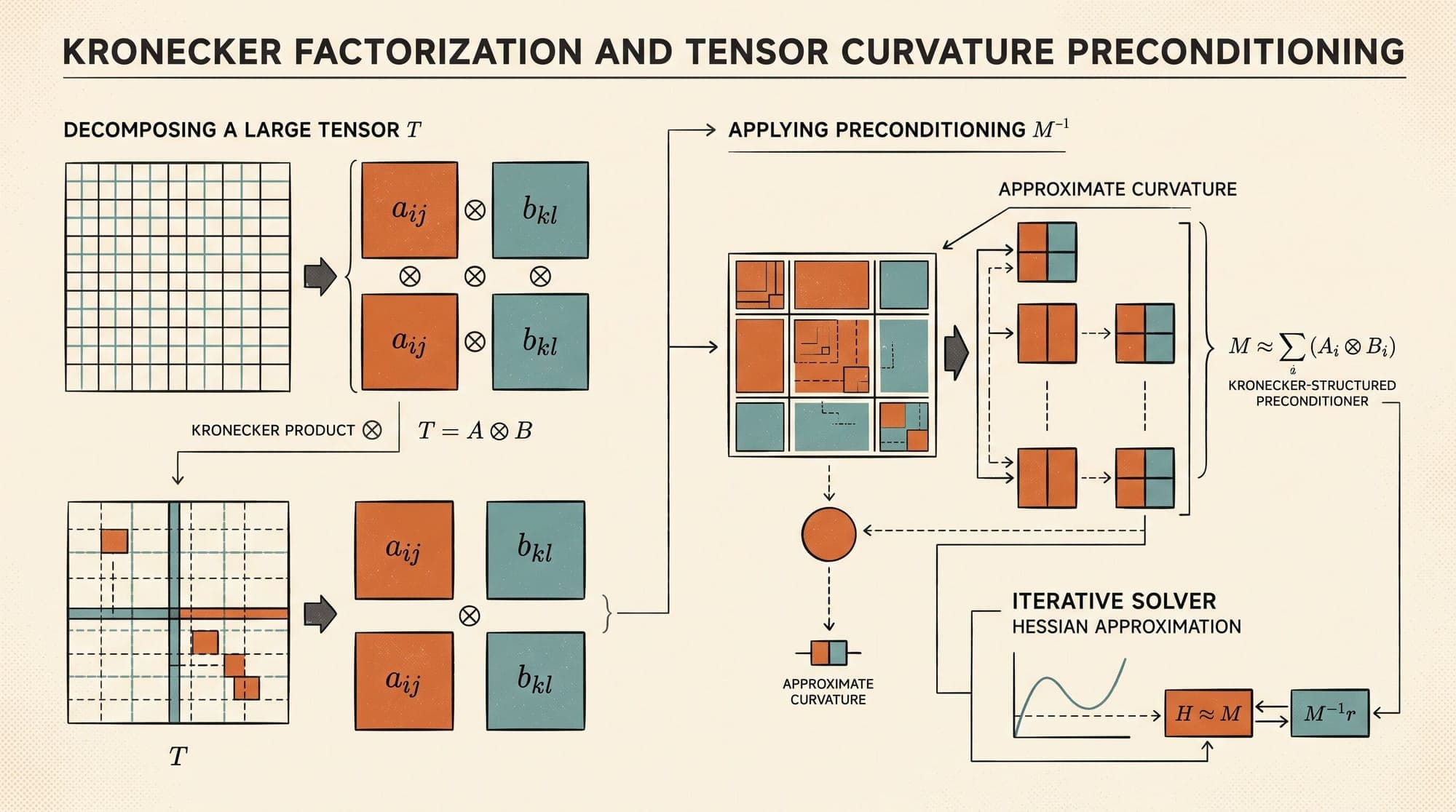
  12. Kronecker-Factored Approximate Curvature (K-FAC) and Shampoo: How Kronecker Preconditioning Scales Second-Order Optimization

    Kronecker-Factored Approximate Curvature (K-FAC) and Shampoo: How Kronecker Preconditioning Scales Second-Order Optimization Standard deep neural network pre-training relies almost exclusively on first-order stochastic gradient methods. Optimizers such as AdamW maintain running averages of individual parameter gradients and uncentered second moments, applying a coordinate-wise diagonal preconditioner. While computationally efficient, diagonal scaling ignores off-diagonal cross-layer and intra-l

    AI
    9 min read
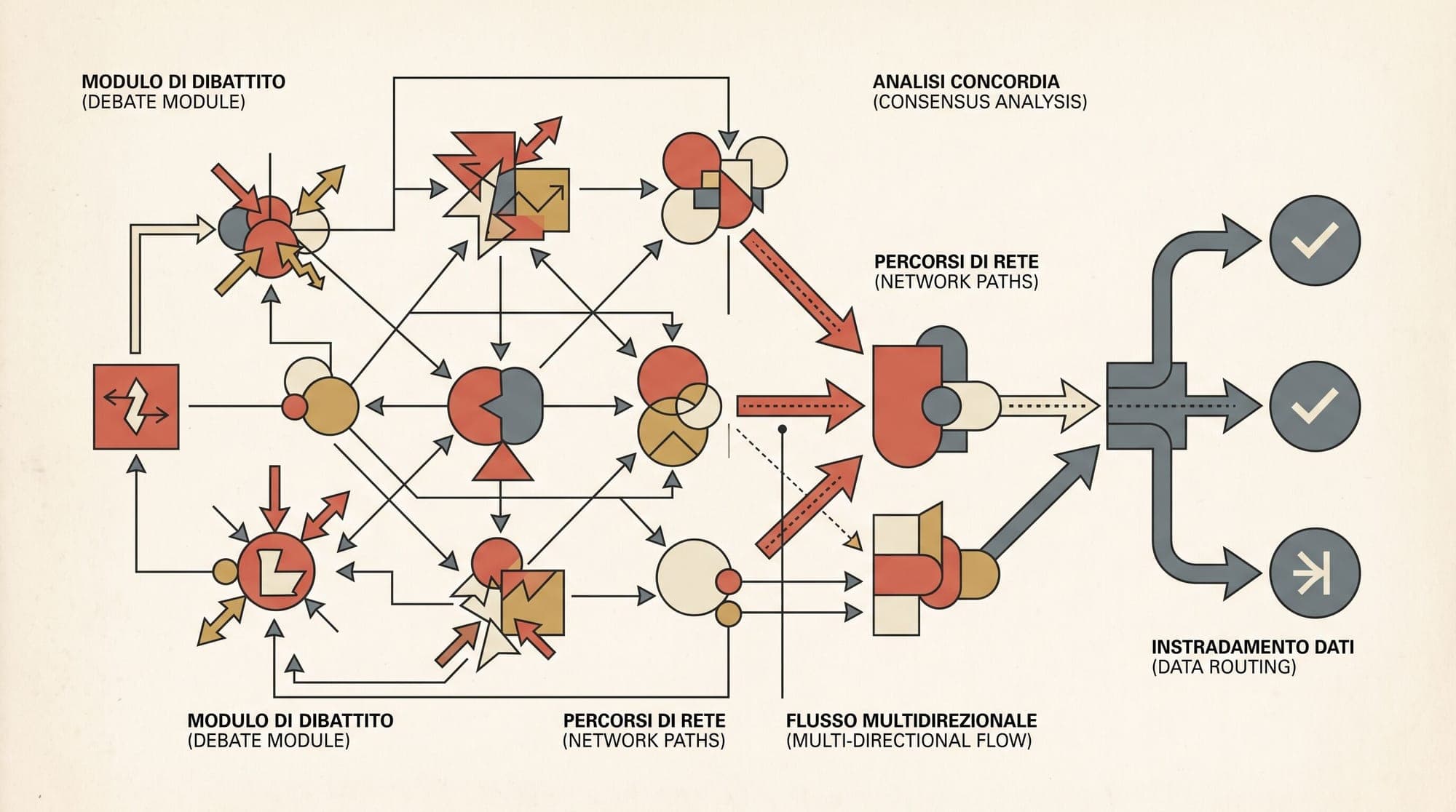
  13. Multi-Agent Debate and Consensus Protocols in Production: Topologies, Stopping Criteria, and Error Cascade Prevention

    Single-model inference pipelines face severe structural limits when handling high-stakes reasoning, multi-step code synthesis, and mission-critical verification. While techniques like self-consistency decoding sample multiple independent trajectories from a single model to find majority consensus, they fail when the underlying model exhibits systemic bias or correlated hallucinations. When an LLM harbors a flawed premise, sampling ten independent stochastic paths frequently yields ten variations

    AI
    7 min read
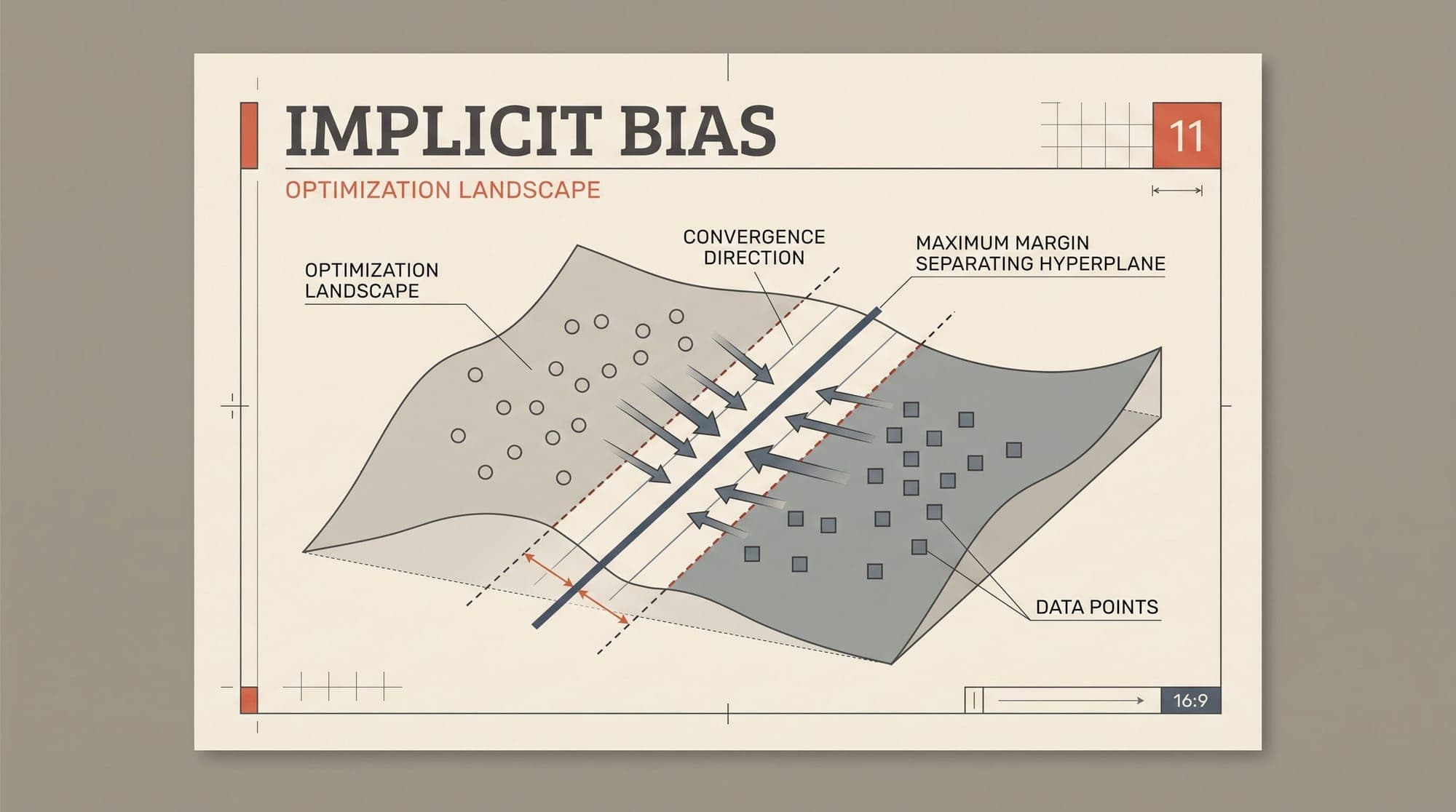
  14. Implicit Bias of Gradient Descent: How Optimization Geometry Replaces Explicit Regularization

    When engineers train a neural network with plain stochastic gradient descent and no weight decay, the result often generalizes instead of collapsing into an overfit mess. Classical learning theory predicts disaster: with more parameters than data points, unregularized training should find a memorizing interpolating solution with no predictive power. Instead, gradient descent reliably lands on solutions that look chosen. This systematic preference — the implicit bias of gradient descent — is one

    AI
    6 min read
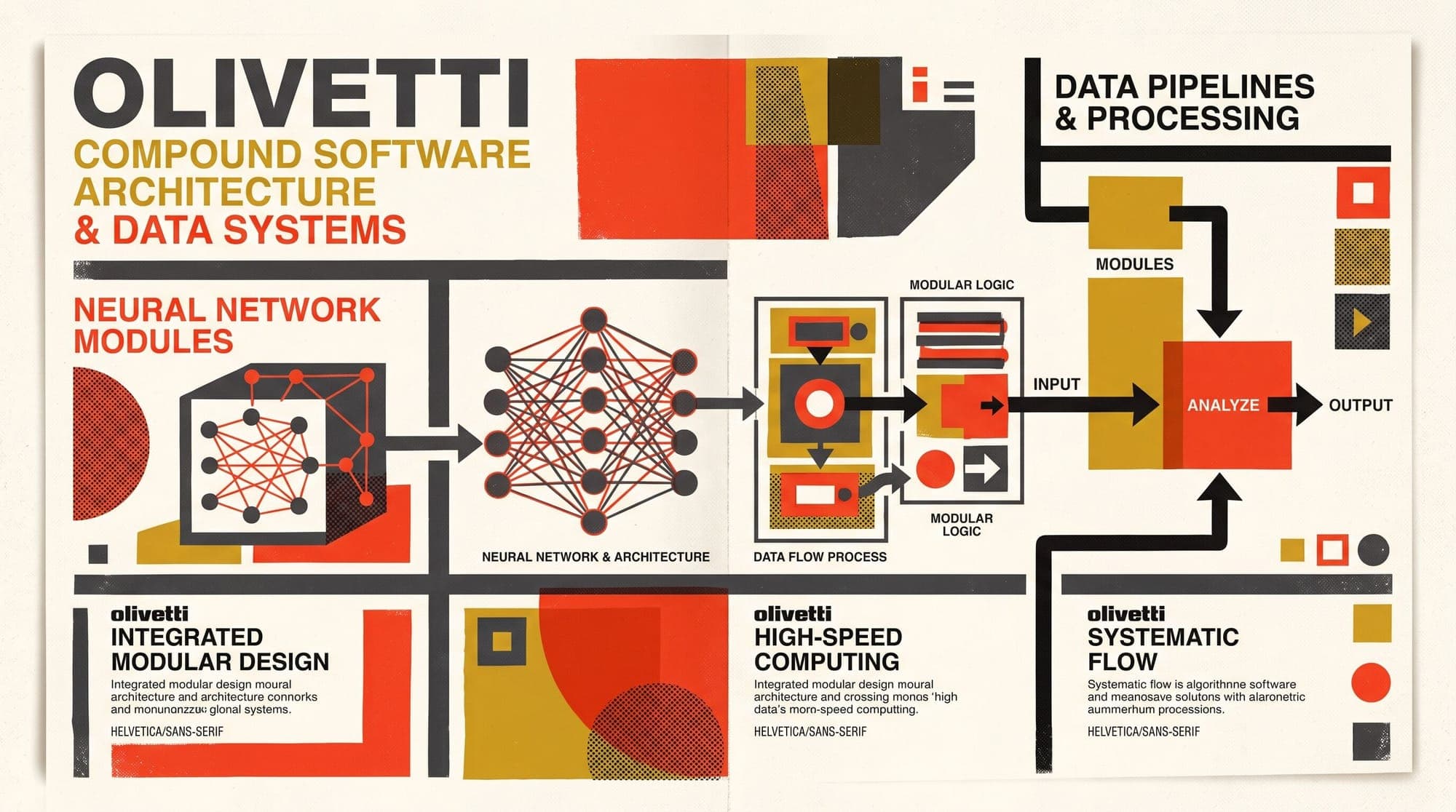
  15. Compound AI Systems in Production: Architecture, Co-Optimization, and Error Cascades

    Compound AI Systems in Production: Architecture, Co-Optimization, and Error Cascades For the first two years following the release of GPT-4, enterprise AI development focused almost exclusively on model-centric scaling: upgrading to larger parameter checkpoints, expanding prompt context windows, and tuning system prompts. However, production deployments quickly revealed a fundamental constraint: single, monolithic foundation models exhibit diminishing returns on high-complexity, multi-step task

    AI
    7 min read
  16. Supervised Contrastive Learning: How Multi-Positive InfoNCE and Geometric Alignment Outperform Cross-Entropy

    Supervised Contrastive Learning: How Multi-Positive InfoNCE and Geometric Alignment Outperform Cross-Entropy For decades, the categorical cross-entropy loss function served as the default objective for supervised neural network training. By minimizing the negative log-likelihood of ground-truth class logits, cross-entropy drives neural network backpropagation across computer vision, natural language processing, and speech recognition. Despite its ubiquity, cross-entropy introduces structural sh

    AI
    8 min read
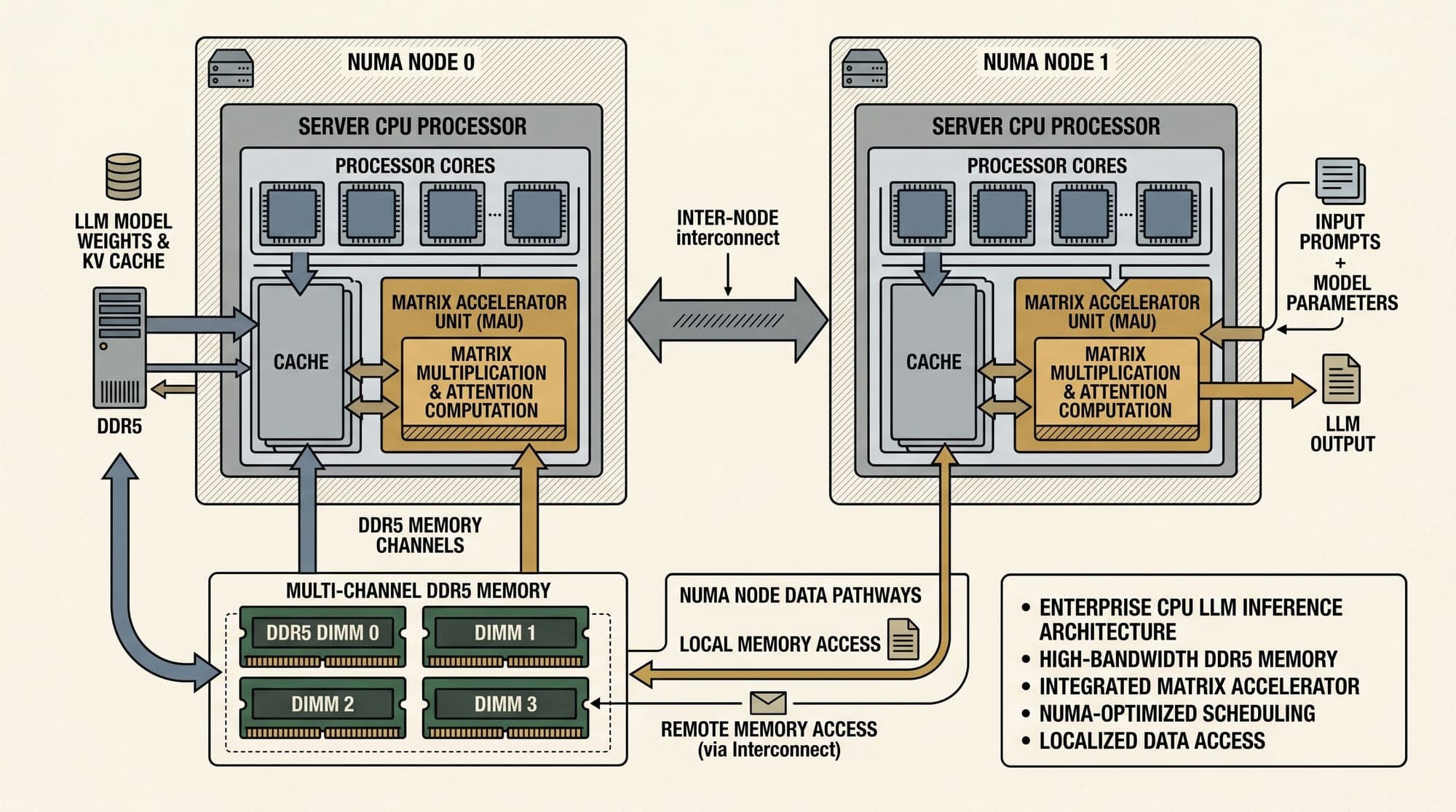
  17. LLM Inference on Enterprise CPUs in Production: Architecture, NUMA Topologies, Matrix Extensions, and Serving Economics

    Deploying large language models has historically been treated as an exclusively GPU-centric problem. Accelerators like NVIDIA H100 and A100 GPUs provide multi-terabyte-per-second High Bandwidth Memory (HBM) and tensor cores essential for training and high-concurrency serving. However, the operational economics of enterprise inference often diverge from frontier training requirements. Many enterprise applications, including internal code assistance, document extraction, low-concurrency agents, an

    AI
    6 min read
  18. Oxford Economics: US Corporate High-Tech Spending to Rise 40% by 2027, Tripling Europe's Pace

    A new macroeconomic forecast from Oxford Economics, reported by the Financial Times, projects that United States corporate capital expenditure on equipment, computing facilities, and structures will surge 40% between 2021 and 2027. This expansion rate is more than three times faster than equivalent capital investment across European economies over the same six-year window, driven primarily by private and hyperscaler investments in artificial intelligence infrastructure. The divergence underscor

    News
    2 min read
  19. The Edge of Stability: How Progressive Sharpening and Hessian Dynamics Govern Deep Learning Optimization

    In classical convex optimization, the behavior of gradient descent is dictated by the Lipschitz smoothness constant of the objective function. If a function $f(\theta)$ has an $L$-smooth gradient—meaning the largest eigenvalue of its Hessian matrix is bounded by $\lambda_{\max}(\nabla^2 f(\theta)) \le L$—gradient descent with learning rate $\eta$ is guaranteed to monotonically reduce the loss if and only if $\eta < 2/L$. When the step size exceeds this threshold ($\eta > 2/\lambda_{\max}$), stan

    AI
    7 min read
  20. Cross-Datacenter Distributed LLM Training in Production: DiLoCo, Local SGD, Communication Compression, and High-Latency Fault Tolerance

    Cross-Datacenter Distributed LLM Training in Production: DiLoCo, Local SGD, Communication Compression, and High-Latency Fault Tolerance Scaling frontier large language model pre-training within a single datacenter is encountering severe physical limits. Hyperscalers and AI laboratories increasingly face localized power grid saturation, where individual datacenter campuses cannot secure the 500 megawatt to multi-gigawatt utility allocations required for next-generation clusters. Consequently, in

    AI
    9 min read