
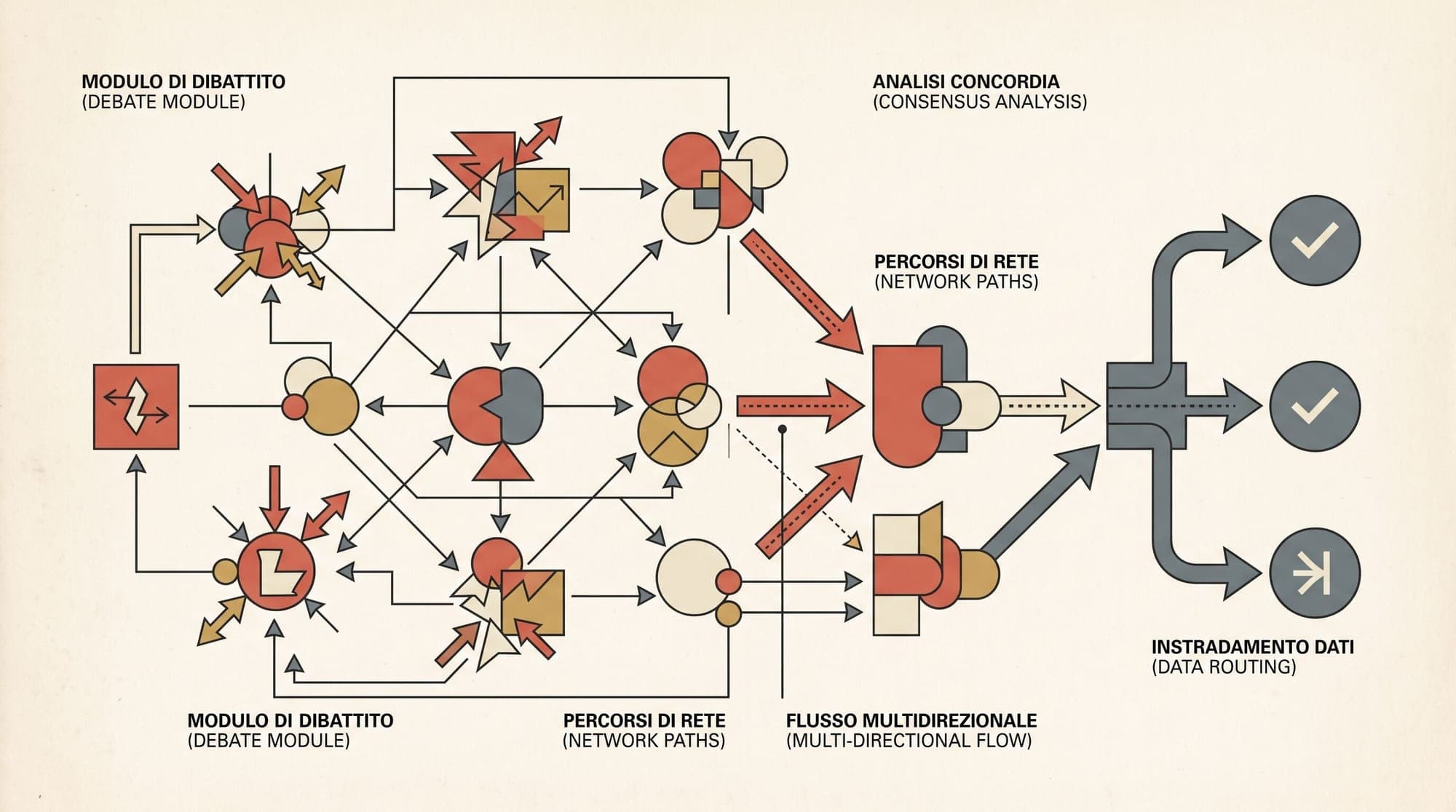
Single-model inference pipelines face severe structural limits when handling high-stakes reasoning, multi-step code synthesis, and mission-critical verification. While techniques like self-consistency decoding sample multiple independent trajectories from a single model to find majority consensus, they fail when the underlying model exhibits systemic bias or correlated hallucinations. When an LLM harbors a flawed premise, sampling ten independent stochastic paths frequently yields ten variations of the same error.
To overcome the blind spots of single-model generation, production architectures increasingly employ Multi-Agent Debate (MAD) and structured consensus protocols. Originally formalized by Du et al. (2023) and Liang et al. (2023), multi-agent debate structures iterative rounds of critique, rebuttal, and defense across diverse agents or distinct model backends. By forcing models to defend their reasoning against competing hypotheses, debate frameworks uncover logical inconsistencies, expose missing edge cases, and converge on higher-fidelity solutions.
However, transitioning multi-agent debate from academic benchmarks to production systems introduces non-trivial distributed systems challenges: quadratic token costs, compounding latency overheads, sycophantic groupthink (the "consensus trap"), and premature convergence. Operating multi-agent consensus at scale requires rigorous communication topologies, semantic convergence metrics, deterministic verification anchors, and strict cost controls.
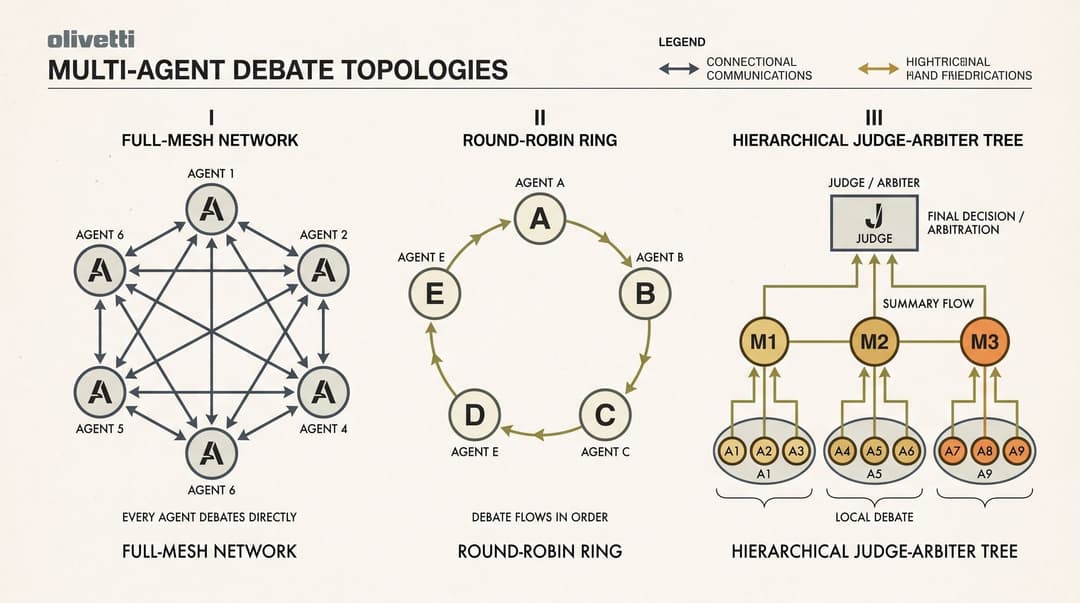
Multi-Agent Debate Topologies
The structural topology governing agent communication determines both the computational complexity and the reasoning diversity of a consensus system. In production, four primary topologies are deployed depending on latency budgets and task complexity:
1. Full-Mesh All-to-All Debate
In a full-mesh topology, every agent reads the complete outputs and rationales of all other agents from the preceding round. In round , agent receives the concatenated transcript and generates an updated critique and solution .
- Advantages: Maximizes information sharing and cross-fertilization of ideas across all participants.
- Failure Modes: Communication complexity scales at per round. Context windows expand rapidly as debate histories accumulate, causing quadratic increases in prefill token costs. Furthermore, full-mesh topologies are highly susceptible to early conformity cascades: if a charismatic or highly verbose agent puts forward an incorrect answer in round 1, peers frequently abandon their correct stances in round 2.
2. Turn-Based Round-Robin Debate
In a round-robin or circular topology, agents speak sequentially (). Each agent critiques only the immediately preceding response or the accumulated linear transcript.
- Advantages: Simplifies token scheduling and reduces concurrency spikes on inference endpoints.
- Failure Modes: Introduces severe recency and position bias. The final agent in the round exerts disproportionate influence over the summary state. Sequential execution eliminates parallel GPU prefilling, multiplying end-to-end Time-to-Last-Token (TTLT).
3. Hierarchical Judge-Arbiter Topology
Popularized by evaluation frameworks like ChatEval (Chan et al., 2023) and ReConcile (Chen et al., 2023), this architecture decouples debate generation from final aggregation. A panel of debater agents (often initialized with distinct system prompts, temperature settings, or underlying foundation models) generates competing arguments over fixed rounds. An independent Judge LLM, which did not participate in generating the intermediate critiques, evaluates the debate transcript and renders a final binding judgment.
- Advantages: Eliminates peer pressure among debaters. Debaters are instructed strictly to advocate their assigned position, while the arbiter applies objective scoring criteria without bias toward self-defense.
- Production Recommendation: This topology consistently delivers the highest accuracy-to-cost ratio for complex enterprise decision-making, code reviews, and policy validation.
4. Adversarial Red-Team / Devil's Advocate Topology
In standard cooperative debate, agents naturally drift toward agreement due to RLHF alignment defaults. The devil's advocate topology explicitly assigns at least one agent node to identify flaws, edge-case failures, and counter-examples against emerging consensus.
- Advantages: Prevents groupthink and forces affirmative agents to provide formal proofs, citations, or execution traces before a stance is accepted.
- Implementation: The contrarian agent is prompted with strict refutation objectives: "Your sole objective is to identify mathematical discrepancies, logical leaps, or unhandled edge cases in the prevailing majority solution."
Stopping Criteria and Convergence Detection
Unbounded multi-agent loops consume substantial compute while yielding diminishing returns. Empirical studies by Du et al. (2023) and Smit et al. (2024) demonstrate that reasoning accuracy typically peaks between rounds 2 and 3; subsequent rounds often degrade into circular conversational banter or sycophantic capitulation.
Production consensus engines require deterministic stopping rules:
1. Categorical and Exact Extraction
For structured reasoning tasks (such as mathematical problem-solving, classification, or unit-test verification), each agent is constrained to emit its final conclusion within a standardized XML or JSON block (e.g., <consensus_target>option_b</consensus_target>).
- Unanimous Early Exit: If all agents converge on identical target values at the conclusion of round , the orchestrator terminates the loop immediately and returns the result, bypassing subsequent debate rounds.
- Supermajority Threshold (): If agents agree on the target value, the majority answer is returned.
2. Semantic Cosine and Embedding Agreement
For open-ended generation, legal summaries, or architectural design reviews, exact string matching fails. Orchestrators compute pairwise cosine similarity across generated dense embeddings :
When average pairwise similarity exceeds a calibrated threshold (typically ), the orchestrator triggers the judge arbiter for final synthesis.
3. Hard Iteration Ceilings
Regardless of convergence status, production engines enforce a strict cap of rounds. If consensus is not reached by , the orchestrator routes the divergent outputs to an arbiter model with an explicit conflict-resolution prompt, or flags the trace for human review.
The Consensus Trap and Error Cascade Mitigation
The primary architectural vulnerability of multi-agent debate is the Consensus Trap: the tendency of LLMs to prioritize conversational harmony over factual accuracy. Because commercial foundation models undergo reinforcement learning with human feedback (RLHF) optimized for agreeableness, agents frequently exhibit sycophancy when confronted with assertive peer arguments.
Round 0: Blind Generation
  Agent A (Accurate): Proposes Solution X with subtle mathematical proof.
  Agent B (Flawed):   Proposes Solution Y with assertive, articulate explanation.
  Agent C (Flawed):   Proposes Solution Y with identical superficial reasoning.

Round 1: Unanchored Peer Exposure
  Agent A observes B and C agreeing on Y.
  Sycophancy bias triggers: Agent A concedes ("I see your point regarding Y...")
  and abandons correct Solution X.

Result: Erroneous Consensus Cascade (Majority Hallucination).
Defense 1: Blind First-Round Generation (Independent Pre-Evaluation)
Agents must never be exposed to peer responses during initial problem ingestion. Round 0 must execute in complete isolation across separate inference contexts. This preserves initial hypothesis entropy and prevents early anchoring.
Defense 2: Grounding with Deterministic Oracles
Language models cannot reliably debate empirical facts or compiler diagnostics without external ground truth. Production debate frameworks must integrate deterministic verification oracles into the debate loop:
- Code Synthesis: Before Agent B critiques Agent A's code, the code is executed in an isolated micro-sandbox. The stdout, stderr, and test suite results are injected into the debate context as immutable system messages.
- Mathematical Reasoning: Intermediate equations are parsed and validated via symbolic solvers (such as SymPy or Z3).
- Factual Knowledge: Assertions are cross-referenced against vector retrieval pipelines or deterministic API lookups.
When deterministic execution feedback is present, agents cannot be persuaded to abandon correct solutions by articulate but failing alternatives.
Defense 3: Heterogeneous Model Ensembling
Homogeneous debate (running three instances of the same model with identical weights) amplifies shared training data blind spots. Robust debate pipelines ensemble heterogeneous model families: for instance, pairing Anthropic Claude, OpenAI GPT, Google Gemini, and open-weight models (such as DeepSeek or Qwen). Different training corpora, tokenizers, and reinforcement learning recipes significantly reduce correlated failure modes.
Latency Budgets, Prefix Caching, and Serving Economics
Multi-agent debate inherently scales token consumption and inference latency. An unoptimized 3-agent, 3-round debate can consume the tokens and the wall-clock time of single-shot inference. Making debate cost-effective in production requires strict caching and scheduling discipline:
| Protocol Stage | Execution Pattern | Cache Optimization Strategy | Latency Budget Impact |
|---|---|---|---|
| Round 0: Independent Generation | Fully Parallel ( concurrent calls) | Shared System Prompt + Problem Prefix Cached across all workers | TTFT bounded to single-request baseline; TTLT equals slowest worker |
| Round 1-2: Critique & Rebuttal | Parallel Step-Locked ( concurrent calls per round) | Prefix cache retains Round 0 transcript; appends incremental turns | Sequential barrier synchronization at end of each round |
| Round 3: Arbiter Synthesis | Single Inference Call | Full transcript evaluated in single forward pass with high-throughput backend | Single generation pass over aggregated context |
Prompt Prefix Caching Architecture
Because all agents operate on the same root problem description and system instructions, modern serving engines (such as vLLM, SGLang, and provider caching APIs) achieve high prompt prefix cache hit rates:
- Static System Prefix (100% Cache Hit): Debate rules, output schemas, and domain constraints remain fixed.
- Problem Context (100% Cache Hit): The original source documents, codebase context, or query remain static across all rounds.
- Turn-Level KV Re-Use: By structuring debate transcripts with deterministic sorting (e.g., sorting agent responses alphabetically by Agent ID before concatenation), downstream agents hit existing KV cache blocks across shared prefix branches.
Architectural Decision Matrix
When architecting production LLM systems, multi-agent debate should be deployed selectively based on error tolerance and unit economics:
- Direct Single-Shot Inference: Use for latency-critical (<500ms) user-facing chat, simple extraction, and low-stakes classification.
- Self-Consistency (Single-Model Sampling): Use for deterministic reasoning tasks with low hallucination variance where inference cost must remain bounded ( parallel calls, 0 sequential debate turns).
- Multi-Agent Debate (Heterogeneous + Arbiter): Use for mission-critical tasks where error costs dwarf inference expenses: regulatory compliance audits, smart contract security verification, autonomous multi-file refactoring, and medical/legal document synthesis.
Sources
- Improving Factuality and Reasoning in Language Models through Multiagent Debate - Du et al., ICML 2024 / arXiv 2023
- Encouraging Divergent Thinking in Large Language Models through Multi-Agent Debate - Liang et al., arXiv 2023
- ChatEval: Towards Better LLM-Based Evaluators Through Multi-Agent Debate - Chan et al., ICLR 2024
- ReConcile: Round-Table Conference Improves Reasoning via Consensus Among Diverse LLMs - Chen et al., arXiv 2023
- Should We Be Going MAD? A Look at Multi-Agent Debate Strategies for LLMs - Smit et al., ICML 2024
- Self-Consistency Improves Chain of Thought Reasoning in Language Models - Wang et al., ICLR 2023
- Voting or Consensus? Decision-Making in Multi-Agent Debate - Kaesberg et al., arXiv 2025
