
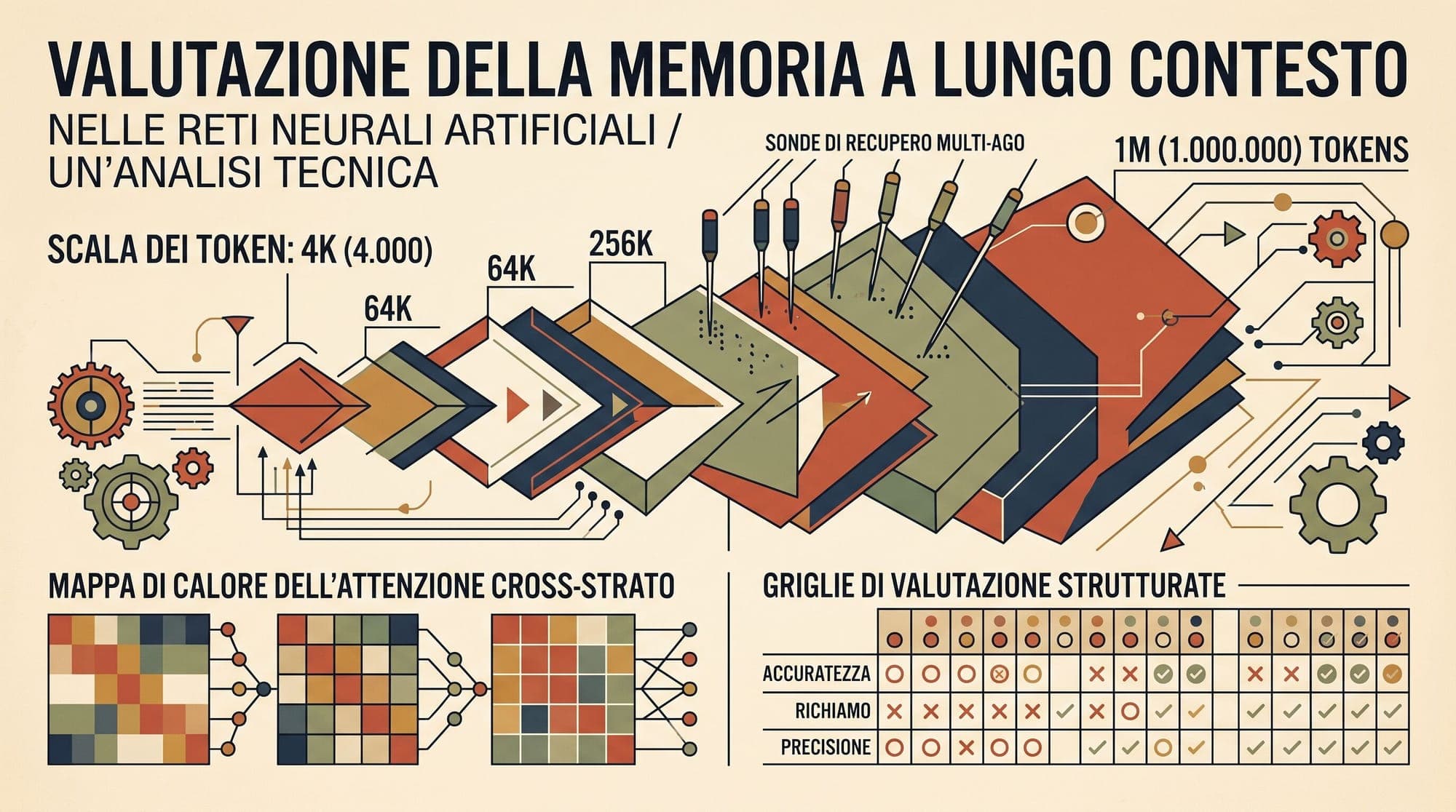
Frontier model providers frequently market sequence lengths spanning 128K, 1M, or 2M tokens. However, engineering teams deploying these models in production environments for codebase refactoring, multi-turn agent execution, or complex document analysis regularly observe severe retrieval failures and reasoning breakdowns well before hitting context boundaries.
The primary culprit behind this disconnect is the widespread reliance on vanilla Needle In A Haystack (NIAH) evaluations. While standard NIAH tests routinely generate pristine green heatmaps indicating 99% to 100% recall, they fail to model the semantic density, distractors, and multi-hop reasoning required in real-world systems. Determining the true effective context length of an LLM requires structured, multi-dimensional benchmarking suites that stress attention mechanisms under real-world conditions.
The Failure Modes of Vanilla Needle In A Haystack
Vanilla NIAH evaluations operate by inserting a single target sentence (the "needle") into an unrelated corpus of text (the "haystack"), such as public essays or classical literature. The model is then prompted to retrieve the exact value embedded in that single sentence.
+-------------------------------------------------------------+
|                      VANILLA NIAH TEST                      |
|                                                             |
| Haystack: Paul Graham Essays (Standard prose)               |
| Needle:   "The secret code to unlock the safe is 849201."   |
| Query:    "What is the secret code to unlock the safe?"     |
|                                                             |
| Result: Trivial attention spike due to extreme lexical     |
|         contrast and zero distractor competition.           |
+-------------------------------------------------------------+
This testing paradigm exhibits several critical blind spots:
- Lexical Outlier Contrast: Synthetic needles typically feature phrases with high out-of-domain contrast against the surrounding text. The query-key dot products for these outlier tokens spike effortlessly, allowing the attention mechanism to isolate the needle without resolving complex semantic relations.
- Zero Distractor Competition: In vanilla tests, background tokens share minimal semantic overlap with the prompt query. In production tasks, such as querying an insurance contract or multi-module codebase, hundreds of irrelevant clauses or functions share nearly identical terminology with the target information.
- Single-Span Retrieval vs. Compositional Reasoning: Vanilla NIAH tests only single-token or single-sentence extraction. They evaluate whether a model can route attention to one position, but ignore whether the model can combine multiple facts, track state updates, or compute aggregations across distributed context spans.
Multi-Dimensional Long-Context Benchmarks
To address the limitations of vanilla NIAH, recent research has introduced rigorous multi-task benchmark suites designed to evaluate realistic long-context capabilities.

RULER: Measuring Effective Context Size
Introduced by researchers at NVIDIA, the RULER benchmark (COLM 2024) provides a comprehensive framework to determine a model's actual effective context length. RULER spans 13 distinct tasks categorized into four core operational primitives:
- Multi-Target Retrieval: Retrieving distinct needles scattered across different positions in the sequence, measuring attention capacity under information density.
- Multi-Query Tracking: Answering multiple independent queries simultaneously over distributed context elements.
- Aggregation and Frequency Counting: Identifying common items, computing word frequencies, or finding top-k frequent entities across 32K to 128K token sequences.
- Variable Tracking: Tracing chains of variable assignments and state mutations through intermediate references (e.g.,
x = 5; y = x; z = y).
Evaluating 17 long-context models on RULER revealed that while all models claimed support for 32K tokens or greater, fewer than half could maintain satisfactory accuracy (defined as exceeding a 4K baseline threshold) at 32K tokens. Performance collapsed rapidly as input lengths approached claimed upper limits.
BABILong: Long-Context Reasoning in a Haystack
The BABILong benchmark (NeurIPS 2024) extends algorithmic reasoning into long contexts by embedding bAbI reasoning tasks into extensive book corpora spanning 10K to 10M tokens. Rather than retrieving a static needle, the model must locate two to five interdependent facts dispersed across tens of thousands of tokens and execute logical induction, spatial navigation, or pathfinding to arrive at the correct answer.
LooGLE and LongBench
Domain-specific benchmarks such as LooGLE (ACL 2024) and LongBench (ACL 2024) evaluate long-dependency question answering, timeline reconstruction, and cross-document summarization over realistic technical documentation, legal proceedings, and financial reports exceeding 24K to 100K tokens.
Architectural Root Causes of Context Degradation
The degradation of long-context capabilities is not solely an empirical artifact; it stems from underlying architectural and mathematical constraints in transformer attention and positional encodings.
Skewed Relative Position Distributions
In autoregressive causal attention, token pairs at relative distance appear with frequency proportional to , where is sequence length. As demonstrated in research on effective context length limitations, long-range token interactions are observed far less frequently during pre-training and post-training than short-range interactions. This triangular frequency skew biases attention projections toward localized dependencies.
Attention Dilution and Softmax Entropy
The attention weight assigned to token from query token is calculated via scaled dot-product softmax:
Attention(Q, K, V) = softmax(Q * K^T / sqrt(d_k)) * VAs sequence length grows from 4,096 to 131,072 tokens, the denominator sums over an increasingly large pool of background tokens:
Denominator = sum_{j=1}^N exp(q_i * k_j^T / sqrt(d_k))Even if individual background tokens produce small logits, the collective sum of thousands of distractor logits inflates the denominator. This mathematical accumulation dilutes the probability mass allocated to informative tokens, lowering signal-to-noise ratios during generation.
Position Interpolation Artifacts
Techniques used to extend context windows post-hoc (such as Position Interpolation, YaRN, or LongRoPE) scale down the rotational frequencies of Rotary Position Embeddings (RoPE). While frequency scaling prevents out-of-distribution rotational values, it compresses high-frequency dimensions, reducing the model's ability to discriminate between fine-grained token positions within long sequences.
U-Shaped Attention Bias
Empirical evaluations systematically reveal a U-shaped accuracy curve across context depth, commonly termed the Lost in the Middle phenomenon. Models allocate strong attention weights to the initial sequence tokens (primacy bias) and the most recent tokens (recency bias), while information placed between 30% and 80% of the total context depth experiences sharp retrieval degradation.
Designing a Production Long-Context Evaluation Suite
Engineering teams evaluating models for production deployment should implement a synthetic and empirical evaluation pipeline that mirrors production query complexity.
+-------------------------------------------------------------+
|             PRODUCTION LONG-CONTEXT EVAL PIPELINE           |
|                                                             |
| 1. Parameterized Distractor Generation                      |
|    - High semantic overlap (shared embedding space)         |
|                                                             |
| 2. Multi-Needle Density Scaling                             |
|    - Test k in {1, 4, 8, 16, 32} targets                    |
|                                                             |
| 3. Depth-Stratified Placement                               |
|    - Probe depths 0% to 100% at 5% intervals                |
|                                                             |
| 4. Multi-Hop Relational Probing                             |
|    - Variable chains and cross-document entity linking      |
|                                                             |
| 5. System Latency and Memory Profiling                      |
|    - TTFT, P99 generation latency, and KV cache memory      |
+-------------------------------------------------------------+
1. Semantic Distractor Injection
Replace generic background text with domain-specific distractors that closely match the query's embedding distribution. If evaluating a legal RAG system, populate the haystack with valid legal clauses containing identical entity types and terminology rather than unrelated essays.
2. Multi-Needle Density Scaling
Benchmark performance across variable needle counts . Plotting accuracy curves against needle density exposes when a model's working memory saturates under heavy information load.
3. Multi-Hop Dependency Chains
Structure test queries such that answering the prompt requires resolving dependent chains of information scattered at disparate context depths:
- Fact 1 (at 15% depth): Service Alpha routes traffic to Gateway Beta on port 8080.
- Fact 2 (at 65% depth): Gateway Beta enforces mTLS using Certificate Authority Gamma.
- Query: Which Certificate Authority validates traffic routed from Service Alpha?
4. Depth-Stratified Grid Sampling
Sample needle placements across context lengths (e.g., 8K, 16K, 32K, 64K, 128K) and sequence depths (0% to 100% in 5% increments). Visualizing accuracy over this 2D grid identifies dead zones where retrieval reliability breaks down.
5. Serving Economics and Latency Metrics
Long-context evaluation must factor in computational cost:
- Time-To-First-Token (TTFT): Prefill latency scales linearly or quadratically with prompt length depending on attention kernel optimizations (such as FlashAttention-3 or Chunked Prefill).
- KV Cache Memory Footprint: Unquantized 16-bit KV caches for a 128K sequence require substantial GPU VRAM, directly impacting concurrency and serving throughput.
- Accuracy-per-Dollar Trade-off: Measuring the performance delta between a full 128K context call versus a hybrid RAG approach combining top-k semantic retrieval with a 16K window.
Architectural Trade-offs and Production Recommendations
When architecting production systems that process extensive textual context:
- Establish Effective Context Baselines: Treat vendor-advertised context lengths as theoretical upper bounds. Establish your model's effective context length where multi-needle or multi-hop accuracy remains above 90%.
- Implement Hybrid RAG and Long-Context Pipelines: When source documents exceed the model's verified effective context size, use dense retrieval or multi-vector rerankers to filter context before passing the consolidated window to the LLM.
- Leverage Prefix Caching: For workloads with repetitive system instructions or static reference corpora, utilize prompt caching or RadixAttention to amortize prefill latencies and GPU memory overhead.
Sources
- RULER: What's the Real Context Size of Your Long-Context Language Models? (COLM 2024, arXiv:2404.06654)
- BABILong: Testing the Limits of LLMs with Long Context Reasoning-in-a-Haystack (NeurIPS 2024, arXiv:2406.10149)
- Why Does the Effective Context Length of LLMs Fall Short? (arXiv:2410.18745)
- Lost in the Middle: How Language Models Use Long Contexts (TACL 2024, arXiv:2307.03172)
- LooGLE: Can Long-Context Language Models Understand Long Contexts? (ACL 2024, arXiv:2311.04939)
- LongBench: A Bilingual, Multitask Benchmark for Long Context Understanding (ACL 2024, arXiv:2308.14508)



