

Tabular RAG in Production: Table Serialization, Row-Column Chunking, NL-to-SQL Hybridization, and Dense Entity Linking
Standard Retrieval-Augmented Generation (RAG) architectures excel when indexing unstructured prose. Dense semantic embeddings, recursive character chunking, and bi-encoder vector similarity match user queries against passages that follow linear syntactic structures. However, when these pipelines encounter tabular data (such as financial statements, medical registries, inventory catalogs, or scientific experimental matrices), retrieval accuracy and downstream generation fidelity degrade sharply.
Tables convey semantic information through two-dimensional spatial topology rather than sequential text. A single cell's meaning depends simultaneously on its column header, its row identifier, parent section hierarchies, and implicit data types. Flattener scripts that linearize tables into raw strings or comma-separated tokens destroy these geometric relationships. Furthermore, vector search cannot compute numerical aggregations, compare values across thousands of rows, or execute multi-hop joins across related schemas.
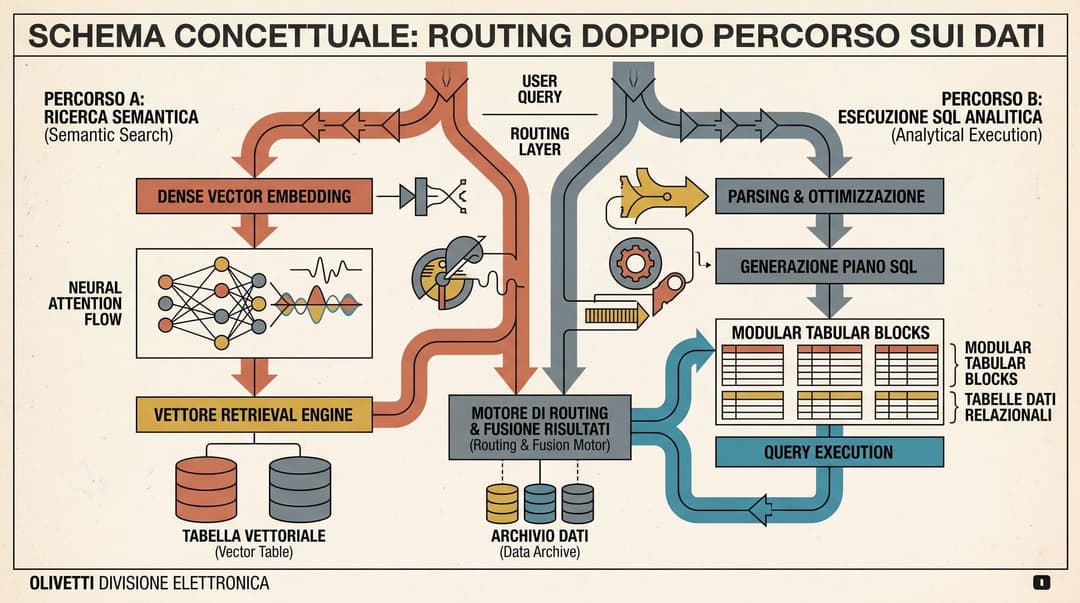
Production engineering teams require specialized tabular RAG architectures. By combining structure-aware table serialization, coarse-to-fine dual indexing, dynamic natural language to SQL (NL-to-SQL) execution engines, and dense entity linking, systems can query complex structured documents at scale while minimizing context window consumption.
1. The Linearization Bottleneck in Standard RAG
The core failure mode of standard RAG on tabular data is the linearization bottleneck. When document ingestion engines parse PDF or spreadsheet tables, they typically convert two-dimensional grids into sequential strings:
Region | Q1 Revenue | Q2 Revenue | YoY Growth | Status
North  | $1.2M      | $1.4M      | +16.7%     | Active
South  | $0.9M      | $0.8M      | -11.1%     | Review
When passed to standard embedding models, three distinct breakdowns occur:
- Loss of Coordinate Context: Dense bi-encoders map sequential token windows into a single vector representation. As row length and table breadth grow, the geometric binding between column headers (such as "YoY Growth") and distant cell values (such as "-11.1%") weakens. The model cannot reliably distinguish whether "-11.1%" belongs to the North or South region once token distances exceed standard attention receptive spans.
- The Numerical Aggregation Blindspot: Vector similarity measures semantic relatedness, not arithmetic logic. Queries such as "What was the average Q2 revenue across all active regions?" or "How many divisions reported negative growth?" require holistic column scans and arithmetic aggregation. Retrieving the top-k most similar row chunks provides the LLM with incomplete subsets of data, guaranteeing inaccurate hallucinations or truncated totals.
- Context Window Inflation and Lost-in-the-Middle: Large tables easily span tens of thousands of tokens. Injecting full raw tables into the context window triggers severe latency penalties and attention degradation. As demonstrated by Liu et al. (2023) in "Lost in the Middle", LLM recall degrades significantly when target facts reside in the middle of long context prompts.
2. Table Serialization and Context-Preserving Row Chunking
To preserve relational semantics without exceeding token budgets, ingestion pipelines must adopt structure-aware serialization formats. Instead of treating the table as an undifferentiated block of text, the system parses the table into structured objects and reconstructs individual records with explicit schema bindings.
Serialization Format Trade-Offs
The choice of serialization format directly influences token overhead and model comprehension:
- Raw Markdown: Offers moderate token efficiency (~1.2x baseline token count) and medium schema fidelity. It relies on delimiter alignment and works best for small reference tables (under 20 rows) embedded in general prose.
- HTML Table Tags: Offers poor token efficiency (~2.5x baseline token count) due to repetitive opening and closing tags, but provides high structural fidelity for tables containing merged cells, column spans, and multi-tier headers.
- JSON-L Key-Value Records: Incurs higher token overhead (~1.8x baseline) because field names repeat on every line, but provides explicit column-to-value associations for vector embedding of individual records.
- Header-Injected Triples: Achieves high token efficiency (~1.1x baseline) and very high schema fidelity by flattening cells into compact semantic tuples with explicit entity prefixes.
Header-Injected Row Chunking
The most effective serialization strategy for vector indexing is Header-Injected Row Chunking (formalized in frameworks like TabRAG). Rather than chunking by fixed character offsets, the pipeline extracts each row and prepends table-level metadata, the primary entity identifier, and explicit column labels:
{
  "chunk_id": "tbl_sec10k_r04",
  "table_title": "Consolidated Segment Operating Income (FY2025)",
  "primary_entity": "Cloud & Enterprise Infrastructure",
  "content": "[Table: FY2025 Segment Income] [Row: Cloud & Enterprise Infrastructure] Segment: Cloud & Enterprise | Operating Income Q1: $412M | Operating Income Q2: $489M | Margin: 28.4% | YoY Change: +14.2%"
}
By explicitly injecting the column headers into every serialized row string, bi-encoder embeddings retain full coordinate context even when individual rows are retrieved in isolation.
3. Coarse-to-Fine Dual-Index Topologies
Production deployments containing hundreds or thousands of tables cannot rely on flat vector search. Instead, modern systems implement a two-stage hierarchical retrieval architecture, pioneered by frameworks like TableRAG (NeurIPS 2024) and GTR (Graph-Table-RAG).
                        [ User Query ]
                              │
                              ▼
                 ┌──────────────────────────┐
                 │  Intent Classification   │
                 │    & Schema Routing      │
                 └─────────────┬────────────┘
                               │
               ┌───────────────┴───────────────┐
               ▼                               ▼
    [ Point / Entity Query ]        [ Analytical / Aggregation ]
               │                               │
               ▼                               ▼
  ┌─────────────────────────┐    ┌──────────────────────────┐
  │  Coarse Table Selector  │    │ Text-to-SQL Engine       │
  │  (Schema / Meta Index)  │    │ (DuckDB / In-Memory SQL) │
  └────────────┬────────────┘    └─────────────┬────────────┘
               │                               │
               ▼                               ▼
  ┌─────────────────────────┐    ┌──────────────────────────┐
  │ Fine Cell / Row Filter  │    │ Deterministic Execution  │
  │ (Header-Injected Dense) │    │ (Filtered Result Set)    │
  └────────────┬────────────┘    └─────────────┬────────────┘
               │                               │
               └───────────────┬───────────────┘
                               │
                               ▼
                 ┌──────────────────────────┐
                 │  Context Assembly & LLM  │
                 │   Answer Generation      │
                 └──────────────────────────┘
Stage 1: Coarse Table Selection (Schema Index)
The first retrieval layer indexes table-level metadata rather than individual cells. For each table in the corpus, the pipeline extracts:
- Table title, section headings, and parent document context.
- Column names and inferred data types (such as VARCHAR, DECIMAL, or DATE).
- High-level natural language summaries generated during ingestion.
- Unique entity samples (such as the top 5 distinct values per categorical column).
When a user submits a query, dense vector search matches the prompt against the schema index to select candidate tables (typically k between 1 and 3), filtering out irrelevant datasets.
Stage 2: Fine Cell and Row Retrieval (Cell Index)
Once candidate tables are identified, the system performs fine-grained cell and row retrieval. As demonstrated in TableRAG, combining column filtering with key-value cell retrieval eliminates up to 90% of irrelevant tokens before passing the structured sub-table to the downstream LLM.
4. Hybrid NL-to-SQL Routing with In-Memory Execution
For analytical queries involving calculations, sorting, filtering thresholds, or multi-row aggregations, semantic retrieval must be paired with structured query execution.
The In-Memory DuckDB Pattern
Leading enterprise implementations pair vector stores with an embedded columnar SQL engine such as DuckDB or SQLite. When tables are ingested:
- Tables are stored as structured Parquet files or relational tables alongside vector embeddings.
- An intent classifier categorizes incoming questions into Point Lookup (such as "What is the warranty period for product X?") or Analytical Aggregation (such as "Which 5 vendors accounted for 80% of Q3 expenditure?").
- For analytical queries, the LLM receives the table schema and generates a SQL query.
- The system executes the SQL query against DuckDB in a sandboxed runtime, returning exact computed rows.
import duckdb
import pandas as pd

def execute_tabular_query(sql_query: str, db_connection: duckdb.DuckDBPyConnection) -> str:
    """
    Executes generated SQL against an in-memory DuckDB instance
    with strict read-only execution guardrails.
    """
    try:
        cursor = db_connection.cursor()
        cursor.execute("PRAGMA query_verification_enabled=true;")
        df_result = cursor.execute(sql_query).fetchdf()

        # Guard against unbounded result serialization
        if len(df_result) > 50:
            return df_result.head(50).to_string(index=False) + "\n\n(Truncated to top 50 rows)"

        return df_result.to_string(index=False)
    except Exception as e:
        return f"EXECUTION_ERROR: {str(e)}"
Schema Pruning and Self-Correction Loops
Passing massive schemas to NL-to-SQL models introduces hallucinations in column selection. Production pipelines employ schema pruning:
- Matching query tokens against column description embeddings.
- Selecting only relevant columns (for example, 6 columns out of a 60-column wide table).
- Validating the generated SQL against an AST database parser (such as
sqlglot) before execution. - If execution fails (due to syntax errors or non-existent column names), the error traceback is fed back into a short reflection loop for immediate self-correction.
5. Handling Heterogeneous and Multi-Tier Tables
Real-world tables in SEC filings, medical reports, and technical manuals rarely conform to neat, single-tier rectangular matrices. Common document artifacts include:
- Hierarchical Column Headers: Multi-tier spans (such as "Year Ended Dec 31" spanning sub-columns "2024" and "2025").
- Merged Section Delimiters: Sub-header rows that define categorical groupings for all subsequent rows until the next delimiter.
- Footnotes and Accounting Superscripts: Qualitative qualifications (such as
[1] Excludes restructuring charges) located outside the grid.
Ingestion Best Practices
- Header Flattening: Ingestion parsers (such as Docling or Table Transformer) must collapse multi-level headers into single composite paths:
Income Statement > Operating Expenses > R&D (2025). - Contextual Footnote Binding: Footnote references in cells should be resolved during parsing and appended to the row metadata chunk rather than left as detached trailing text.
- Sub-header Propagation: When a table uses category break rows (such as "Operating Expenses"), that category label must be propagated as an explicit attribute to every following data row until the next section break.
6. Production Benchmarks and Evaluation
Recent academic and industrial benchmarks provide clear performance baselines for tabular RAG architectures:
- TableRAG (NeurIPS 2024): Evaluated across million-token tables on Arcade and BIRD-SQL benchmarks. Baseline naive RAG achieved 34.2% accuracy, whereas TableRAG achieved 71.8% accuracy while reducing prompt token overhead by up to 90% via dual schema and cell retrieval.
- MultiTableQA (2025): Evaluated across 60,000 tables requiring cross-table joins and multi-hop reasoning. Baseline naive RAG scored 28.5%, while Graph-Table-RAG (GTR) achieved 64.3% accuracy.
- HeteQA (2025): Tested reasoning across mixed documents containing both narrative text and tables. Standard text RAG achieved 41.6% accuracy, compared to 76.9% for hybrid SQL execution frameworks.
- TabFact (2020): Benchmark for factual verification across complex tables. Naive text retrieval achieved 52.1% accuracy, whereas header-injected row serialization with cell filtering reached 83.4% accuracy.
Operational Takeaways
- Never vectorize raw tables without header injection: Bare numbers and dates without column names lose semantic relevance in vector space.
- Implement dual-path routing: Use dense vector retrieval for specific entity lookups and deterministic in-memory SQL (DuckDB or SQLite) for numerical aggregations and filtering thresholds.
- Decouple schema retrieval from cell extraction: Retrieve candidate tables via metadata and schema descriptions first; fetch relevant rows and columns only after the table context is established.
- Enforce query verification and guardrails: Restrict NL-to-SQL engines to read-only execution on ephemeral in-memory tables to eliminate data exposure and execution timeout risks.
Sources
- TableRAG: Million-Token Table Understanding with Language Models (NeurIPS 2024)
- TabRAG: Tabular Document Retrieval via Structured Language Representations
- GTR: Graph-Table-RAG for Cross-Table Question Answering (MultiTableQA)
- TableRAG: A Retrieval Augmented Generation Framework for Heterogeneous Document Reasoning (HeteQA)
- Lost in the Middle: How Language Models Use Long Contexts (Liu et al., 2023)
- TABFACT: A Large-scale Dataset for Table-based Fact Verification (Chen et al., 2020)
- BIRD: A Big Bench for Large-Scale Database Grounded Text-to-SQL Evaluation
- DuckDB: An In-Process SQL OLAP Database Management System
- Docling: Technical Report for Document Processing (IBM Research)
