
For most of the history of neural networks, there was a wall around how deep a trainable network could be. Ten layers was ambitious. Twenty was exotic. The barrier was not memory, not compute, and not data. It was that the learning signal itself decayed to nothing before it reached the early layers. Researchers call this the vanishing gradient problem, and its defeat is the reason modern language models can be deep at all.
The chain rule turns learning into multiplication
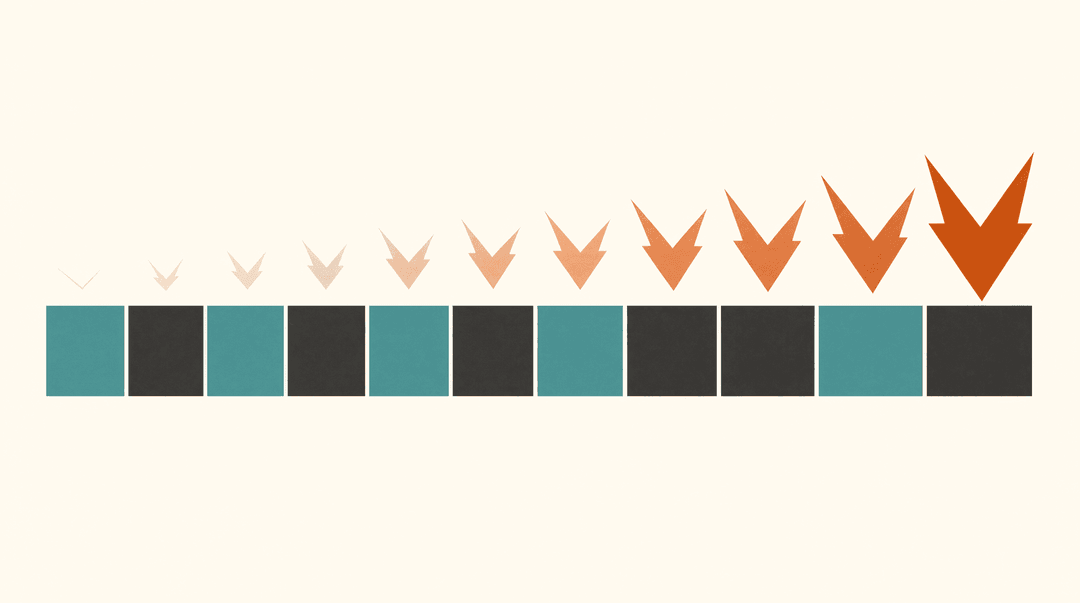
To train a network, backpropagation computes how much each weight is to blame for the error, then nudges the weight in the direction that reduces it. For a weight in an early layer, that blame calculation must be chained through every layer that sits between it and the output. Mathematically, the gradient of the loss with respect to an early-layer weight is a product of derivatives, one per intervening layer.
Two factors made that product deadly for the networks of the 1980s and 1990s. First, the standard activation functions saturated. A sigmoid squashes its input into a curve that flattens at both ends, and its derivative never exceeds 0.25. At the edges of its range it is effectively zero. Second, weights were typically initialized small. So each layer in the chain contributed a factor well below 1, and multiplying many such factors shrinks the result exponentially. A gradient that is 0.1 of its size per layer is 10^-15 by the twentieth layer. The early layers still received a number, technically. It was just too small to move their weights in any useful direction within a training run.
The result looks like a specific failure signature: the output-side layers learn, the input-side layers barely change, and the network plateaus as if it had converged, even though capacity sits unused near the front.
Named in 1991, proven in 1994
The analysis predates the deep learning boom by two decades. Sepp Hochreiter described vanishing error flow in recurrent networks in his 1991 diploma thesis, written in German and largely ignored at the time. Yoshua Bengio, Patrice Simard and Paolo Frasconi published the formal version in 1994: "Learning Long-Term Dependencies with Gradient Descent is Difficult" proved, for recurrent networks, that the gradient signal for events far back in a sequence decays exponentially toward zero, making gradient descent unable to learn long-term dependencies.
In 1997, Hochreiter and Jurgen Schmidhuber answered their own problem with the LSTM, adding multiplicative gates that let a cell keep information and error signals constant over many steps. The paper's stated motivation was exactly this: to keep errors from vanishing or exploding during long training.
The problem got its modern name from a 2013 paper by Razvan Pascanu, Tomas Mikolov and Yoshua Bengio, "On the Difficulty of Training Recurrent Neural Networks," which analyzed both failure modes together, proposed gradient norm clipping for the exploding case, and introduced the loss function with saturation they called "soft clipping."
The louder sibling: exploding gradients
Vanishing gradients are half of an instability pair. If the per-layer factors exceed 1, the same product grows exponentially instead, and the update for an early layer can become so large it throws the whole network into a bad region of parameter space, sometimes producing NaN weights in a single step. Pascanu and colleagues showed that exploding events are caused by long-term components of the gradient growing faster than short-term ones, and that simple norm clipping controls them. Both pathologies share one root cause: backpropagation multiplies layer-by-layer factors, and repeated multiplication ends in zero or infinity, with very little in between.
The fixes that made depth possible
Between 1994 and 2015, five ideas, largely independent of each other, dismantled the problem.
ReLU activations. Sigmoid and tanh kill their own gradient through saturation. A rectified linear unit, f(x) = max(0, x), has gradient exactly 1 for all positive inputs, so the signal stops being multiplied by numbers below 0.25 at every layer. AlexNet, the 2012 network that kicked off the modern era, used ReLUs, and its authors reported that rectifier networks trained several times faster than tanh equivalents. The cure has its own pathology: a ReLU neuron whose inputs stay negative outputs zero and receives zero gradient forever, the dying ReLU problem documented by He and colleagues in 2015 and analyzed theoretically by Beyer and colleagues in 2019.
Variance-aware initialization. Xavier Glorot and Yoshua Bengio showed in 2010 that badly scaled initial weights drive activations toward saturation and make gradient variance shrink layer by layer even at initialization, and proposed choosing weight variance so forward and backward signal variance is preserved. Kaiming He and colleagues extended the calculation for rectifiers in 2015, doubling the variance to compensate for the half of the signal ReLU discards; they reported that 30-layer networks with Xavier-style initialization stalled from diminishing gradients while the corrected scale converged.
Normalization layers. Ioffe and Szegedy's batch normalization (2015) re-centers and re-scales activations inside the network during training, keeping each layer's inputs in a range where gradients stay healthy and reducing dependence on initialization.
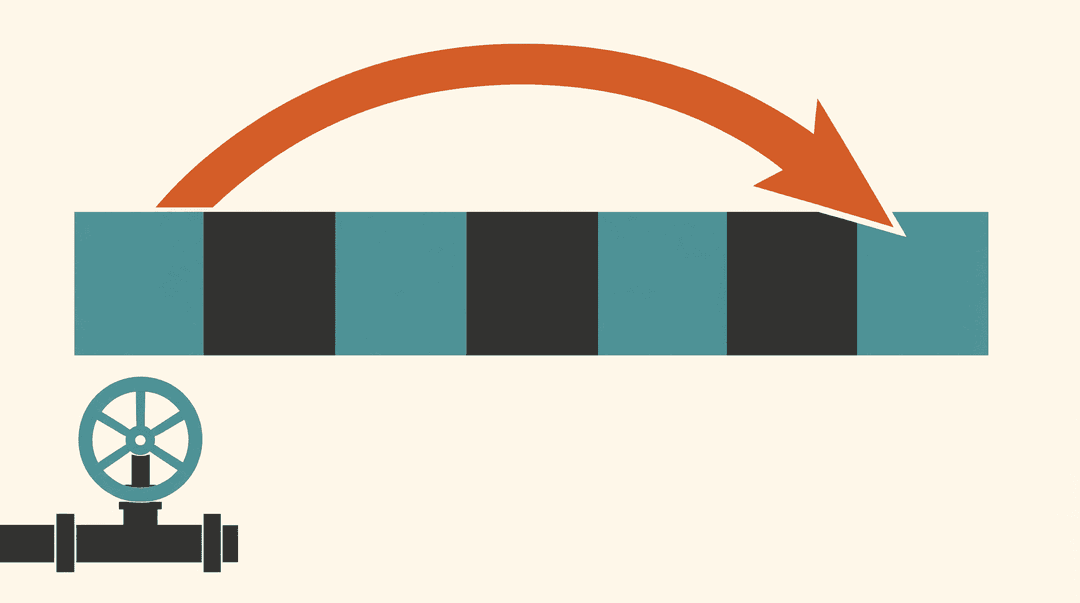
Residual connections. The most direct fix. He and colleagues' ResNet (2015) adds each block's input to its output, giving the gradient a shortcut path that passes through unchanged instead of being multiplied layer after layer. The identity path means depth no longer exponentially attenuates the learning signal, and it is the reason networks hundreds of layers deep became trainable.
Architectural gates. The LSTM (1997) solved the same problem for sequences by letting the network learn what to keep and what to let go, an idea that reappears in every gated architecture since.
Why it still matters for language models
Modern LLM training runs look far removed from 1994, yet they carry the answers, not the problem. A transformer is a stack of residual blocks, each with layer normalization, GELU-style activations, careful initialization and, in nearly every published recipe, gradient clipping. The 100-plus layers of a frontier model are trainable precisely because all five fixes above are applied at once. The residual stream in a transformer plays the same role the identity shortcut played in ResNet: it is a highway along which gradients, and information, travel without exponential decay.
The historical lesson is uncomfortable for anyone who treats neural scaling as obvious. The idea of a deep network was not new in 2012. The obstacle was that gradient descent could not train one, and it took twenty years to work around. As the NVIDIA historical survey of the field puts it, the main hurdle at the time was that features in early layers could not be learned because no learning signal reached those layers.
Takeaways
- Backpropagation multiplies per-layer derivatives; if they are below 1, early-layer gradients decay exponentially. That is the vanishing gradient problem.
- Sigmoid and tanh saturation, with gradients capped at 0.25, made this acute in pre-2010 networks; the paired failure mode is exploding gradients, controlled by clipping.
- The problem was analyzed in 1991 (Hochreiter) and 1994 (Bengio, Simard, Frasconi), and named in its modern form in 2013 (Pascanu, Mikolov, Bengio).
- ReLU, Xavier and He initialization, normalization, LSTM gating and residual connections collectively removed the depth barrier.
- Every transformer block ships with all of these fixes. Depth is cheap now because the gradient problem was solved, not because it never existed.
Sources
- Yoshua Bengio, Patrice Simard, Paolo Frasconi, "Learning Long-Term Dependencies with Gradient Descent is Difficult," IEEE Transactions on Neural Networks, 1994. https://ieeexplore.ieee.org/document/279181
- Razvan Pascanu, Tomas Mikolov, Yoshua Bengio, "On the Difficulty of Training Recurrent Neural Networks," ICML 2013. https://arxiv.org/abs/1211.5063
- Sepp Hochreiter, Jurgen Schmidhuber, "Long Short-Term Memory," Neural Computation, 1997. https://direct.mit.edu/neco/article/9/8/1735/6103/Long-Short-Term-Memory
- Xavier Glorot, Yoshua Bengio, "Understanding the Difficulty of Training Deep Feedforward Neural Networks," AISTATS 2010. https://proceedings.mlr.press/v9/glorot10a.html
- Kaiming He, Xiangyu Zhang, Shaoqing Ren, Jian Sun, "Delving Deep into Rectifiers," ICCV 2015. https://arxiv.org/abs/1502.01852
- Lucas Beyer et al., "Dying ReLU and Initialization: Theory and Numerical Examples," 2019. https://arxiv.org/abs/1903.06733
- Sergey Ioffe, Christian Szegedy, "Batch Normalization," ICML 2015. https://arxiv.org/abs/1502.03167
- Kaiming He et al., "Deep Residual Learning for Image Recognition," CVPR 2016. https://arxiv.org/abs/1512.03385
- Alex Krizhevsky, Ilya Sutskever, Geoffrey Hinton, "ImageNet Classification with Deep Convolutional Neural Networks," NeurIPS 2012. https://papers.nips.cc/paper/4824-imagenet-classification-with-deep-convolutional-neural-networks
- NVIDIA Technical Blog, "Deep Learning in a Nutshell: History and Training." https://developer.nvidia.com/blog/deep-learning-nutshell-history-training
- IEEE Spectrum, "How AlexNet Transformed AI and Computer Vision Forever." https://spectrum.ieee.org/alexnet-source-code
- Wikipedia, "Vanishing gradient problem." https://en.wikipedia.org/wiki/Vanishing_gradient_problem
