
Humanoid robots now work beside people. In June 2024, GXO Logistics and Agility Robotics signed what both companies called the industry's first formal commercial deployment of humanoid robots in live operations, a robots-as-a-service contract putting Digit units in a Georgia warehouse (Agility). By the time the partnership expanded, Digit had moved more than 100,000 totes at that facility, with two more US sites scheduled for 2027 (Agility). Figure's Figure 03 robot arrived at BMW's Spartanburg plant in June 2026 to sort components into sequencing trolleys, following a year-long Figure 02 assembly deployment (Figure).
Every one of these machines poses a design question that a two-page Japanese essay from 1970 first named: how human should a robot look, and what happens when it looks almost human but not quite.
The essay
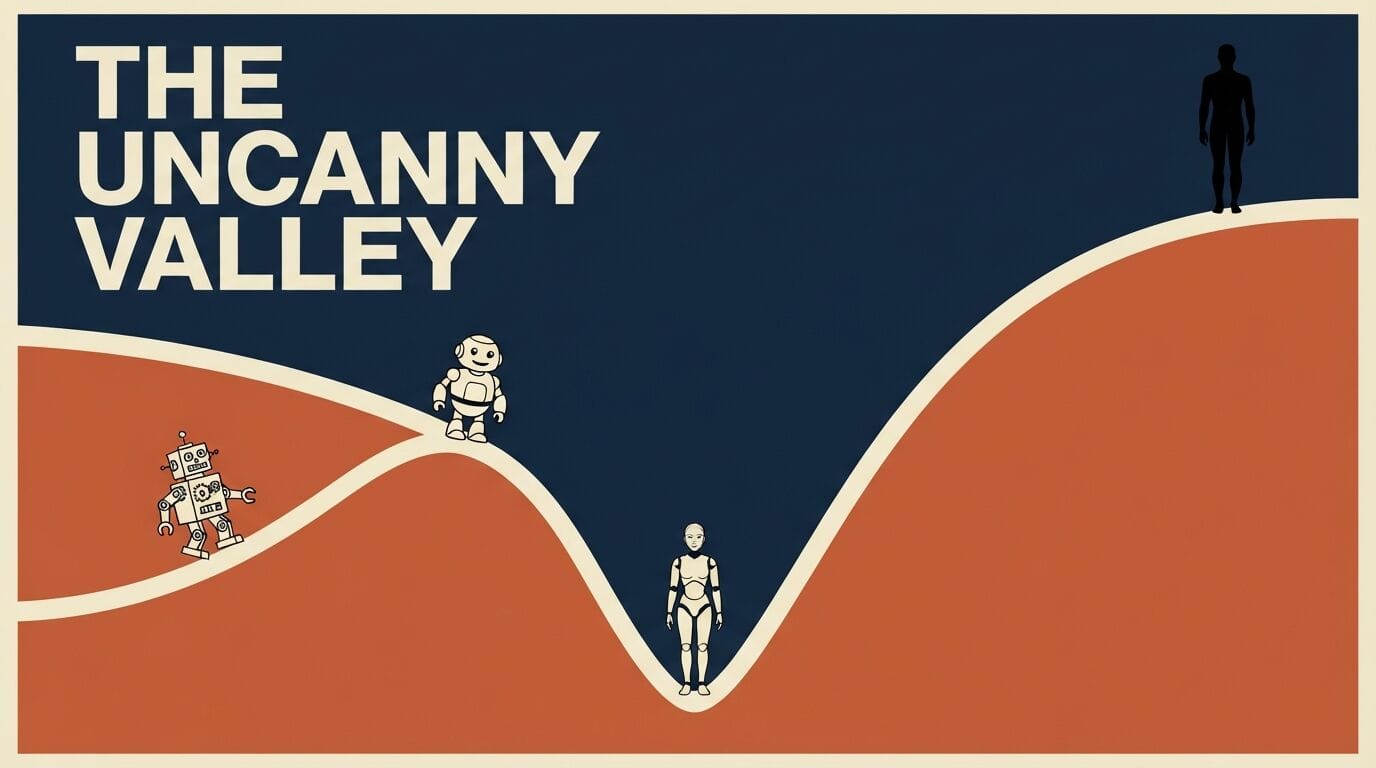
Masahiro Mori was a robotics professor at the Tokyo Institute of Technology when he published "Bukimi no Tani Gensho" (the uncanny valley phenomenon) in Energy, a magazine put out by Esso, the Japanese subsidiary of Standard Oil (IEEE Spectrum interview). His observation: as a robot's appearance becomes more humanlike, our empathy toward it rises, until resemblance gets close but imperfect. At that point the response plunges into revulsion. Only a replica indistinguishable from a healthy person restores the feeling. Plotted on a graph, affinity forms a dip, a valley.
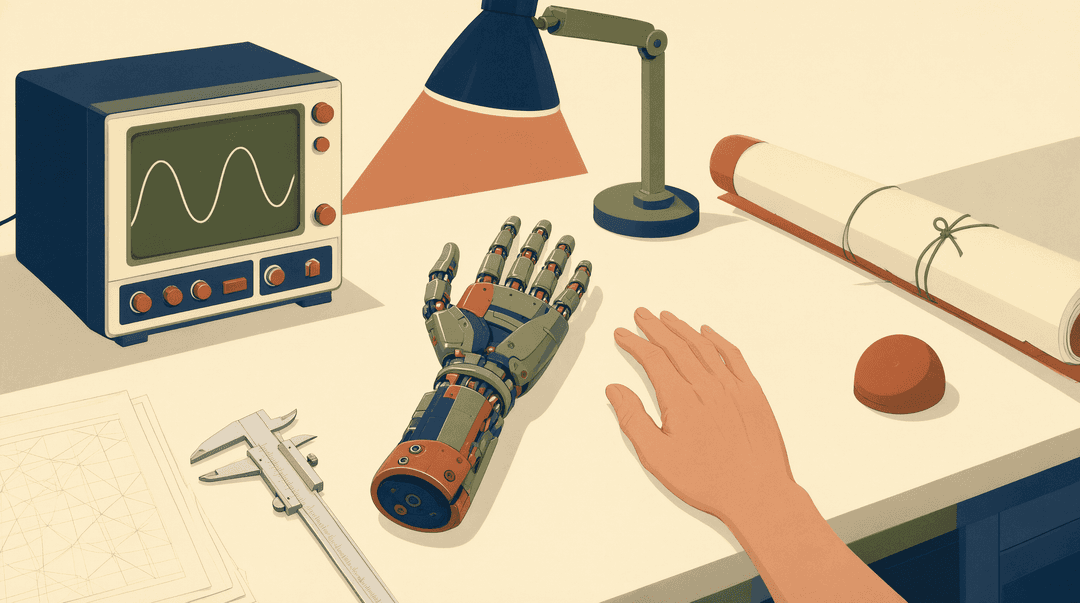
Mori's trigger was a myoelectric prosthetic hand, a functional artificial hand controlled by muscle signals. He found it unsettling when the person wearing it moved it, and calm when it lay still. The essay also drew on wax figures and dental training models. Mori was explicit about the status of his idea. "Pointing out the existence of the uncanny valley was more of a piece of advice from me to people who design robots rather than a scientific statement," he said in the essay's first authorized English translation, published in IEEE Robotics & Automation Magazine in 2012 (IEEE Spectrum).
The translated essay noted that movement mattered more than looks. A face with 29 pairs of artificial muscles, built for the 1970 Osaka World Exposition, smiled correctly but crept people out when the motion ran at half speed (IEEE). For Mori, the valley is mostly about mismatch: an artificial appearance paired with human motion, or human appearance paired with mechanical motion.
Where familiar robots sit on the curve
The hypothesis sorts machines into bands. Clearly mechanical robots, R2-D2, industrial arms, are safe. Stylized humanoids read as endearing. Near-human androids and photoreal CGI characters land in the valley, and it has become the stock explanation for the cold reception of The Polar Express in 2004 (overview; PMC review). Karl MacDorman, the Indiana University researcher who co-translated Mori's essay, says the effect follows from blending categories: build robots that combine features from opposite sides of a boundary, human and nonhuman, living and nonliving, and you get eeriness. A robot with a human voice, or a human with a robotic voice, is eerie for the same reason (IEEE Spectrum).

Does the valley exist?
For years the evidence was thin because the stimuli were fake. Early studies morphed robot faces into human faces, and morphing artifacts made results inconsistent. Bartneck and colleagues reported instead that likability fell off more like a monotonic drop, which they framed as an "uncanny cliff" (RO-MAN 2009 paper).
The strongest result came from real robots. Maya Mathur and David Reichling took 80 robot face images collected from internet searches, plus a controlled six-face morph series, and had 66 raters score likability. The dip appeared. Then a second group of 92 people played an investment game, deciding how much of a fictional $100 to trust to each face, and their money followed the same valley curve. Faces deepest in the valley also took longest to categorize as human or machine (Cognition, 2016; New Scientist). The authors read that as evidence the valley is real and reaches past stated preferences into economic behavior.
Two caveats survive. First, the follow-up multisite work found the categorization confusion, while elevated in the valley, did not statistically explain the dislike, so the mechanism is still open (as summarized with the 2020 study record). Second, a meta-regression of social robot studies found that highly anthropomorphic robots were sparsely used in the experimental literature, so the descent Mori sketched at the high-similarity end remains under-tested, even though likability clearly drops at low-to-medium human-likeness (Mara et al., HRI 2022).
Candidate explanations
Researchers have offered three, none settled.
A Bayesian account from Robert Moore treats the valley as prediction error: human perception is tuned to expect human-like forms to behave humanly, violations of that expectation carry a surprise signal, and the unpleasant feeling of surprise gets projected onto the stimulus (Scientific Reports, 2012).
Mind-perception work by Kurt Gray and Daniel Wegner proposes that human appearance prompts people to attribute experience, the capacity to feel, to a machine, and that machines become unnerving at the point people sense something is going on inside (summarized with follow-up in PMC). An Emory experiment added timing: when people looked at android faces, the sense of aliveness dropped between roughly 100 and 500 milliseconds after exposure, consistent with a second step of dehumanizing the face rather than a first step of sensing a mind (Emory News, 2020).
Mori himself gestured at mortality: near-human but not-human things, prosthetic hands of the deceased, wax figures, corpses, remind observers of death (IEEE Spectrum translation).
The part that concerns language models
The uncanny valley stopped being only a robotics problem when text and voice systems started claiming humanity. The mismatch logic applies directly: a product that looks, sounds, or reads human while behaving mechanically sits in the valley regardless of its chassis.
There is now a small experiment on the other side of that trade. A 2025 study put an LLM-powered conversational layer onto a hyper-realistic social robot and had 80 students interact with it. Better conversation measurably reduced creepiness and raised pleasantness and approachability, suggesting behavioral realism can partially buy back trust that near-human appearance spends (arXiv, 2025). That is one student-centered study, not a field consensus, but it points at the practical rule the literature keeps converging on: eeriness tracks the gap between what a system presents and what it delivers. Designers can stay clearly mechanical, go all the way to indistinguishable, or, in software, be honest about the machine. Mori gave the advice in 1970. It was aimed at robot hands. It now applies to every assistant that types like a person.
Sources
- Masahiro Mori, "The Uncanny Valley," trans. MacDorman & Kageki, IEEE Robotics & Automation Magazine, 2012: https://spectrum.ieee.org/the-uncanny-valley
- IEEE Xplore record of the translation: https://ieeexplore.ieee.org/document/6213238
- Norri Kageki's interview with Mori, IEEE Spectrum: https://spectrum.ieee.org/an-uncanny-mind-masahiro-mori-on-the-uncanny-valley
- "What Is the Uncanny Valley?", IEEE Spectrum: https://spectrum.ieee.org/what-is-the-uncanny-valley
- Mathur & Reichling, "Navigating a social world with robot partners," Cognition, 2016: https://pubmed.ncbi.nlm.nih.gov/26402646/
- New Scientist coverage of the 80-face study: https://www.newscientist.com/article/2063807-into-the-uncanny-valley-80-robot-faces-ranked-by-creepiness
- Bartneck, Kanda, Ishiguro & Hagita, "Is the Uncanny Valley an Uncanny Cliff?", RO-MAN 2009: https://www.bartneck.de/publications/2009/roboticDoppelgangerUncannyValley/bartneckKandaRoMan2009.pdf
- Moore, "A Bayesian explanation of the 'uncanny valley' effect," Scientific Reports, 2012: https://www.nature.com/articles/srep00864
- "Persistence of the uncanny valley" (Gray & Wegner, Polar Express citations), PMC: https://pmc.ncbi.nlm.nih.gov/articles/PMC4484984/
- Emory University news on the animacy timing experiments: https://news.emory.edu/stories/2020/09/experiments-reveal-why-human-robots-elicit-uncanny-feelings
- Mara et al., "Human-Like Robots and the Uncanny Valley," meta-regression: https://www.mcm.uni-wuerzburg.de/fileadmin/06110000/2026/mara-et-al-2022-human-like-robots-and-the-uncanny-valley.pdf
- "Mitigating the Uncanny Valley Effect in Hyper-Realistic Robots: LLM-Driven Conversations," arXiv 2503.16449: https://arxiv.org/abs/2503.16449
- GXO and Agility Robotics agreement, June 2024: https://www.agilityrobotics.com/content/gxo-signs-industry-first-multi-year-agreement-with-agility-robotics
- GXO/Agility expansion and tote count: https://www.agilityrobotics.com/content/gxo-and-agility-robotics-expand-partnership-to-accelerate-deployment-of-humanoids-in-u-s-operations
- Figure 03 at BMW Spartanburg: https://www.figure.ai/news/f-03-at-bmw
- Uncanny valley overview: https://en.wikipedia.org/wiki/Uncanny_valley
