
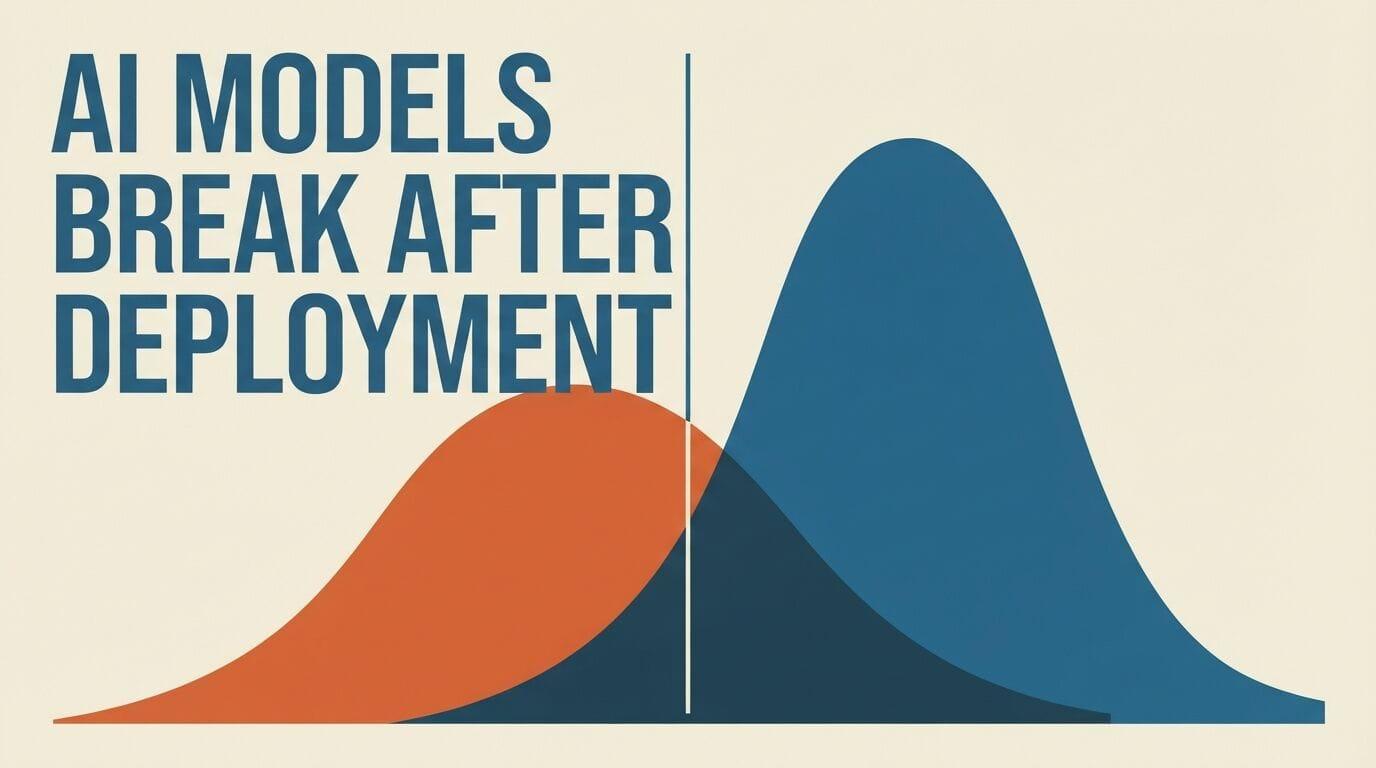
Machine learning models are trained and validated under what statisticians call an i.i.d. assumption. Training examples and future test examples are assumed to be drawn from the same distribution. The whole edifice of holdout sets, cross-validation scores and published benchmarks rests on it. Distribution shift is the failure mode on the other side of that assumption: the joint distribution of inputs and outputs at deployment time differs from the one the model learned from. As Dan Roth's Trustworthy Machine Learning textbook puts it, it is "the mismatch between the probability distribution of the training data and the data you will see during deployment."
The field formalized the problem in 2009, when the MIT Press volume Dataset Shift in Machine Learning, edited by Joaquin Quiñonero-Candela, Masashi Sugiyama, Anton Schwaighofer and Neil D. Lawrence (MIT Press listing), collected the scattered research into one framework. Its core observation was blunt: most practical prediction problems involve shift of some kind, and the standard training playbook has no answer for it.
Three ways the ground moves
The literature splits distribution shift into named cases, depending on which part of the probability picture changes. The taxonomy below follows the Trustworthy ML chapter, Sebastian Raschka's treatment and Chip Huyen's widely cited overview.
Covariate shift. The input distribution P(X) changes, but the relationship P(Y|X) stays the same. The model sees cases it was not trained on, yet the rules of the world have not moved. Raschka's example: a breast cancer classifier trained on an older population, because the typical screening population includes more women over 40 than the inference population does. The medicine has not changed. The patients have.
Label shift (also called prior probability shift). The mirror image: the output distribution P(Y) changes while the feature distribution given the label P(X|Y) stays fixed. Disease prevalence drops, spam ratios change, a store sells a different product mix than last season.
Concept drift. The hardest case: P(Y|X) itself changes while the inputs look identical. Huyen's example is house-price prediction. Before 2020, a given set of features for a three-bedroom San Francisco apartment pointed to roughly $2 million. During the pandemic exodus, the same input pointed somewhere else. Same data, different answer. No amount of input monitoring catches this, because nothing in X told you anything moved.
The three cases have very different cures. Prior probability shift and covariate shift are largely correctable after training, because the underlying mapping is intact; label shift can be patched with recalibration and covariate shift with importance reweighting of the training examples. Concept drift means the mapping itself is stale, which is why the Vector Institute's review of remedies concludes that the model must be refit from scratch. The Trustworthy ML chapter sums up the general position: often you cannot detect distribution shift, you just have to assume it.
What shift costs, measured
Two bodies of evidence show this is not a theoretical hazard.
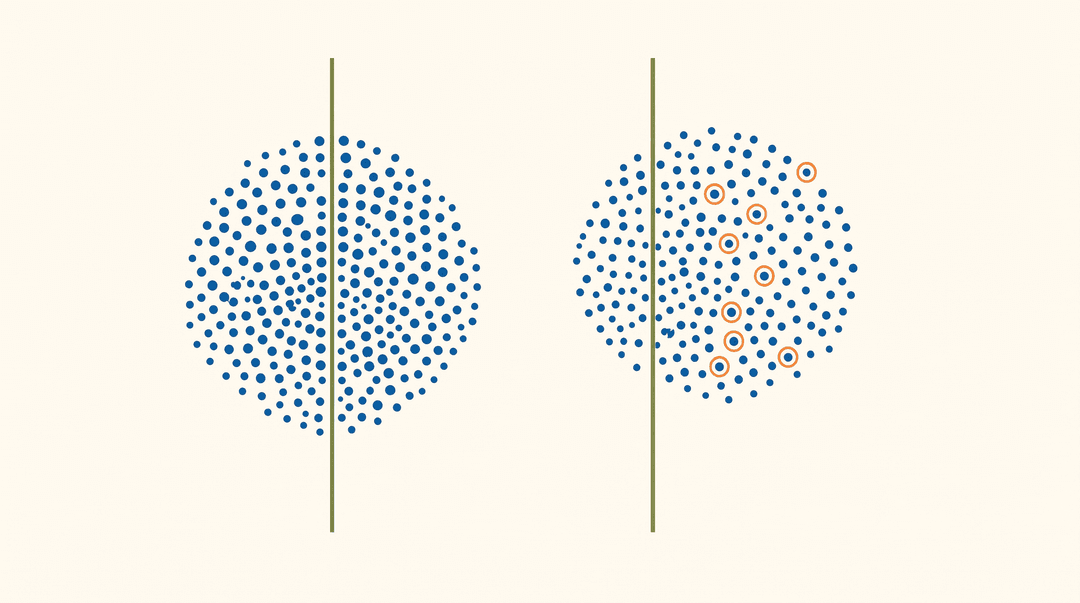
Corruption benchmarks. Hendrycks and Dietterich built ImageNet-C (ICLR 2019 paper) to test classifiers on 15 common image corruptions at 5 severity levels, 75 shifted test sets in all: noise, blur, weather and digital artifacts. Their finding was uncomfortable. From AlexNet to ResNet-50, clean top-1 error fell from 43.5% to 23.9%, but relative corruption robustness barely budged: the relative mean corruption error rose from 100% to 105% (paper summary). In the authors' words, "many years of architectural advancements corresponded to minuscule changes in relative corruption robustness." Models had gotten better at the benchmark, not at the world.
Clinical deployment. The Epic Sepsis Model, a proprietary risk score implemented at hundreds of US hospitals, predicted sepsis onset with an area under the ROC curve of 0.63 in external validation at Michigan Medicine across 38,455 hospitalizations, "substantially worse than the performance reported by its developer" (Wong et al., JAMA Internal Medicine, 2021). The model was trained on one health system's data and patient mix. Another system's data was a different distribution. Discrimination of 0.63 is barely above a coin flip, and thousands of alert decisions ran on it anyway.
The LLM version
For language models, distribution shift arrives from two directions at once, and users tend to blame the wrong one.
Direction one is the input. Prompt distributions move as products move: a chat assistant that served students in September serves insurance adjusters in January; an agent's traffic shifts as its tool integrations change. Anything the model learned about "typical" requests is a snapshot of a user base that no longer exists.
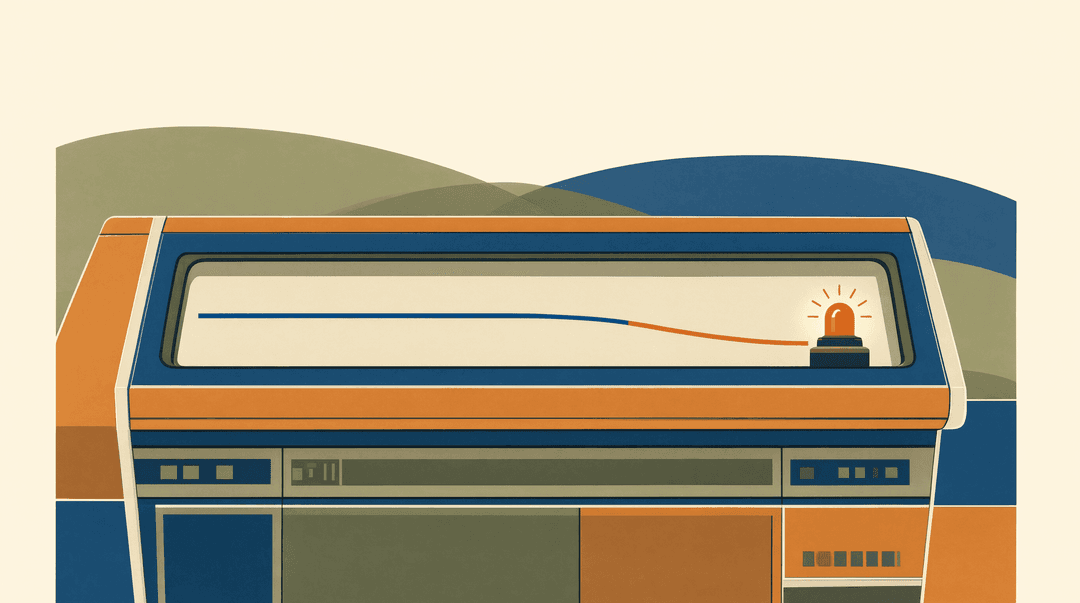
Direction two is the service itself. Lingjiao Chen, Matei Zaharia and James Zou benchmarked the March 2023 and June 2023 versions of GPT-4 and GPT-3.5 on identical tasks and found behavior "can vary greatly over time" (arXiv:2307.09009). GPT-4 identified primes with 84% accuracy in March and 51% in June, partly because it became less amenable to chain-of-thought prompting, while GPT-3.5 got better at the same task in the same window. The authors read this as temporal drift in the underlying model and concluded that the "same" LLM service requires continuous monitoring. That is the complement of classical distribution shift: the data moved, and sometimes the model moved under the data. Either way, a frozen eval you passed once tells you nothing today.
A knowledge cutoff is its own scheduled shift. A model trained on web text through 2025 meets a 2026 web: new products, new prices, new laws. This is concept drift with an expiry date stamped at training time.
Detection and damage control
The practical problem is that labels, the ground truth that would reveal drift, usually arrive late or never in production. That is why teams monitor the inputs instead. The standard tool is a distance between the reference (training-era) feature distribution and the live one. NannyML's technical treatment uses the total variation distance, half the summed absolute difference between shifted and reference probabilities per feature; the R package drifter packages the same idea as a battery of one-dimensional distribution checks, residual drift checks and model-drift checks, on the premise that k-fold cross-validation "test models on data with the same distribution as training data" and therefore prove nothing about a non-stationary world.
For LLM systems the same logic runs on proxies: embedding distances between yesterday's and today's prompts, rising refusal or fallback rates, output length distributions, and a small re-scored regression suite that runs continuously rather than once before launch. None of it catches pure concept drift; only labels do, which is why late-arriving outcome data (user edits, thumbs, escalations, corrections) is the most valuable logging a team can add.
When shift is detected, the ladder of responses is well-trodden: recalibrate for label shift, reweight or fine-tune for covariate shift, retrain for concept drift, and design the pipeline so that retraining on recent windows is routine rather than a crisis. The 2009 book's central advice remains the honest version: assume the ground will move, and instrument for it before it does.
Sources
- Dan Roth, Trustworthy Machine Learning, Chapter 9: Distribution Shift (PDF)
- Sebastian Raschka, Data Distribution Shifts (ML Q&A, Ch. 23)
- Chip Huyen, Data Distribution Shifts and Monitoring
- Quiñonero-Candela, Sugiyama, Schwaighofer, Lawrence (eds.), Dataset Shift in Machine Learning, MIT Press 2009
- Hendrycks and Dietterich, Benchmarking Neural Network Robustness to Common Corruptions and Perturbations, ICLR 2019 (PDF), abstract
- Wong et al., External Validation of a Widely Implemented Proprietary Sepsis Prediction Model in Hospitalized Patients, JAMA Internal Medicine 2021
- Chen, Zaharia and Zou, How is ChatGPT's behavior changing over time?
- Vector Institute, Understanding Dataset Shift and Potential Remedies (PDF)
- NannyML, Understanding Data Distribution Shifts in Machine Learning
- ModelOriented, drifter: Concept Drift and Concept Shift Detection
